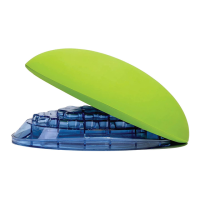
The Backpod
®
is a logical and appropriate counter
to milder scoliosis in the thoracic spine. Scoliosis is
a complex three-dimensional deformity of the spine,
ranging from a barely noticeable twist to appallingly
severe spinal distortion requiring surgical stabilization.
The Backpod
®
can’t significantly unwind the extreme
cases, but it is a logical and practical approach to
opposing the twist in milder examples – fortunately the
vast majority.
Milder scoliosis is readily identified in two ways. Seen
from behind, as the patient bends forward from
standing, one side of their rib cage will show as higher
than the other. Similarly, with the patient lying flat on
their front with their head not turned to either side
(ideally, prone on a plinth with their nose in the nose
hole), the posterior curve of the ribs on one side will be
raised relative to the other side. This indicates a twist
of the thoracic vertebrae towards the raised side.
Keeping it simple and treating it as a pure rotation
problem (which it isn’t), downward manual pressure on
the posterior curve of the raised ribs will use them as
levers through the costovertebral joints to ‘unwind’ the
thoracic rotation. The patient can produce this same
pressure at home by lying back on the Backpod
®
with it
positioned under the curve of the raised ribs, i.e. about
50mm (2 inches) out from the midline of the spine.
The amount of actual unwinding of the scoliotic twist
depends on its severity and chronicity, what is driving
it, patient compliance with the Backpod
®
and any
exercise programme, etc. However, nearly all scoliotic
problems start out mildly, commonly manifesting
first in adolescence. As they frequently progress over
the years, using the Backpod
®
to oppose, limit and
even unwind the torsion where possible is strongly
indicated.
Later mild scoliosis often exists in association with
an excessive thoracic kyphosis. The Backpod
®
is
ideally suited for treating both components of the
spinal torsion, being positioned in midline to treat the
kyphosis and slightly to the raised side to oppose the
scoliosis.
Use of the Backpod
®
should be combined with
thorough musculoskeletal assessment, looking for
underlying drivers of the scoliosis. These include
leg length difference, muscle imbalance, and pelvic
torsion associated with sacroiliac joint dysfunction
among others. Each identified factor needs to be
addressed specifically, for instance using shoe
inserts to compensate for a leg length difference,
Schroth method or similar gym approach to muscular
asymmetries, etc. The common statement that 65% of
scoliosis is idiopathic is highly suspect, and probably
set so high because in very many cases the underlying
drivers have not been understood.
Backpod
®
for scoliosis
18
Health Practitioner pages


 To Next Page