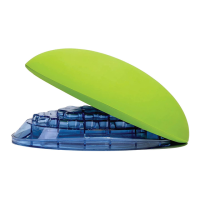
The Backpod
®
can be surprisingly useful in a number
of respiratory conditions, especially chronic asthma
and bronchitis. Regardless of the state of the lungs,
they cannot fully inflate unless the ribcage can expand
fully to allow this. This in turn requires full range of
movement at the costovertebral joints where the ribs
hinge onto the spine.
This movement has often become quite restricted
in patients with chronic asthma or bronchitis,
especially where the onset has been in childhood,
with the patient developing while bent forward trying
to suck in enough air. These patients usually exhibit
the common excessively hunched thoracic spine, with
rounded shoulders sitting more towards the front of
the chest. This posture will have become ‘set’ by the
tightening of the collagen of ligaments, capsules, etc.
around the restricted rib and spinal joints.
Chronically tightened collagen is extremely tough
and responds best to long sustained stretching. The
Backpod
®
provides this, with enough leverage to be
effective. It is used in the usual way, positioned for
about a minute at a time – up and down the middle
and upper back to stretch the thoracic hunch, and
about 50mm (2 inches) out to the sides of the spine
on the curve of the ribs to loosen the rib hinges.
The strengthening exercise on page 10: ‘Two simple
strengthening exercises’ (for the middle back muscles)
will probably be needed also to build up the support
strength for the area.
As a bonus, the Backpod
®
use position is also ideal
for practising deep diaphragmatic (also called
‘abdominal’) breathing at the same time. While lying
on the Backpod
®
, the patient inhales slowly through
the nose to a count of ten, then slowly and completely
exhales to a similar count. One hand may be placed
just below the rib cage to feel the stomach rise as the
air is drawn in to the deepest parts of the lungs.
A suitable timing would be three of these slow deep
breaths, then move the Backpod
®
50mm (2 inches)
to another position under the spine or ribs. As well as
filling the lungs fully, diaphragmatic breathing is also
held to reduce anxiety and stress and boost energy
and stamina.
A variety of other lung conditions can leave behind
them a secondary effect of restricted CV joint
movement even after the condition has resolved.
For instance, the pain of pleurisy can mean that
the patient avoids expanding the ribcage fully, and
over time the limited rib hinge range becomes ‘set’
Backpod
®
for chronic asthma, bronchitis and some other respiratory
conditions; also rib pain in pregnancy
21
Health Practitioner pages


 To Next Page