All these conditions affect the middle back.
Ankylosing spondylitis is a rheumatoid condition
that can cause extreme thoracic flexion and eventual
fusion of the vertebrae – a severe progression of the
hunched-forward/poked-chin pattern of most neck
problems. It affects 0.1–0.2% of the population,
mostly males. Initially the thoracic spine is painful and
inflamed; only in later decades does it become fixed,
flexed and fused.
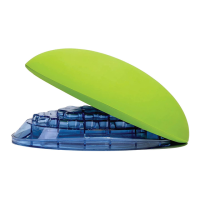
The Backpod
®
and its programme should be used
once the condition is diagnosed to slow and possibly
even halt the progression into flexion. The Backpod
®
in particular is ideally designed to gently oppose the
ongoing flexion contraction. As well, the Backpod used
for sacroiliac joint stretches (see pages 25 & 26) will
oppose the ongoing tightening at these joints which is
part of ankylosing spondylitis.
Scheuermann’s Osteochondritis (also known as
Scheuermann’s disease) is an inflammation affecting
the thoracic spine, usually in adolescents. The acute
inflammation generally burns itself out after a few
years, commonly leaving adhesive fibrosis and locked
thoracic segments in its wake. These should respond
to the Backpod
®
and its programme in the usual way.
However, even the acute inflammatory stage is worth
treating cautiously in the same fashion, as why the
spine gets inflamed has not been explained. Excessive
flexion stress on the slouching adolescent spine is a
reasonable bet, and the Backpod
®
and programme will
address that.
Parkinson’s disease is a degenerative disorder of
the central nervous system, with motor symptoms
resulting from the death of dopamine-generating cells
in the mid-brain. The Backpod
®
and its programme
cannot help the degenerative progression of the
disease, of course. However, they can help with
the musculoskeletal consequences, namely the
characteristic thoracic hunching, muscular rigidity,
neck pain and headache.
The Backpod
®
is ideal to oppose the increasing
thoracic kyphosis. This will of itself drive neck pain
and headache as the posterior neck muscles strain to
simply hold the head up, with Parkinsonian muscular
rigidity compounding the problem. The two massage
techniques shown on pages 13 & 14 are simple and
easy for home carers to use, and a considerable help
in alleviating the musculoskeletal pain and headache,
on a daily or less frequent basis.
Backpod
®
for ankylosing spondylitis, Scheuermann’s Osteochondritis
and Parkinson’s Disease
23
Health Practitioner pages


 To Next Page