Maintenance
BOMAG36 BPR 45/55 D, BPR 55/65 D
6.1 General notes on mainte-
nance
When performing maintenance work ensure strict
compliance with the respective safety instructions
and particularly the safety regulations mentioned
in the corresponding section of these operating
and maintenance instructions.
Thorough maintenance of the machine guaran-
tees far longer safe functioning of the machine and
prolongs the lifetime of important components.
The effort needed for this work is only little com-
pared with the problems that may arise when not
observing this rule.
l Always clean machine and engine thoroughly
before starting maintenance work.
l For maintenance work stand the machine on
level ground.
l Do not touch hot engine parts.
l Perform maintenance work only with the en-
gine shut down.
Environment
During maintenance work catch all oils and fu-
els and do not let them seep into the ground or
into the sewage system. Dispose of oils and fu-
els environmentally.
Keep used filters in a separate waste container
and dispose of environmentally.
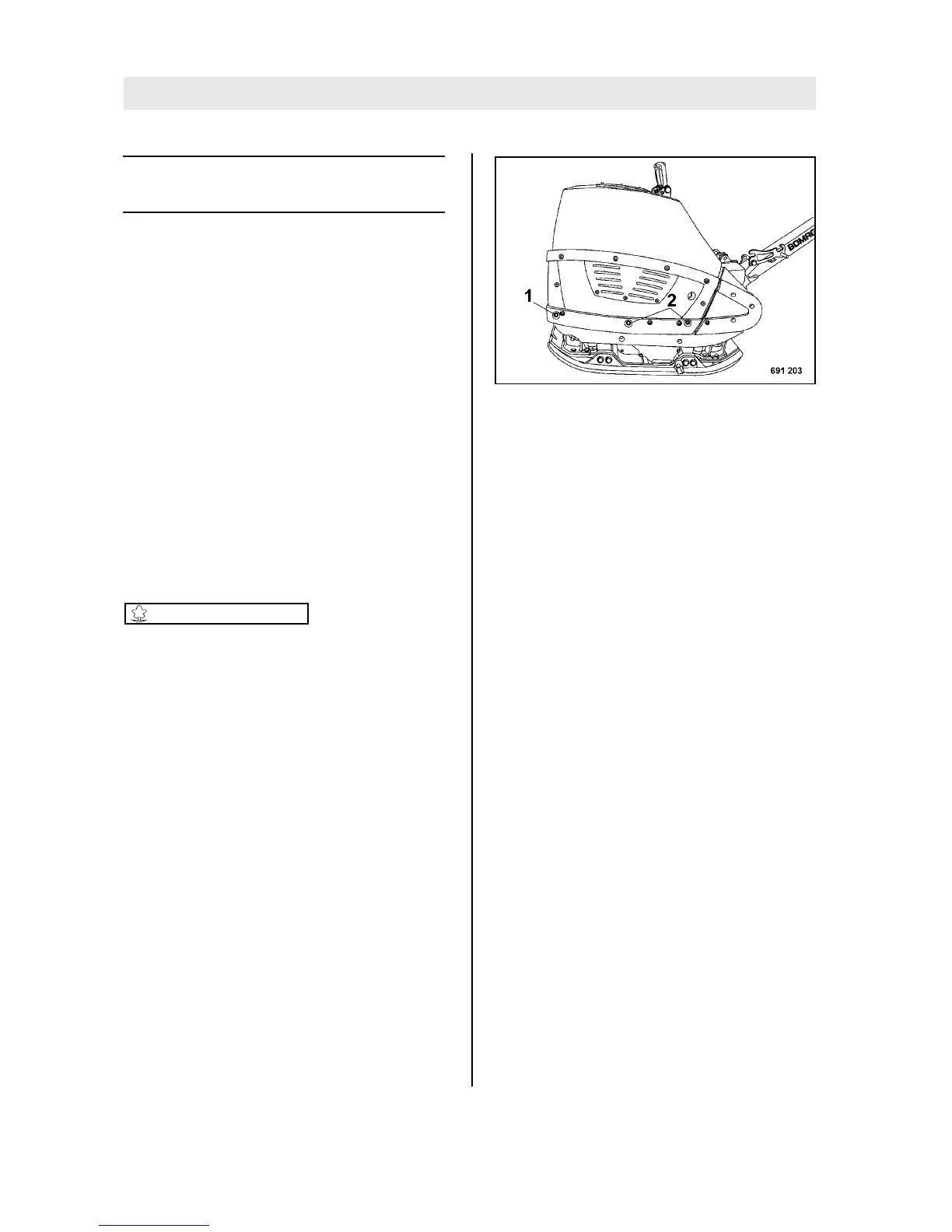
l Open the hood to perform maintenance work.
Fig. 38
l Loosen the hood fasteners (1) on both sides
and remove the fasteners (2) from both sides
(Fig. 38).
l Fold the hood back.
Notes on the fuel system
The lifetime of the diesel engine depends to a
great extent on the cleanliness of the fuel.
l Keep fuel free of contaminants and water,
since this will damage the injection elements
of the engine.
l Drums with inside zinc lining are not suitable to
store fuel.
l The fuel drum must rest for a longer period of
time before drawing off fuel.
l Under no circumstances must the drum be
rolled to the tapping point just before drawing
out fuel.
l When choosing the storage place for fuel
make sure that spilled fuel will not harm the en-
vironment.
l Do not let the hose stir up the slurry at the bot-
tom of the drum.
l Do not draw off fuel from near the bottom of
the drum.
l Fuel residues in the drum are not suitable for
the engine.
Notes on the performance of the en-
gine
On diesel engines both combustion air and fuel in-
jection quantities are thoroughly adapted to each



 To Next Page