
 To Next Page
S
samuelcalhounSep 2, 2025
What to do if the O-ring is cut or cracked on my Bostitch MCN150?
- NNicole GoldenSep 2, 2025
If the O-ring is cut or cracked, replace the O-ring.

What to do if the O-ring is cut or cracked on my Bostitch MCN150?
If the O-ring is cut or cracked, replace the O-ring.
What to do if the CT housing plate is loose or damaged on my Bostitch Power Tool?
If the CT housing plate is loose or damaged, replace the CT housing assembly.
What to do if the bumper is cracked or worn on my Bostitch MCN150?
If the bumper is cracked or worn, replace it.
What to do if the head valve piston is cracked or worn on my Bostitch MCN150 Power Tool?
If the head valve piston is cracked or worn, replace the head valve piston.
What to do if the sleeve is cracked or damaged on my Bostitch Power Tool?
If the sleeve is cracked or damaged, replace the sleeve.
What to do if the deflector screws are loose on my Bostitch MCN150 Power Tool?
If the deflector screws are loose, tighten them and check again.
Mandatory eye protection conforming to ANSI Z87.1 for operator and others.
Includes hearing and head protection based on work environment needs.
Do not use oxygen, combustible, or bottled gases; avoid exceeding 200 PSI.
Use free-flowing fittings; disconnect air supply before adjustments or servicing.
Keep body parts away from discharge; never point tool at anyone.
Unique sequential operation with moveable nose as contact trip.
Details dimensions and weight for MCN150, MCN250, MCN250S models.
Specifies 35° paper collated metal connector nails for each model.
Details 1/4" NPT fitting and recommended operating pressure range (70-120 PSI).
Lists CFM requirements for MCN150, MCN250, MCN250S models.
Use specific air tool lubricant; avoid detergent oils for best performance.
Use winter formula lubricant; avoid storing tools in freezing environments.
Mandatory eye protection; prevent accidental injuries during loading.
Step-by-step guide for inserting nails into the magazine.
Instructions for MCN250/MCN250S dual channels and mixing nail lengths.
Steps to disengage pusher, slide nails, and remove from magazine.
Distinguishes unloading steps for MCN150 and MCN250/MCN250S.
Read manual, understand warnings, refer to tool specifications.
Describes the tool's single operating mode and its safety advantages.
Do not hold trigger pulled; keep hands away from discharge area.
Use genuine nails; place nail point in connector hole perpendicular.
Tests to ensure correct sequential triggering operation.
Use tool as intended, never clamp trigger, handle with care.
Warning about handling the pusher spring assembly safely.
Use genuine parts; lubricate O-rings and surfaces during assembly.
Adequate air volume and pressure are critical for performance.
Warning against tampering; replace as a complete assembly.
Troubleshooting for air leaks from trigger valve and housing.
Diagnosing and fixing leaks from the tool's body and nosepiece.
Addressing issues where the tool does not cycle or operates slowly.
Resolving problems with skipping fasteners, jamming, or incorrect nail placement.
 General
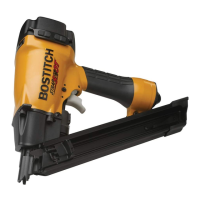
| Type | Metal Connector Nailer |
|---|---|
| Magazine Capacity | 29 |
| Operating Pressure | 70 - 120 psi |
| Fastener Type | Metal Connector Nails |
| Power Source | Pneumatic |
| Fastener Range | 1-1/2 inches |
| Fastener Diameter | 0.148" |