17
low, by a difference set in the SET-Mode 5, an audio alarm starts to sound through the
Intercom and the altitude display starts flashing.
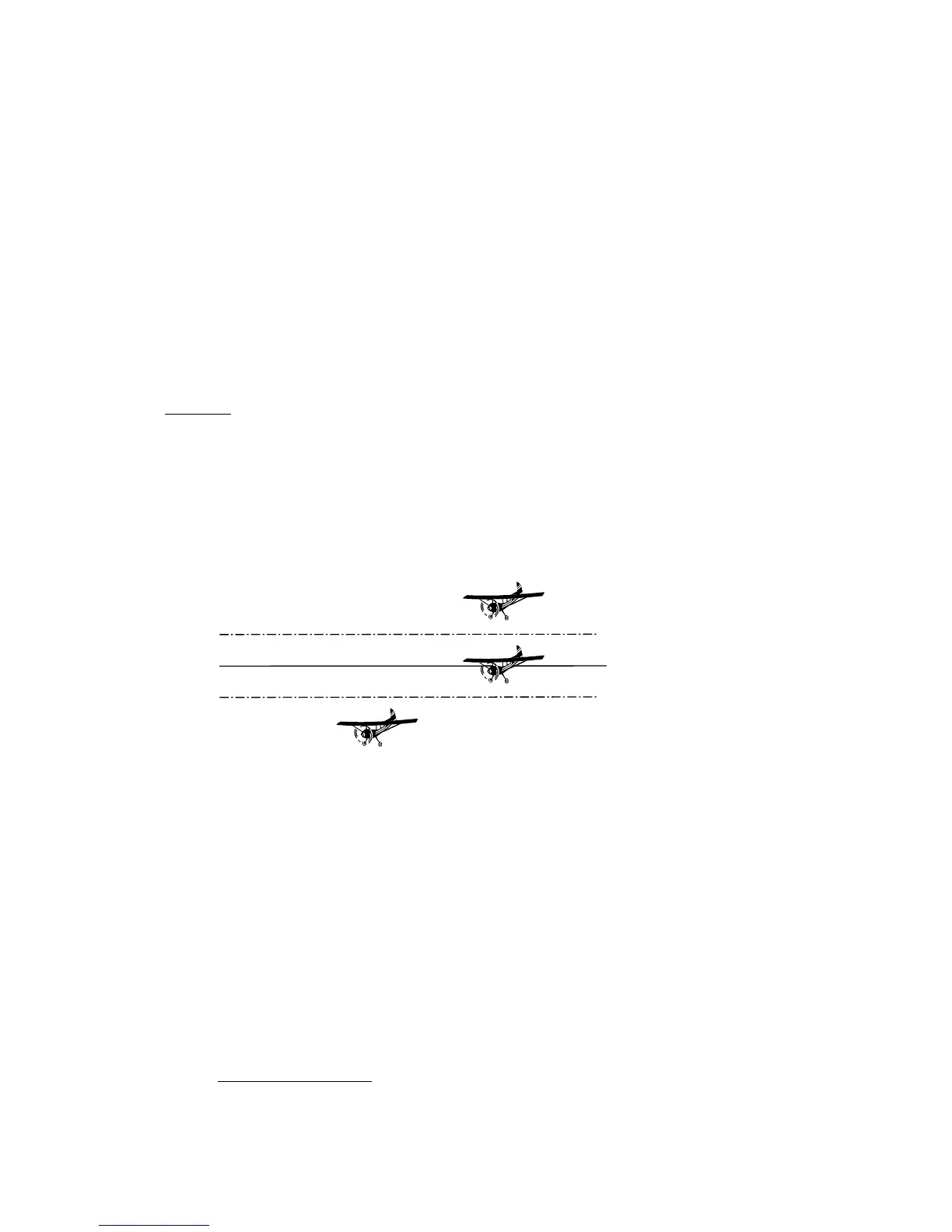
Example: A pilot flies 2000 ft MSL and wants to maintain this altitude for a longer
period of time because he would otherwise enter controlled airspace when flying
higher. He doesn't want to check the altimeter all the time so he activates AGM which
will warn him if he flies too high or too low. The altitude difference which triggers the
alarm can be set in SET-Mode 5. As soon as the desired altitude to be maintained is
reached, the AGM is activated by pressing >m/ft/QNH/AGM< for several seconds.
The display shows <AGM ON>.
By pressing >m/ft/QNH/AGM< again for several seconds, AGM is deactivated and
<AGM OFF> is displayed.
Example:
2000 ft shall be maintained. Altitude difference of 200 ft or greater above 2000 ft and
200 ft and greater below 2000 ft will trigger the audio alarm. As soon as the pilot
inadvertently climbs to 2200 ft and more, the alarm goes off and the altitude display
starts flashing. The same happens if the pilots descends to 1800 ft or less. As soon as
the pilot returns to within the desired altitude range (2000 ft + 200 ft or – 200 ft), the
alarm stops automatically and the altitude display stops flashing.
The altitude range is set in SET-Mode 5, the set value represents the maximum
allowed altitude difference for above and below the desired altitude
4.4 VSI (Vertical Speed Indicator)
Climbing or descending speeds are shown on a large, easy to read, analogue display
with a resolution of 0.25 m/s. Values between +/- 10 m/s are displayed (or the
equivalent in ft/min)
The ALPHAMFD has two different ways of indication values on the round analogue
scales. They can be chosen according to personal preferences in SET-Mode 17.
4.4.1 Single Pointer Display
The Single Pointer Display indicates rate of climb or sink with a conventional single
pointer. If the climb or sink rate exceeds +/- 5 m/s, the values from 5 m/s to 10 m/s
are displayed in a second stage which is indicated by a second pointer at 5 m/s.


 To Next Page