13
Table 4 – Opening Dimensions (In.)
FURNACE
CASING
WIDTH
APPLICATION
PLENUM OPENING FLOOR OPENING
A B C D
14–3/16
Upflow Applications on Combustible or Noncombustible Floor-
ing (KGASB subbase not required)
12---11/16 21--- 5/8 13--- 5/16 22---1/4
Downflow Applications on Noncombustible Flooring (KGASB
subbase not required)
12---9/16 19 13---3/16 19---5/8
Downflow applications on combustible flooring (KGASB sub-
base required)
11---13/16 19 13--- 7/16 20---5/8
Downflow Applications on Combustible Flooring with CAPVP,
CAPMP, or CNPVP Coil Assembly or KCAKC coil box (KGASB
subbase not required)
12---5/16 19 13---5/16 20
17–1/2
Upflow Applications on Combustible or Noncombustible Floor-
ing (KGASB subbase not required)
16 21 ---5/8 16---5/8 22--- 1/4
Downflow Applications on Noncombustible Flooring (KGASB
subbase not required)
15---7/8 19 16---1/2 19--- 5/8
Downflow applications on combustible flooring (KGASB sub-
base required)
15---1/8 19 16---3/4 20--- 5/8
Downflow Applications on Combustible Flooring with CAPVP,
CAPMP, or CNPVP Coil Assembly or KCAKC coil box (KGASB
subbase not required)
15---1/2 19 16---1/2 20
21
Upflow Applications on Combustible or Noncombustible Floor-
ing (KGASB subbase not required)
19---1/2 21---5/8 20--- 1/8 22--- 1/4
Downflow Applications on Noncombustible Flooring (KGASB
subbase not required)
19---3/8 19 20 19---5/8
Downflow applications on combustible flooring (KGASB sub-
base required)
18---5/8 19 20---1/4 20--- 5/8
Downflow Applications on Combustible Flooring with CAPVP,
CAPMP, or CNPVP Coil Assembly or KCAKC coil box (KGASB
subbase not required)
19 19 20 20
24---1/2
Upflow Applications on Combustible or Noncombustible Floor-
ing (KGASB subbase not required)
23 21 ---1/8 23---5/8 22--- 1/4
Downflow Applications on Noncombustible Flooring (KGASB
subbase not required)
22---7/8 19 23---1/2 19--- 5/8
Downflow applications on Combustible flooring (KGASB sub-
base required)
22---1/8 19 23---3/4 20--- 5/8
Downflow Applications on Combustible Flooring with CAPVP,
CAPMP, or CNPVP Coil Assembly or KCAKC coil box (KGASB
subbase not required)
22---1/2 19 23---1/2 20
FILTER ARRANGEMENT
CARBON MONOXIDE POISONING HAZARD
Failure to follow this warning could result in personal
injury, or death.
Never operate a furnace without a filter or with filter access
door removed.
!
WARNING
There are no provisions for an internal filter rack in these
furnaces. An external filter rack is required.
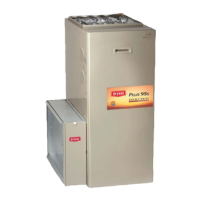
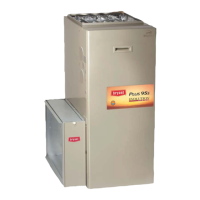
This furnace is shipped with a factory--supplied Media Filter
Cabinet. The Media Filter Cabinet uses either a factory--supplied
standard 1--inch filter or 4--inch wide Media Filter which can be
purchased separately.
Refer to the instructions supplied with Media Cabinet for
assembly and installation options.
AIR
DUCTS
General Requir
ements
The duct system should be designed and sized according to
accepted national standards such as those published by: Air
Conditioning Contractors Association (ACCA), Sheet Metal and
Air Conditioning Contractors National Association (SMACNA)
or American Society of Heating, Refrigerating and Air
Conditioning Engineers (ASHRAE) or consult The Air Systems
Design Guidelines reference tables available from your local
distributor. The duct system should be sized to handle the
required system design CFM at the design external static pressure.
The furnace airflow rates are provided in Table 5--Air
Delivery--CFM (With Filter). When a furnace is installed so that
the supply ducts carry air circulated by the furnace to areas
outside the space containing the furnace, the return air shall also
be handled by duct(s) sealed to the furnace casing and
terminating outside the space containing the furnace.
Secure ductwork with proper fasteners for type of ductwork used.
Seal supply-- and return --duct connections to furnace with code
approved tape or duct sealer.
NOTE: Flexible connections should be used between ductwork
and furnace to prevent transmission of vibration.
Ductwork passing through unconditioned space should be
insulated to enhance system performance. When air conditioning
is used, a vapor barrier is recommended.
Maintain a 1--in. clearance from combustible materials to supply
air ductwork for a distance of 36 in. horizontally from the
furnace. See NFPA 90B or local code for further requirements.
Ductwork Acoustical Tr
eatment
NOTE: Metal duct systems that do not have a 90 degree elbow
and 10 ft. of main duct to the first branch take--off may require
internal acoustical lining. As an alternative, fibrous ductwork may
be used if constructed and installed in accordance with the latest
edition of SMACNA construction standard on fibrous glass
ducts. Both acoustical lining and fibrous ductwork shall comply
with NFPA 90B as tested by UL Standard 181 for Class 1 Rigid
air ducts.
315A



 To Next Page
 Loading...