4
INTRODUCTION
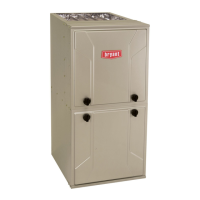
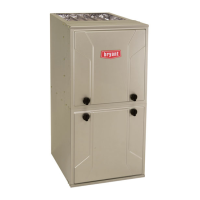
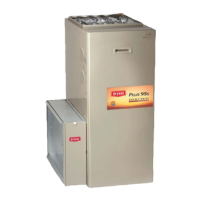
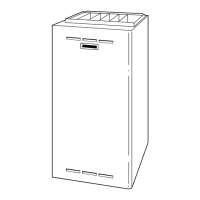
The Series 120/C 4.way multipoise Category I fan--assisted
furnace is CSA (formerly A.G.A. and C.G.A.) design--certified. A
Category I fan-- assisted furnace is an appliance equipped with an
integral mechanical means to either draw or force products of
combustion through the combustion chamber and/or heat
exchanger. The furnace is factory-- shipped for use with natural
gas. This furnace is not approved for installation in mobile
homes, recreational vehicles, or outdoors.
60
80 / 27 C
/ 16 C
A06745
Fig. 2 -- Return Air Temperature
This furnace is designed for minimum continuous return --air
temperature of 60_F db or intermittent operation down to 55_F
db such as when used with a night setback thermostat. Return--air
temperature must not exceed 80_F db. Failure to follow these
return--air temperature limits may affect reliability of heat
exchangers, motors, and controls. (See Fig. 2.)
For accessory installation details, refer to the applicable
instruction literature.
NOTE: Remove all shipping brackets and materials before
operating the furnace.
CODES AND STANDARDS
Follow all national and local codes and standards in addition
to these instructions. The installation must comply with
regulations of the serving gas supplier, local building, heating,
plumbing, and other codes. In absence of local codes, the
installation must comply with the national codes listed below and
all authorities having jurisdiction.
In the United States and Canada, follow all codes and standards
for the following:
Safety
S US: National Fuel Gas Code (NFGC) NFPA
54.2006/ANSI Z223.1.2006 and the Installation
Standards, Warm Air Heating and Air Conditioning
Systems ANSI/NFPA 90B .
S CANADA: CSA B149.1 --00 National Standard of
Canada Natural Gas and Propane Installation Code
(CAN/CSA-- B149.1 --05)
General
Installation
S US: Current edition of the NFGC and the NFP A 90B.
For copies, contact the National Fire Protection
Association Inc., Batterymarch Park, Quincy, MA
02269; (www.NFPA.org) or for only the NFGC,
contact the American Gas Association, 400 N. Capitol
Street, N.W., Washington, DC 20001 (www.AGA.org.)
.
S CANADA: CAN/CSA--B149.1 --05. For a copy,
contact Standard Sales, CSA International, 178
Rexdale Boulevard, Etobicoke (Toronto), Ontario,
M9W 1R3 Canada
Combustion and Ventilation Air
S US: Section 9.3 of the NFGC, Air for Combustion and
Ventilation .
S CANADA: Part 7 of CAN/CSA-- B149.1 -- 05, Venting
Systems and Air Supply for Appliances
Duct
Systems
S US and CANADA: Air Conditioning Contractors
Association (ACCA) Manual D, Sheet Metal and Air
Conditioning Contractors National Association
(SMACNA), or American Society of Heating,
Refrigeration, and Air Conditioning Engineers
(ASHRAE) 2001 Fundamentals Handbook Chapter 34
or 2000 HVAC Systems and Equipment Handbook
Chapters 9 and 16.
Acoustical Lining and Fibrous Glass
Duct
S US and CANADA: current edition of SMACNA and
NFPA 90B as tested by UL Standard 181 for Class I
Rigid Air Ducts
Gas Piping and Gas Pipe Pressure T
esting
S US: NFGC; chapters 5, 6, and 7 and National
Plumbing Codes .
S CANADA: CAN/CSA--B149.1 --05 Parts 4, 5, 6, and 9
and Appendices A, B, E and H.
Electrical
Connections
S US: National Electrical Code (NEC) ANSI/NFPA
70.2006 .
S CANADA: Canadian Electrical Code CSA C22.1
V
enting
US: NFGC; chapters 12 and 13 .
CANADA: CAN/CSA -- B149.1 --05 Part 8 and Appendix C
ELECTROSTATIC DISCHARGE (ESD)
PRECAUTIONS PROCEDURE
FURNACE RELIABILITY HAZARD
Failure to follow this caution may result in unit component
damage.
Electrostatic discharge can affect electronic components.
Take precautions during furnace installation and servicing
to protect the furnace electronic control. Precautions will
prevent electrostatic discharges from personnel and hand
tools which are held during the procedure. These
precautions will help to avoid exposing the control to
electrostatic discharge by putting the furnace, the control,
and the person at the same electrostatic potential.
CAUTION
!
1. Disconnect all power to the furnace. Multiple disconnects
may be required. DO NOT TOUCH THE CONTROL OR
ANY WIRE CONNECTED TO THE CONTROL PRIOR
TO DISCHARGING YOUR BODY’S ELECTRO-
STATIC CHARGE TO GROUND.
2. Firmly touch the clean, unpainted, metal surface of the
furnace chassis which is close to the control. Tools held in
315A



 To Next Page
 Loading...