STOVE OPERATION
Page 16 of 37
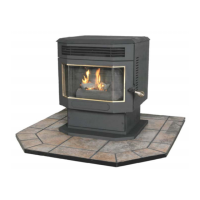
Your Buffalo Pellet Stove is designed to burn
wood pellets. It’s operation and maintenance
requirements are unique to that of any other
heat-generating appliance (wood, coal, corn,
electric, propane or oil).
How Your Buffalo Pellet Stove Works
Fuel (wood pellets) is stored in the hopper of
your stove. An auger, located on the
underside of the hopper transports the pellets
to the top of the drop tube, which guides the
pellets into the burn pot. The burn pot,
located directly behind the artificial log, is
where the pellets are burned. The heat from
the fire heats a series of ten heat exchanger
tubes located directly above the burn pot.
Room air is passed through the heat
exchanger tubes by way of the circulation
blower. The air passing through the heat
exchanger tubes is heated, then blown out
the front of the stove into the room effectively
transferring the heat generated by the burning
pellets to the air in the room.
Exhaust Blower At Power Up
Upon initial power up, the control software will
turn the exhaust blower on for 30 minutes.
This is done as a safety precaution in case
there is a loss of power to the stove. If there
is a loss of power to the stove and then power
is restored, the most important function of the
stove (at power up) is to evacuate all exhaust
gasses that have accumulated within the burn
chamber (during the power outage) to outside
your home.
At any time during the initial 30 minutes that
the exhaust blower is running at power up,
the software can take control and initiate a
start-up sequence if it is detected that there is
a demand for heat.
Thermal Sensing Cable
Your Buffalo Pellet Stove automatically
senses the current room temperature via a
thermal sensing cable that exits the back of
the stove. The stove software and the
thermal sensing cable combine to become an
integral thermostat for the stove. When the
stove is in Automatic Temperature Control
Mode, the feed rate, exhaust and circulation
blower speeds are all adjusted based on the
temperature sensed by the thermal sensing
element on the end of the cable. The end of
the thermal sensing cable should be located
within the home at a stable temperature
location (away from any door or window that
may be opened or closed occasionally or any
heat duct or register that may cause the
temperature at the cable end to fluctuate
significantly). If the thermal sensing element
at the end of the cable is subjected to
frequent fluctuations in temperature, this will
cause the stove to start-up and shut down
frequently. Frequent start-ups and shut
downs may cause undesired fluctuation of
room temperature, will result in overall higher
than necessary pellet consumption and may
lead to premature igniter element failure.
The standard length thermal sensing cable
included with each Buffalo Pellet Stove is 10
feet. Longer length cables are available from
your Buffalo Pellet Stove dealer.
Automatic Fire Ignition
Your Buffalo Pellet Stove is equipped with an
igniter, located behind the burn pot, which is
used to initiate a fire in the stove when heat is
called for by the control electronics. During
the start-up process the igniter is activated,
provides the required heat to initiate a fire,
then is turned off.


 To Next Page