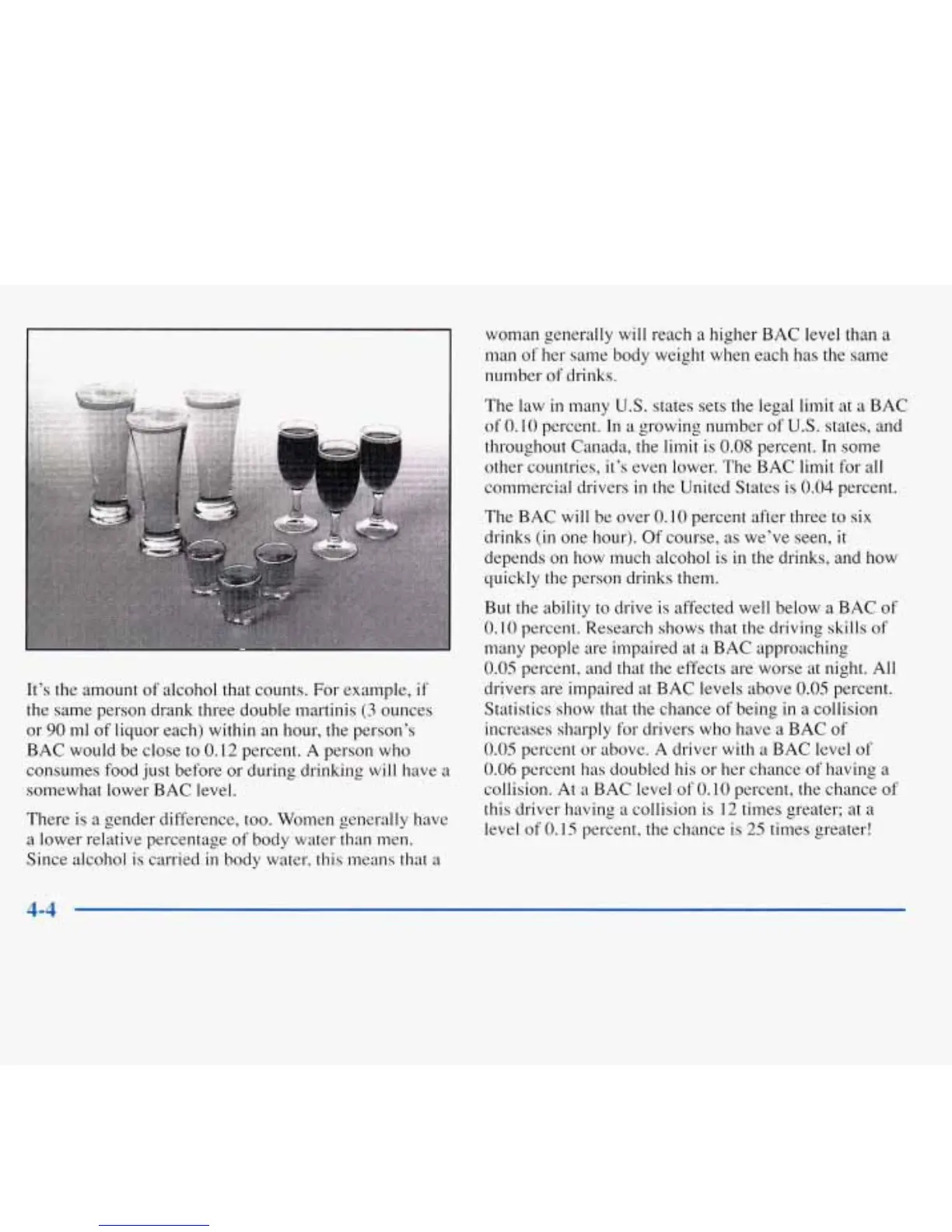
It’s the amount of alcohol that counts. For example,
if
the same person drank three double martinis
(3
ounces
or
90
ml
of
liquor each) within an hour, the person’s
BAC would be close to
0.12
percent. A person who
consumes food just before or during drinking
will
have
a
somewhat lower BAC level.
There is
a
gender difference, too. Women generally have
a lower relative percentage
of
body water than men.
Since alcohol is carried
in
body water, this means that a
woman generally will
reach
a
higher BAC
level
than
a
man
of
her same body weight when each has the same
number
of
drinks.
The law
in
many
U.S.
states sets the legal limit at
a
BAC
of
0.10
percent.
In
a growing number of
US.
states, and
throughout Canada, the limit is
0.08
percent. In some
other countries, it’s even lower. The BAC limit for all
commercial drivers in the United States is
0.04
percent.
The BAC
will
be over
0.10
percent after three
to
six
drinks
(in
one hour). Of course,
as
we’ve seen,
it
depends on how much alcohol is in the drinks, and how
quickly the person drinks them.
But the ability to drive is affected well below
a
BAC of
0.
IO
percent. Research
shows
that the driving
skills
of
many people are impaired at
a
BAC approaching
0.05
percent, and that the effects are worse at night. All
drivers are impaired at BAC levels above
0.05
percent.
Statistics show
that
the chance
of
being
in
a
collision
increases sharply for drivers who have
a
BAC of
0.05
percent or above.
A
driver
with
a
BAC level of
0.06
percent has doubled his or her chance of having a
collision. At a BAC level of
0.10
percent, the chance
of
this driver having
a
collision
is
12
times greater; at
a
level of
0.15
percent, the chance is
25
times greater!
4-4







 To Next Page