Need help?
Do you have a question about the Caple C886G and is the answer not in the manual?
This document is an instruction manual for Caple Gas on Glass Hobs, specifically models C886G, C887G, and C889G. It provides comprehensive guidance on installation, operation, maintenance, and troubleshooting to ensure safe and efficient use of the appliance.
The manual begins with an introduction that congratulates the user on their purchase and emphasizes the importance of reading the manual thoroughly, especially the installation and safety sections, before using the hob. It highlights that the manual should be kept for future reference.
A dedicated "WARNING" section outlines critical safety information. Users are explicitly instructed to read these warnings carefully before installation or use. It states that if the supply cord is damaged, it must be replaced by the manufacturer, its service agent, or similarly qualified persons to avoid hazards. The appliance is intended for household and similar applications, including staff kitchen areas in shops, offices, and other working environments, farmhouses, hotels, motels, other residential type environments, and bed and breakfast type environments.
"INSTALLATION WARNINGS" provide crucial details for safe setup. It specifies that the appliance can be used by children aged 8 years and above, and persons with reduced physical, sensory, or mental capabilities or lack of experience and knowledge, provided they receive supervision or instruction on safe use and understand the hazards. Children should not play with the appliance, and cleaning and user maintenance should not be performed by children without supervision. The appliance is for indoor use only. To prevent electrical shock, the unit, cord, or plug should not be immersed in water or other liquid, and the appliance should be unplugged before cleaning. Prior to installation, it's essential to ensure that local distribution conditions (gas type and pressure) are compatible with the appliance. Installation and connection must comply with current regulations, with particular attention to ventilation requirements.
Further "IMPORTANT SAFETY INSTRUCTIONS" advise against leaving the appliance unattended during use, as boiling over can lead to smoking or grease spills that may ignite. The hob should not be used as a work or storage surface, or for warming/heating the room. Users are reminded to always turn off cooking zones after use. Children should not be allowed to play, sit, stand, or climb on the appliance, nor should they be left alone or unattended in the kitchen when the hob is in use. Steam cleaners, harsh abrasive cleaning agents, or heavy objects should not be used on the hob, and users should not stand on it.
The "HOT SURFACE HAZARD" section warns that accessible parts of the appliance become hot enough to cause burns during use. Saucepan handles may also be hot, and users should ensure they do not overhang other active cooking zones and are kept out of reach of children. Failure to follow this advice can result in burns and scalds. Repairs or replacements of appliance parts should only be done as detailed in the manual; all other servicing must be performed by a qualified technician. Proper installation and connection according to current regulations are critical, with emphasis on ventilation. Adequate air circulation around gas appliances is necessary to prevent oxygen depletion. Intensive or prolonged use may require increased ventilation, such as opening a window or increasing extractor fan power.
The manual includes sections on "ENVIRONMENTAL PROTECTION," "CE DECLARATIONS OF CONFORMITY," "UKCA DECLARATIONS OF CONFORMITY," and "TECHNICAL FICHE." These sections address responsible disposal of waste electrical products, compliance with European and UK legislation, and where to find technical data.
A "WARRANTY" section explains that the new appliance is covered by a warranty, and users should keep their warranty card safe along with proof of purchase. Registration can be completed online. Failure to present the warranty card may result in repair charges, and spare parts are only available from Caple Service or authorized centers.
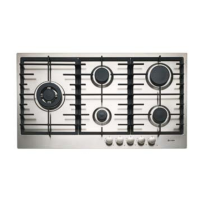
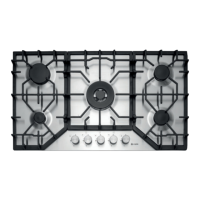
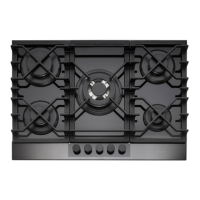
The "PARTS OF THE APPLIANCE" section provides diagrams and a list of components, including auxiliary gas burners, semi-rapid burners, rapid burners, triple ring burners, ignitors for gas burners, safety devices (which interrupt gas delivery if the flame goes out), and control knobs.
"HOW TO USE YOUR APPLIANCE" explains that the position of each gas burner is indicated on its corresponding control knob. Burners vary in size and power, and users should select the appropriate one for their cookware. The burner can be regulated using "OFF," "HIGH," and "LOW" settings. To light a burner, the knob must be pressed in and turned counter-clockwise to the "HIGH" setting, held for about 6 seconds to activate the safety device and warm up the flame. To turn off a burner, the knob is turned clockwise to the "OFF" setting.
"CARE AND MAINTENANCE" advises disconnecting the appliance from the electrical supply before cleaning or maintenance. To extend the hob's life, frequent and thorough cleaning is essential. Enameled parts should be washed with warm water without abrasive powders or corrosive substances. Removable burner parts should be washed frequently with warm water and soap to remove caked-on substances. The electronic ignition device's end must be cleaned carefully and frequently to prevent gas holes from clogging. Stainless steel parts should be rinsed thoroughly and dried well after contact with highly calcareous water or aggressive detergents, and spills should be cleaned promptly. "GREASING THE GAS VALVES" notes that if valves become sticky or difficult to turn over time, they must be cleaned and re-greased by a Caple approved engineer or similar qualified person.
"PRACTICAL ADVICE" offers guidelines for optimal performance, such as using appropriate cookware for each burner to prevent flames from reaching the sides of pots, using flat-bottomed cookware with lids, and turning the knob to "LOW" once contents boil. A table provides recommended cookware diameters for semi-rapid, auxiliary, rapid, and triple ring burners.
The "TROUBLESHOOTING" section helps users address common issues before contacting Caple service. It suggests checking for gas and electrical supply interruptions and open gas valves. If a burner doesn't light or the flame is incomplete, users should check for clogged gas holes, correctly mounted movable burner parts, and drafts. If the flame doesn't stay lit, users should ensure the knob is pressed in long enough to activate the safety device and that gas holes near the safety device are not clogged. If the burner doesn't stay on "LOW," users should check for clogged gas holes, drafts, and correct valve adjustment. If cookware is unstable, users should check for flat-bottomed cookware, correct centering on the burner, and properly inverted support grids. If problems persist, users are advised to contact Caple Service.
"INSTALLATION INSTRUCTIONS" reiterate that installation should only be performed by a qualified installer. It emphasizes unplugging the electrical connection before any maintenance. "POSITIONING FOR GAS HOB" states that the unit must be installed and used only in permanently ventilated rooms according to British standards. Requirements include a ventilation system (hood or electric ventilator) to vent combustion gases, and an influx of air for proper combustion (at least 2m³/h per kW of installed capacity) through a duct with a minimum inner cross-section of 100cm². Intensive use may require supplemental ventilation.
"GAS HOB INSTALLATION" provides details on cabinet clearances. The hob can be installed next to cabinets if their height doesn't exceed that of the hob. Furniture higher than the worktop must be at least 110mm from the hob's edge. Cabinets next to the hood should be at least 420mm high. A minimum 25mm gap is required between the hob's underside and any surface directly below it. Diagrams illustrate minimum clearances for different hob models (C886G, C887G, C889G) and hood types (600mm, 700mm, 900mm). Cut-out dimensions for the worktop are specified, and fixing hooks are provided for worktops 20-40mm thick. If not installed above a built-in oven, a wood panel (at least 20mm from the hob's bottom) must be inserted as insulation. For built-in ovens without forced ventilation, adequate air inlets and outlets for cabinet ventilation are necessary.
"GAS CONNECTION" specifies that connection must be done by a Gas Safe registered installer, with an approved gas tap for isolation. Connection to gas mains or liquid gas must comply with regulations and be compatible with the gas type. Pressure regulators conforming to current regulations should be used for liquid gas. The appliance has a 1/2″ gas male 'L' shaped union and gasket; if repositioned, the gasket must be replaced. Connections should not create stress points.
"CONNECTION TO FLEXIBLE STEEL TUBE" details that the gas feed connector is a threaded, male 1/2” connector. Only pipes and sealing gaskets conforming to standards should be used, with a maximum length of 2000mm for flexible pipes. The flexible metal tube must not touch moving parts or be crushed. "CHECK THE INSTALLATION" advises using liquid detector fluid and a 'U' gauge to ensure connections are sealed after installation, never a flame.
"ELECTRICAL CONNECTION" states the hob is fitted with a standard 13A plug. The supply cable can be fitted with a standard plug or connected directly to the mains via a single pole switch with a minimum 3mm contact opening, ensuring the earth wire is uninterrupted. The power supply cable must not exceed 50°C above room temperature. Before connection, users must ensure the fuse and electrical system can handle the load, the system has an efficient earth hook-up, and the plug or switch is easily accessible. Wire colors are coded: Green & Yellow for Earth, Blue for Neutral, Brown for Live.
"BURNERS AND INJECTOR SPECIFICATIONS" includes a table detailing thermal power, injector size, and supply pressures for different gas types (G20, G25, G25.1, G27, G2.350, G30) across auxiliary, semi-rapid, rapid, and triple ring burners.
"ADAPTING TO DIFFERENT TYPES OF GAS" provides a comprehensive table with nozzle diameters, nominal charge (g/h, l/h, kW, kcal/h), and reduced charge (kW, kcal/h) for various gas types and burner types.
"REPLACEMENT OF BURNER INJECTOR" instructs users to loosen the injector with a dedicated wrench and fit a new injector suitable for the required gas type, referring to the "Burners and Injectors Specifications" table. After conversion, a label with the new gas information must be placed on the appliance. The reduced valve flow also needs adjustment. A table outlines the steps for converting the hob between LPG and natural gas, involving replacing the burner injector and adjusting the flame.
"VALVE ADJUSTMENT" explains that this should be done with the control knob set at the "Burner ON saving flame" position. The knob is removed, and the flame is adjusted with a small screwdriver. After heating the burner at full open for 10 minutes, the knob is turned to the minimum setting. The flame should not extinguish or move to the injector; if it does, the valves need readjustment. It notes that the user must request conversion to another gas type from a licensed gas fitter/service if local conditions require it.
"FLAME SELECTION" describes that correctly adjusted flames should be light blue with a clearly visible inner cone. Flame size depends on the control knob position. A diagram illustrates "Burner ON, large flame," "Burner ON, small flame," and "Burner OFF" settings. The manual advises using a large flame for initial cooking to bring food to a boil, then turning to a small flame for simmering. Adjustments in between are also possible. It is prohibited to adjust the flame between the "Burner OFF" and "Burner ON large flame" positions. Significant energy savings can be achieved by using proper pots, operating the unit correctly with suitable flame size (up to 60% savings), and using lids on pans. Keeping burners clean (especially flame slots and injectors) is crucial for efficient operation.
"DIMENSIONS" provides detailed diagrams with measurements (in mm) for the C886G, C887G, and C889G hob models, including overall dimensions and cut-out dimensions.
The manual concludes with blank "NOTES" pages for users to add their own information and contact details for Caple Service.
 General
| Type | Gas Hob |
|---|---|
| Fuel Type | Gas |
| Number of Burners | 5 |
| Width | 860 mm |
| Control Type | Knob |
| Ignition Type | Automatic |
| Finish | Stainless Steel |
| Material | Stainless Steel |
| Gas Supply Pressure | 20 mbar |
| Burner Types | Auxiliary, Semi-Rapid |
| Gas Type | Natural Gas |

 To Next Page