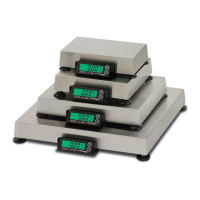
The Cardinal DETECTO AP-Series is an All-Purpose scale designed for a variety of weighing needs. This operation manual provides essential information for its setup, use, and maintenance.
Function Description
The AP-Series scale is a compact, solid device primarily used for weighing. It features an automatic tare function, allowing users to subtract the weight of containers or other unwanted fixed values from the total weight reading. The scale can display both gross weight (total weight on the platform) and net weight (gross weight minus stored tare weight). It includes a "Setup Review" mode to check operational parameters such as scale interval, decimal point position, capacity, zero tracking range, tracking range limit, power-up zero setting, digital filter level, motion (unstable) range, and sample rate. The scale is designed for ease of use with a simple membrane keyboard interface.
Important Technical Specifications
- Construction: 304 Stainless Steel
- Display: 4-digit, 1/2" red LED digital display
- Dimensions: 7 1/2" W x 7" D x 2 3/4" H
- Weight: 3.5 lb
- Zero: Established on power-up routine and maintained automatically by auto-zero circuitry.
- Power: 115 VAC, 50/60 Hz or 220 VAC 50/60 Hz; AC adapter with 6" power cord.
- Operating Temperature: 14°F to 104°F (-10°C to 40°C)
- Humidity: 75% without condensation
- Accuracy: Class III
- Capacity Models:
- AP-4K: 4 kilo - 3999g x 1g (Maximum Tare Weight: 999 gm)
- AP-6: 6 lb - 99.95 oz x .05 oz (Maximum Tare Weight: 9.95 oz)
- AP-8: 8 lb - 7.998 lb x .002 lb (Maximum Tare Weight: .998 lb)
- AP-10: 10 lb - 9.995 lb x .005 lb (Maximum Tare Weight: .995 lb)
- AP-20: 20 lb - 19.99 lb x .01 lb (Maximum Tare Weight: 9.99 lb)
The scale is FCC compliant (Class A computing device) and is designed and manufactured in the U.S.A.
Usage Features
- Power Connection: The scale connects to a 115V 50/60 Hz or 220V 50/60 Hz outlet via an AC adapter.
- Initial Power-Up: After connecting power, users press and hold the ON/ZERO key until an annunciator (ZERO, NET, or MOTION) turns on. The display should then show zero weight with the ZERO annunciator on. If not, pressing ON/ZERO again will zero the display.
- Gross Weight Mode: This is the normal display mode, showing the total weight on the platform. The NET annunciator is off in this mode. Pressing the GROSS key returns the scale to this mode from net weight display.
- Tare Weight Entry: Pressing the TARE key stores the currently displayed gross weight as the new tare weight and switches the scale to net weight display mode, indicated by the NET annunciator. The scale subtracts the tare value from the gross weight, displaying the net weight. The maximum tare weight allowed varies by model.
- Net Weight Display: Pressing the NET key displays the net weight (gross weight less stored tare weight) without entering a new tare value. If no valid tare weight is stored, this key is ignored.
- Setup Review Mode: To access, turn the instrument off, then press and hold the GROSS key, then press and release the ON/ZERO key. The display will show "int=". Users can then press the NET key to cycle through and review various operational parameters such as scale interval, decimal point position, capacity, zero tracking range, tracking range limit, power-up zero, digital filter level, motion (unstable) range, and sample rate. This mode is for review only; parameters cannot be changed here.
- Error and Status Displays: The manual lists various display codes and their meanings, such as "Unst" (motion present), "UnLd" (weight exceeds zero range on power on), "LoAd" (scale deadload less than zero range), "-OC-" (over capacity), "-OF-" (negative number greater than -999 or count greater than 9,999), "CALb" (not calibrated or interrupted calibration), "Err" (disallowed keyboard entry, e.g., tare value out of range, zero out of range, EEProm failure), and "ErrA" (no load cell signal or polarity reversed).
Maintenance Features
- Placement: The scale should be set on a stable, vibration-free surface, away from direct sunlight and rapidly moving air sources. The tray should be placed lip side down onto the platform.
- Cleaning: Clean the scale with a damp, soft cloth and mild non-abrasive detergent. Remove power before cleaning.
- Precautions:
- DO NOT submerge the scale in water or spray water directly on it.
- DO NOT use acetone, thinner, or other volatile solvents for cleaning.
- DO NOT expose the equipment to temperature extremes.
- DO NOT place the equipment in front of heating/cooling vents.
- DO provide clean AC power and adequate protection against lightning damage.
- DO keep the surroundings clear for adequate air circulation.
- DO NOT operate the membrane keyboard with pointed objects (pencils, pens, fingernails) to prevent damage.
- Troubleshooting: Before calling for service, users should check for common issues such as power connection, proper platform placement, and adherence to operating procedures. The manual provides solutions for problems like the display not turning on, incorrect weight displayed, or the scale not displaying weight.
- Service: If problems persist, users are advised NOT to attempt repairs themselves but to unplug the power cord and contact a qualified scale technician. The scale's precision load cell, located in the center of the base, requires protection from overload, dropping items, or extreme shock to ensure accurate operation.

 Need help?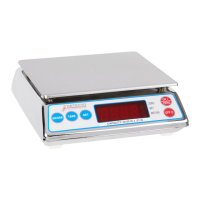

 To Next Page
 General