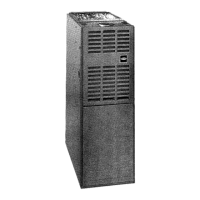
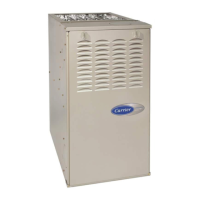
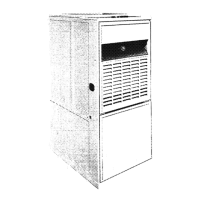
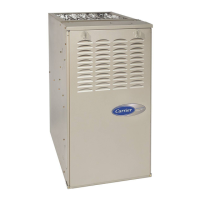
The Carrier 58ED,PB Horizontal Gas-Fired Furnaces are designed for residential heating applications, offering flexibility in installation and operation. These furnaces are suitable for use with natural gas and can be adapted for propane gas with appropriate modifications.
Function Description:
The Carrier 58ED,PB furnaces provide forced-air heating for residential spaces. They operate by burning natural or propane gas to heat a heat exchanger, and a blower then circulates the warmed air through ductwork to the living areas. The furnaces are equipped with either a standing pilot or an electronic ignition system, offering different methods for igniting the main burners. A thermostat controls the system, turning the furnace on when the indoor temperature drops below the set point and off when the desired temperature is reached. A high-temperature limit switch is integrated to prevent overheating, and a blower door switch ensures safety by cutting electrical power when the blower door is removed. The design allows for component reversal (gas valve, controls, and draft hood assembly) to accommodate various field installation requirements.
Important Technical Specifications:
The manual provides detailed specifications for various models (050, 075, 100, 125, 140) within the 58ED,PB series.
Physical Dimensions (Furnace Cabinet):
- Input (1000 Btuh): 50, 75, 100, 125, 140
- Heating Capacity (1000 Btuh): 38, 56, 75, 94, 105
- Dimensions (in.):
- Length: 40-70 (varies by model)
- Width: 4-6 (varies by model)
- Height: 1-1½ (varies by model)
- Vent Diameter: 0-4 (varies by model)
- Shipping Weight (lb): 155 to 250 (varies by model)
Blower Data (Direct Drive):
- Blower Size (in. DxW): 10x4, 10x6, 10x8, 12x9, 12x12 (varies by model)
- Motor HP (PSC): ⅓, ½, ¾ (varies by model)
- Speed Tap: Lo, Med, Hi (controlled by wire color: Red, Blu, Blk)
- Blower RPM: Ranges from 700 to 1080 (varies by model and speed tap)
- External Static Pressure (in. wg): 20 to 50 (varies by model)
- Airflow (Cfm): Ranges from 735 to 2350 (varies by model and speed tap)
Draft Hood Dimensions (in.):
- Length: 16 to 17¼
- Height: 10
- Depth: 8
- Pipe Dia.: 4 to 6
Gas Pipe Sizing (Cu Ft of Gas per Hour):
- Length of Pipe (ft): 10 to 150
- Diameter of Pipe (IPS in.): ½, ¾, 1, 1¼, 1½
- Based on gas pressures of 0.5 psig or less and pressure drop of 0.3 in. wg and 0.60 specific gravity gas.
Burner Orifices:
- Natural Gas (Manifold Press. 3.5 in. wg): Drill No. 43-46 (for heating values 800-1100 Btu/cu ft)
- Propane (Manifold Press. 10 in. wg): Drill No. 54 (for heating value 2500 Btu/cu ft)
Usage Features:
- Installation Flexibility: Can be located in an attic, basement, crawl space, alcove, or suspended from the ceiling. Minimum clearances to combustible materials must be maintained.
- Component Reversal: The gas valve, controls, and draft hood assembly can be reversed to either side of the furnace to accommodate various field installations.
- Ductwork Sizing: Proper ductwork sizing is crucial for satisfactory heating operation, following NFPA-90A and NFPA-90B guidelines. Locking-type dampers are recommended for system balancing.
- Venting: Must be vented to the outside in accordance with local codes or the National Fuel Gas Code (NFPA 54-1984/ANSI Z223.1-1984 Part 7). Can be vented into an existing masonry chimney or with a Type B-1 vent.
- Gas Piping: Requires proper sizing and installation to ensure sufficient gas supply without undue pressure loss. All piping must be tested for leaks.
- Electrical Connections: Requires 115V copper wiring and proper grounding in accordance with National Electric Codes (N.E.C.) and local codes.
- Filter Requirement: All furnaces must be equipped with a filter, with recommended sizes provided for accessory filter racks.
- Cooling Equipment Integration: Designed to work with cooling equipment, supporting both series and parallel airflow configurations. Dampers are required for parallel flow to direct air over either the heat exchanger or cooling coil.
- Altitude Adjustment: For installations at elevations of 2000 ft or more above sea level, input ratings should be reduced by 4% for each 1000 ft, which may require changing orifices.
Maintenance Features:
- Air Filter: Users should be instructed on how to locate, remove, clean, and replace the furnace filter(s). Regular filter maintenance is essential for efficient operation.
- Heat Exchanger and Venting System Cleaning: Annual inspection and cleaning by a qualified dealer are recommended. This involves removing burner covers, manifold assembly, vent connectors, and draft hood to clean the flue box, flue ways, burner box, and burners.
- Burner Flame Adjustment: Primary air shutters are provided on each burner for adjustment to achieve a soft, blue flame. This adjustment should be checked visually at the beginning of each heating season.
- Manifold Pressure Adjustment: For natural gas, manifold pressure should be between 3.0 and 3.5 in. wg. For LP gases, 10 in. wg is required.
- Fan Adjustment: The 3-speed direct drive motor allows for adjustment of fan speed to achieve the specified temperature rise within the rating plate specifications.
- Fan and Limit Control Check: After 15 minutes of operation, the furnace should shut down on high limit if return air is restricted, and the fan should continue to run.
- Lubrication: Direct drive motor and blower assemblies are factory lubricated and normally do not require oiling.
- Troubleshooting Charts: Comprehensive charts are provided for both standing pilot and electronic ignition models, detailing symptoms, probable causes, and remedies for common issues like burners not igniting, inadequate heating, and aldehyde odors/sooting flame.
- Safety Precautions: Emphasizes turning off all gas and electrical power before servicing, never using an open flame to test for gas leaks, and ensuring the blower compartment door is securely fastened during operation.

 Need help?


 To Next Page
 General