I-120
GH Pump 120 – 16.02.EN
9
VII. INSTALLATION.
A. LOCATION. The pump assembly should be
located in an area that will permit periodic inspection
and maintenance. Head room and access should be
provided and all units should be installed in a dry
location with adequate drainage. The discharge piping
should be direct with as few elbows and fittings as
possible.
The pump assembly should be installed as close to the
fluid as possible. A short, direct suction pipe can be
used to keep suction losses at a minimum. If possible,
locate the pump so fluid will flow by gravity to the
suction opening. The discharge piping should be direct
with as few elbows and fittings as possible. The total
NPSHA, which includes the suction lift and pipe friction
losses, must be greater than the Net Positive Suction
Head Required (NPSHR) by the pump.
B. HANDLING.
CAUTION
Use a hoist with adequate lifting capacity. See
pump nameplate for weights.
Do not pick up the complete unit by the motor
or the pump shafts or motor lifting eyes.
If the pumping unit slips out of the sling
arrangement, it may cause injury to personnel
and/or damage to the pumping unit.
Moving the unit requires proper preparation and
handling. Always make sure that the pump or the
pumping unit while being moved cannot slip out of the
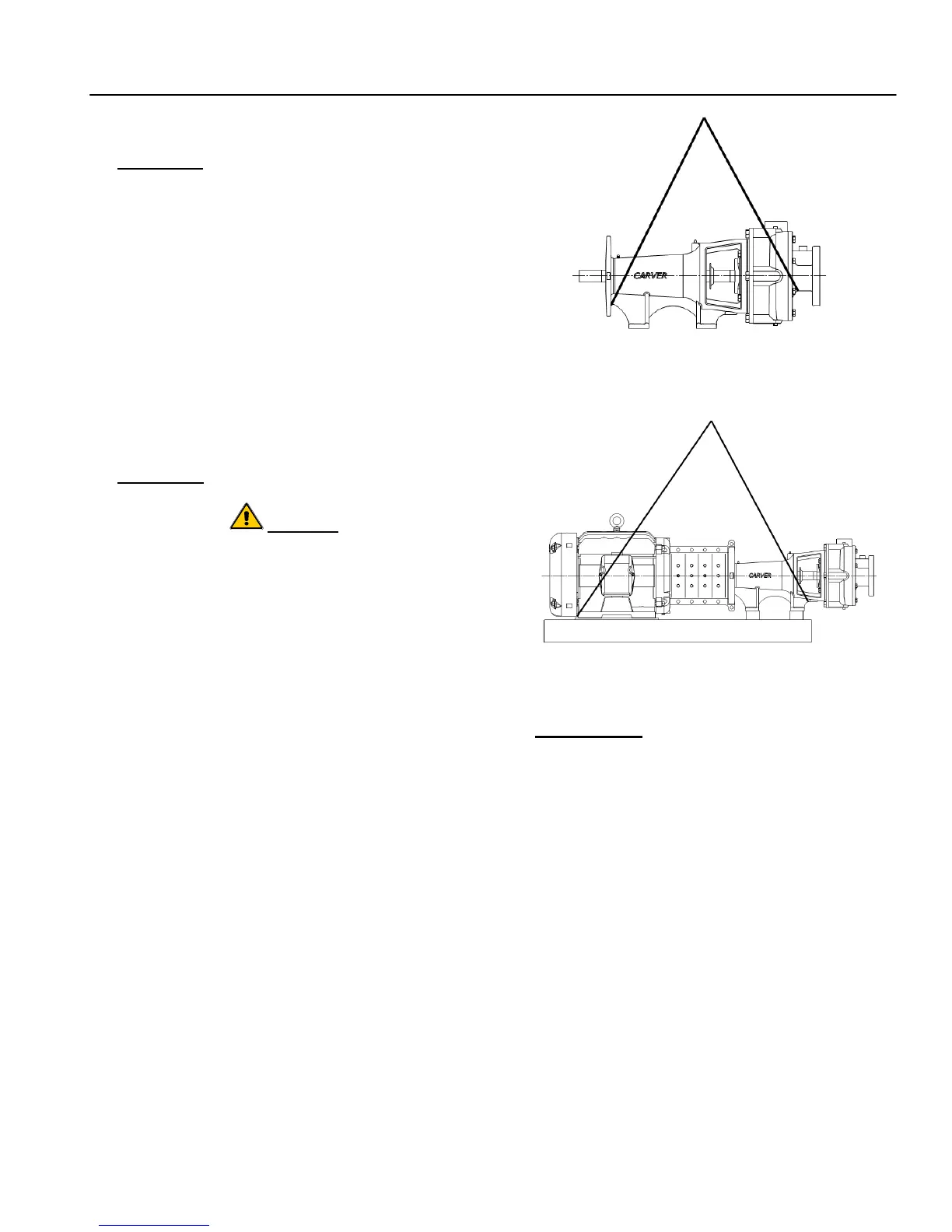
transport suspension arrangement. Use a sling for
pumps without bases, refer to Figure 2. To lift a
complete unit, a hoist or suitable lifting device should be
attached to the base, refer to Figure 3. The individual
motor may be lifted using proper eyebolts provided by
the manufacturer, but these should not be used to lift the
assembled unit.
Figure 2. Transport of the Bare Pump
Figure 3. Transport of Coupled Pump
C. FOUNDATION. Make sure that the concrete
foundation has set firmly before placing the unit on it. Its
surface must be truly horizontal and even. The
foundation bolts must be inserted in the baseplate holes.
The foundation should be 3 to 6 inches wider and longer
than the baseplate, have a level surface, and be of
sufficient mass to prevent vibration and form a
permanent rigid support for the unit. The best
foundations are concrete with anchor bolts of adequate
size embedded in the foundation in pipe sleeves having
an inside diameter 2-1/2 times larger than the bolt
diameter. This will allow for accurate positioning of the
unit. Keep the concrete surface clean, yet rough.



 To Next Page