Need help?
Do you have a question about the Champion A Series and is the answer not in the manual?
Definitions for DANGER, WARNING, CAUTION, and NOTICE hazard communication.
Critical safety notices to prevent severe personal injury or death.
Safety notices to prevent damage to equipment.
Follow startup procedures for initial use and cold weather conditions.
Maintain correct oil level and viscosity for temperature to prevent damage.
Ensure electrical disconnect and pressure release before any maintenance.
Perform daily checks on air filter, oil, valves, and leaks.
Understand the compressor's lubrication system and recommended lubricants.
Diagnose and resolve slow air pressure build-up problems.
Identify causes and solutions for low oil pressure.
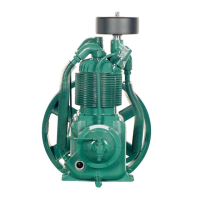
This document is a comprehensive manual for the Champion A-Series Compressor/Vacuum Pump, providing detailed information on its operation, maintenance, and parts. It is designed to ensure optimal performance, reliability, and safety for users.
The Champion A-Series Compressor/Vacuum Pump is a robust and versatile machine, available in both 3" and 4-1/2" stroke models, catering to various industrial applications. The model description breaks down the product code, indicating features such as air-cooled design, pressure lubrication, horsepower (15 HP or 30 HP), construction type (single stage with suction unloading valves or plain valves), rotation direction (counterclockwise or clockwise), and design version. This detailed breakdown allows users to understand the specific configuration and capabilities of their unit.
The primary function of the Champion A-Series Compressor/Vacuum Pump is to compress air or create a vacuum, depending on the specific model and application. The compressor operates by drawing in air, compressing it, and then discharging it at a higher pressure. The vacuum pump variant functions by removing air from a sealed volume to create a partial vacuum. The manual emphasizes the importance of proper installation and operation to achieve the intended function and prevent damage. Key components like the crankshaft, pistons, and valves work in concert to achieve the compression or vacuum action. The pressure lubrication system ensures that critical moving parts, such as crankpin bearings, receive adequate lubrication, maintaining smooth operation and extending the lifespan of the unit.
The manual provides extensive guidance on the proper usage of the compressor/vacuum pump. It stresses the importance of correct installation, including selecting a clean, well-lighted location with ample space for accessibility and ensuring the unit is set on a firm foundation to eliminate rocking and undue stresses. The air filter is highlighted as a critical component, preventing dust and abrasives from entering the cylinders, which could lead to excessive wear. Users are instructed to ensure the air filter is properly installed and regularly cleaned.
For units using an inlet line between the air filter and the compressor, thorough cleaning of the line's interior is crucial to prevent contamination. If welded construction is used, the line must be shot blasted and cleaned to remove welding scale and then coated internally. The manual specifies appropriate pipe sizes for inlet lines of varying lengths to ensure efficient air intake. Similarly, the air discharge pipe must be the full size of the discharge opening, as short and direct as possible, and free of pockets. A pressure relief valve is a mandatory safety device in the discharge line, preventing overpressure.
Rotation direction is a critical usage feature, as the compressor must run in the proper direction for the fan to blow air over the compressor and for the oil pump to operate correctly. The manual includes diagrams to illustrate clockwise and counterclockwise rotation as viewed from the sheave end. The V-belt drive system requires proper tensioning, and users are advised to consult V-belt supplier catalogs for guidelines. Covers and guards must always be securely fastened during operation to protect personnel from moving parts and to prevent damage to the equipment from foreign objects.
Prestart checks are outlined for new or overhauled units, including verifying the tightness of all bolts and nuts, inspecting the air filter and intake line, and ensuring proper V-belt alignment and tension. The manual also details the initial starting procedure, emphasizing running the compressor with receiver outlet valves wide open for about ten minutes to distribute oil to all wearing surfaces. For new or overhauled units, a 40-hour fully loaded run is recommended to ensure proper ring seating. Cold weather starting procedures are also provided, focusing on using the correct oil viscosity for existing temperatures and starting the unit under no load.
Maintenance is a cornerstone of the manual, with a strong emphasis on regular and careful servicing to ensure efficiency and longevity. Daily maintenance tasks include checking oil pressure and level, listening for unusual noises from compressor valves, observing the control's loading and unloading action, draining condensate from the air receiver, inspecting for air or oil leaks, and manually operating the relief valve.
Oil changes are critical, with specific intervals recommended: after the first 50 hours for new or overhauled units, then after another 100 hours, and subsequently based on the oil's discoloration and physical condition, but not exceeding 500 hours. Oil filters must be changed with every oil change. The crankcase breather also requires regular washing and inspection for wear.
Air filter servicing is highlighted as one of the most important maintenance operations. The frequency depends on atmospheric conditions and filter type, with daily maintenance being common in dusty environments. Users are cautioned never to operate the compressor with a damaged filter or while servicing it. For dry-type filter silencers, servicing involves cleaning the exterior, disassembling, cleaning the cover and base, and replacing the filter element.
Valve maintenance is crucial, with concentric valves requiring inspection and cleaning at regular intervals, typically every 1000 hours or four months. The manual warns against running the unit with noisy, hot, or low-output valves, as this can lead to serious damage. Instructions are provided for disassembling, inspecting, and reassembling valves, emphasizing the use of new O-rings and proper lubrication.
Piston and piston ring installation guidelines are detailed, stressing cleanliness to avoid scoring and proper orientation of piston rings with "pip" marks facing up to prevent oil consumption. The manual also covers the installation of piston pin bushings, crankpin bearings, and crankshaft oil seals, providing specific instructions to prevent damage and ensure correct operation. Main bearings, which are Timken tapered roller type, are factory-adjusted with shims, and correct crankshaft end play is specified.
The manual also includes a comprehensive troubleshooting guide for common issues such as slow air pressure build-up, short valve life, units failing to unload, control malfunctions, noisy valves, and low oil pressure. This section helps users diagnose and resolve problems efficiently.
Finally, the manual contains a detailed parts list, operating instructions, and service information, including standard dimensions, running clearances, and torque values for various components. It also outlines available spare parts and repair kits, ensuring users can easily identify and order necessary replacements. The warranty information clearly defines the terms and conditions, emphasizing the importance of using genuine Champion parts and adhering to recommended maintenance practices.
 General
| Pump Type | Cast Iron |
|---|---|
| Horsepower | 5 HP |
| Tank Size | 60 gallons |
| Voltage | 230V |
| Drive | Belt Drive |


 To Next Page