SERRATED BLADES
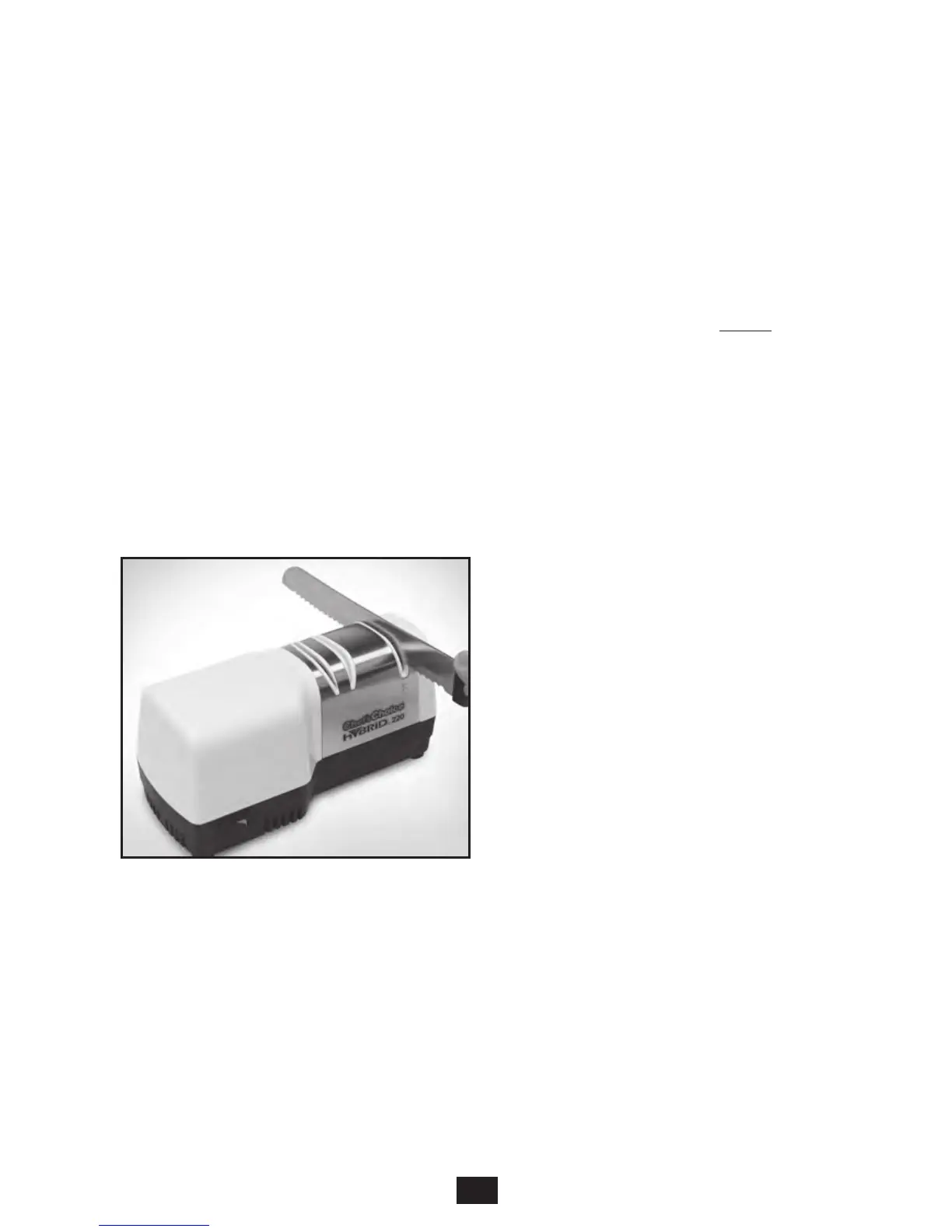
Serrated blades can be sharpened in Stage 2 (see Figure 5). Center the blade in the slot of
Stage 2 and make five (5) back and forth pairs of strokes. Examine the edge and if
necessary make another 5 full stroke pairs. Test the blade for sharpness. If the blade to be
sharpened is very dull, first make two fast but full pairs of pulls — alternating right and left
slots in Stage 1 and then make five (5) paired strokes (back and forth) in Stage 2. Because
of its nature, a serrated knife will not ever appear as sharp or cut as smoothly as a straight
edged blade. Caution: Do not make many strokes in Stage 1, or you will remove too much
metal from the teeth of the serrated edge.
ASIAN BLADES
The Hybrid
™
which sharpens at a primary angle of 20 degrees, can sharpen double faceted
Asian blades such as the Santoku which is traditionally sharpened at 15º. However, for opti-
mum results with all Asian blades we recommend a 15º sharpener such as the Chef’sChoice
®
Electric Models 15XV or 1520 as the preferred choice for all Asian style blades.
Do not sharpen in the Hybrid
™
any single sided, single faceted Asian Kataba knives, such
as the traditional sashimi styled blade that is commonly used to prepare ultra thin sashimi.
Stage 2 sharpens simultaneously both sides of the cutting edge while the sashimi knives
are designed to be sharpened only on one side of the blade. The Chef’sChoice electric
sharpeners listed in the previous paragraph will correctly sharpen these single sided knives.
6
Figure 5. Serrated knife in Stage 2.




 To Next Page