English — 7
To ensure uniform sharpening along the entire blade length, insert the blade near its
bolster or handle and pull it at a steady rate until it exits the slot. Always make an equal
number of pulls alternating one pull in the left slot and then one pull in the right slot in
order to keep the edge facets symmetrical. Generally in Stage 1 you will find that only one
or two pairs of pulls is adequate.
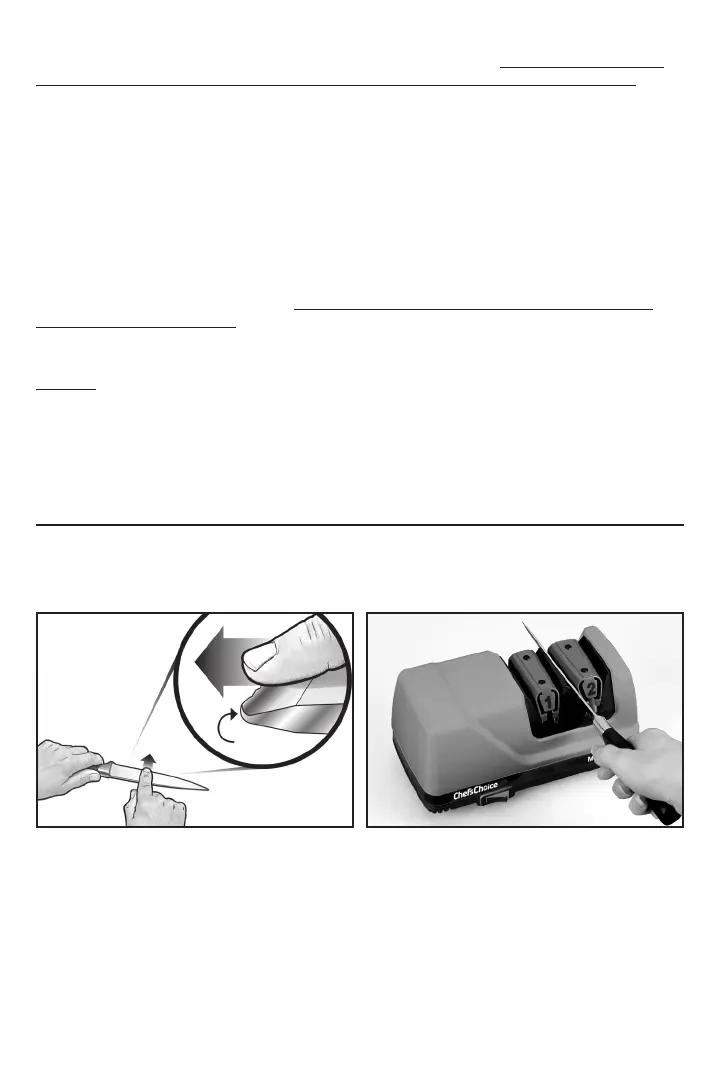
Before moving to Stage 2 you will find it helpful to confirm that a burr (see Figure 5)
exists along one side of the edge. To check for the burr, move your forefinger carefully
across the edge as shown. (Do not move your finger along the edge – to avoid cutting
your finger). If the last pull was in the right slot, the burr will appear only on the right side
of the blade (as you hold it) and vice versa. The burr, when present, feels like a rough
and bent extension of the edge; the opposite side of the edge feels very smooth by
comparison. If a burr exists along the entire edge, proceed to Stage 2.
If no burr exists, make one (1) additional pull in the left and right slots of Stage 1 before
proceeding to Stage 2. Slower pulls will help you develop the burr. Confirm the presence
of the burr and proceed to Stage 2. It is always necessary to create the burr in Stage 1
before stropping in Stage 2.
If the knife is extremely dull, additional pulls in Stage 1 may be needed before proceeding
to Stage 2.
Stage 2: In general only one or two pairs of pulls in Stage 2 will be necessary to obtain a
razor sharp edge. Make alternate pulls in left (Figure 6) and right slots pulling the knife
through the slots at the same speed used in Stage 1.
Added pulls in Stage 2 will refine the edge further, creating an edge ideal for gourmet
preparations. Fewer pulls in Stage 2 may be preferable if you will be cutting fibrous foods
as discussed in more detail in the following sections.
OPTIMIZING THE KNIFE EDGE
GOURMET FOOD PREPARATION:
Where the finest and smoothest cuts are preferred in preparing smooth, unmarked
sections of fruits or vegetables, sharpen in Stage 1 and 2 as described above and make
extra pulls through Stage 2. Three or more pairs of pulls with each pull alternating in the
Burr
Figure 5. Develop a distinct burr along knife edge
before stropping in stage 2. Burr can be detected
by sliding finger across and away from the edge.
Caution! See text.
Figure 6. Inserting blade in left slot of Stage 2.
Alternate individual pulls in left and right slots.



 To Next Page