Need help?
Do you have a question about the Chemtrol 255 and is the answer not in the manual?
Covers critical safety warnings regarding injury, electric shock, cord use, and equipment abuse.
Instruction to retain safety instructions for future reference.
Explains Free Chlorine equilibrium and key water chemistry factors affecting control.
Details how ORP and PPM sensors measure sanitizer levels and their operational principles.
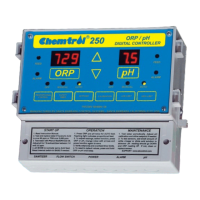
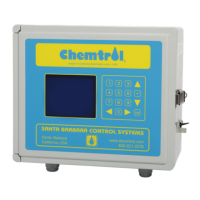
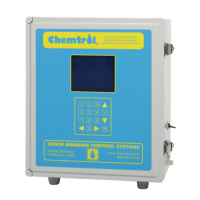
Describes the types of sensors the controller accepts and its output capabilities.
Guidelines for selecting a secure and accessible location for the controller cabinet.
Instructions for storing and properly mounting the ORP, pH, and PPM sensors.
Procedure for mounting sensors directly onto the main recirculation line.
Recommendations for using a bypass line assembly for easier sensor installation.
Details on using the optional flow cell assembly for improved sensor mounting.
Explains the importance of proper water flow past sensors for accurate readings.
Checking and configuring the controller's operating voltage and power board.
Setup for PPM battery, remote alarms, and flow switch interlocks.
Navigating the setup menu for feed modes, interlocks, and safety flow switches.
Diagram and explanation of terminal block connections for various functions.
Instructions for installing chemical feed pumps and erosion feeders.
Procedure for conditioning the PPM sensor before use to ensure accuracy.
Steps for calibrating PPM/pH sensors and adjusting PPM gain factor.
Setting desired control setpoints and configuring overfeed safety timers.
Details on feed modes, proportional control, alarms, and controller reset.
Steps for initial startup, including default parameters and automatic control.
Routine maintenance, water testing compliance, and cyanuric acid effects.
Testing, battery check, and cleaning warnings for the PPM sensor.
Procedures for testing and cleaning ORP and pH sensors.
Guidelines for sensor replacement, storage, and preparing for winter.
Using the portable tester to diagnose ORP sensor performance.
Using the portable tester to diagnose pH sensor performance.
Simulating ORP and pH signals to test controller feed and alarm functions.
Diagnosing issues related to no lights, alarm lights, and buzzers.
Troubleshooting illogical displays and lack of chemical feed.
Addressing issues with chemical residuals and frequent pH calibration needs.
Diagnosing feeder operation, setpoint overshoots, and failure to reach setpoint.
 General
| pH Control Range | 0 to 14 pH |
|---|---|
| Display | LCD |
| Output Current | 4-20 mA |
| Temperature Display Range | 32 to 212°F (0 to 100°C) |
| Enclosure | NEMA 4X |
| Operating Temperature | 0 to 50°C |

 To Next Page