MAN250/04 Page 3
INTRODUCTION
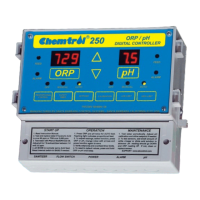
The CHEMTROL
®
250 Series Controllers are microprocessor-
based digital controllers designed to monitor and control the
sanitizer and pH levels in swimming pools, spas, cooling towers
and industrial applications.
The controllers are available with three types of sensors for
measurement of water acidity (pH) and of sanitizer level in either
PPM (parts per million or milligrams/liter) or ORP in millivolts.
This manual covers new versions (4.0 and up) of five models:
• CHEMTROL
®
255 PPM/pH Controller,
• CHEMTROL
®
250 ORP/pH Controller,
• CHEMTROL
®
240 pH Controller,
• CHEMTROL
®
235 PPM Controller.
• CHEMTROL
®
230 ORP Controller.
FREE CHLORINE
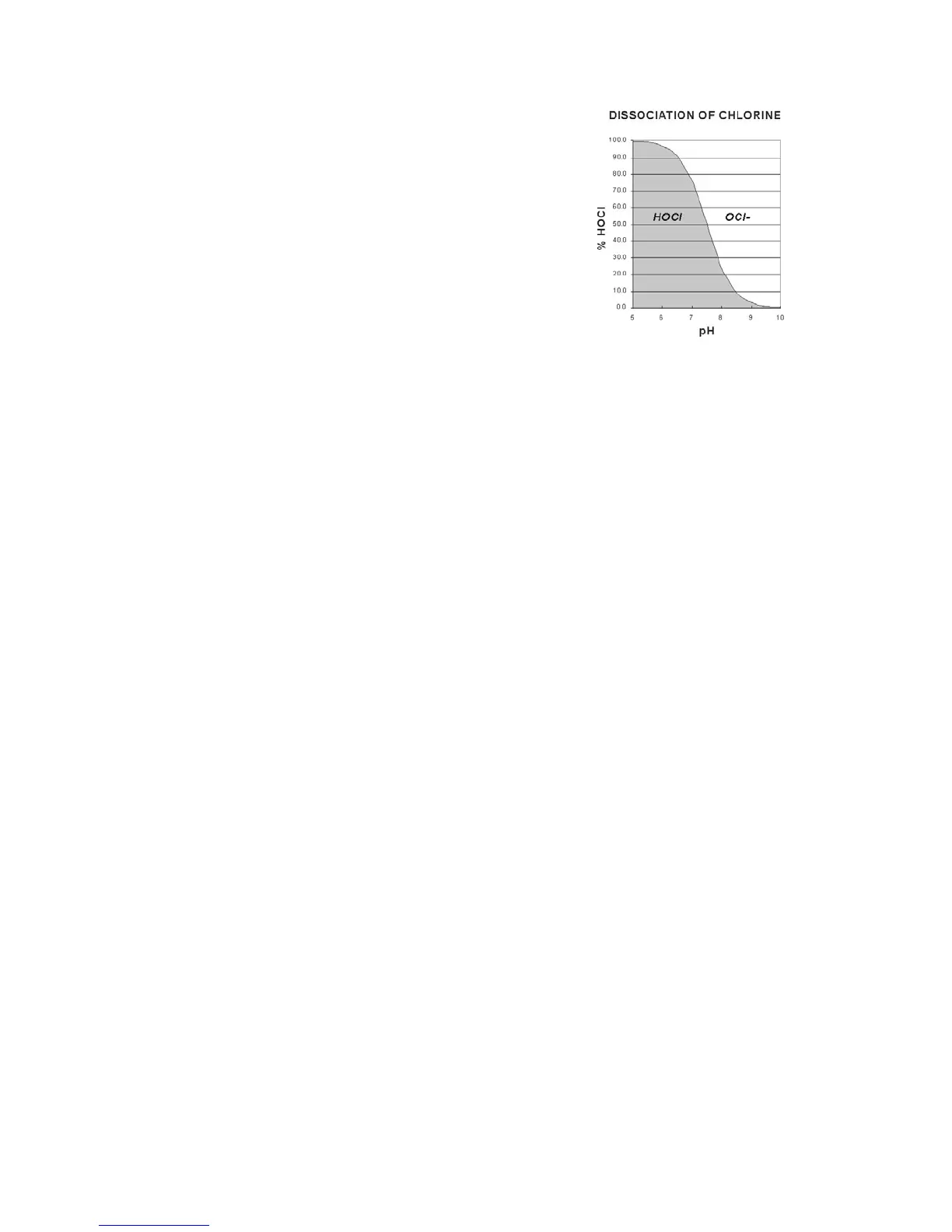
As shown on Figure 1, Free Chlorine in water is in equilibrium
under two forms:
• Molecular HOCl, a strong sanitizer and oxidizer,
• Ionized OCl-, a weak sanitizer and oxidizer.
At a pH of 7.5, the two forms are in equal proportions of 50%
each. At lower pH values, HOCl predominates. At higher pH
values, OCl- is dominant.
ORP CONTROL (Models 230/250)
The ORP sensor shows the voltage (in mV) produced by
oxidizers in water.
It responds to strong oxidizers, such as HOCl and its bromine
equivalent HOBr. It also responds to other strong oxidizers that
are used in water treatment, such as Ozone (O3) or Potassium
Monopersulfate (KSO3).
Because HOCl is the primary oxidizer, the signal of the ORP
sensor decreases with increasing pH values.
It is not specific to chlorine or bromine and responds to other
oxidizers.
The chlorine or bromine concentration required to generate a
desired ORP value varies with pH and overall water quality,
particularly Total Dissolved Solids (TDS) concentration, organic
load and cyanuric stabilizer concentration.
The ORP setpoint default value on the controller is 700 mV,
which is recommended to kill germs and bacteria and maintain
good water quality.
PPM CONTROL (Models 235/255)
The PPM sensor is specific to Free Chlorine only.
The controller displays the concentration of Total Free Chlorine
(HOCl + OCl-) in PPM (parts per million or milligrams/liter). It
does not respond to Bromine and/or oxidizers.
The Free Chlorine display does not vary up to a pH of 7.8.
The PPM setpoint default value on the controller is 1.0 ppm,
which is recommended to kill germs and bacteria and maintain
good water quality. It can be adjusted to meet local conditions
and Health Department requirements.
WATER CHEMISTRY
Before starting automatic control, test the water chemistry to
make sure that the pH, Cyanuric Acid and Total Dissolved Solids
are within the ranges recommended by the National Spa and Pool
Institute (NSPI).
The pH should be adjusted manually within 7.4 to 7.6. If it is
below 7.0 or above 8.0, the controller will show an alarm condition
and prevent feeding (programmable option).
To stabilize chlorine against solar UV radiation, a cyanuric acid
level of 20 to 25 ppm is ideal. However, this level can be quickly
exceeded with stabilized chlorine (dichlor or trichlor). Note that
many Health Department codes do not allow stabilizer levels
above 100 ppm. If above 100 ppm, this results in chlorine lock
that shows as low ORP readings even with high chlorine levels.
The Total Dissolved Solid (TDS) level should be below 2,000
ppm. If higher, the water is full of organic and inorganic
impurities and should be dumped and replaced partially or
completely.
For effective pH control, the Total Alkalinity should be between
80 to 120 ppm. If too low, the pH will bounce and be hard to
control. If too high, the pH will be hard to change.
INPUTS AND OUTPUTS
Depending on the model number, the inputs include one or two
sensors:
• a PPM sensor to monitor free chlorine concentration,
• an ORP sensor to monitor ORP or Redox,
• a pH sensor and a safety flow switch (optional).
The outputs are two relays for sanitizer and pH feed - acid or
base - plus a relay for an optional remote alarm or telephone
dialer.
Figure 1 - Equilibrium of Free Chlorine


 To Next Page
 Loading...