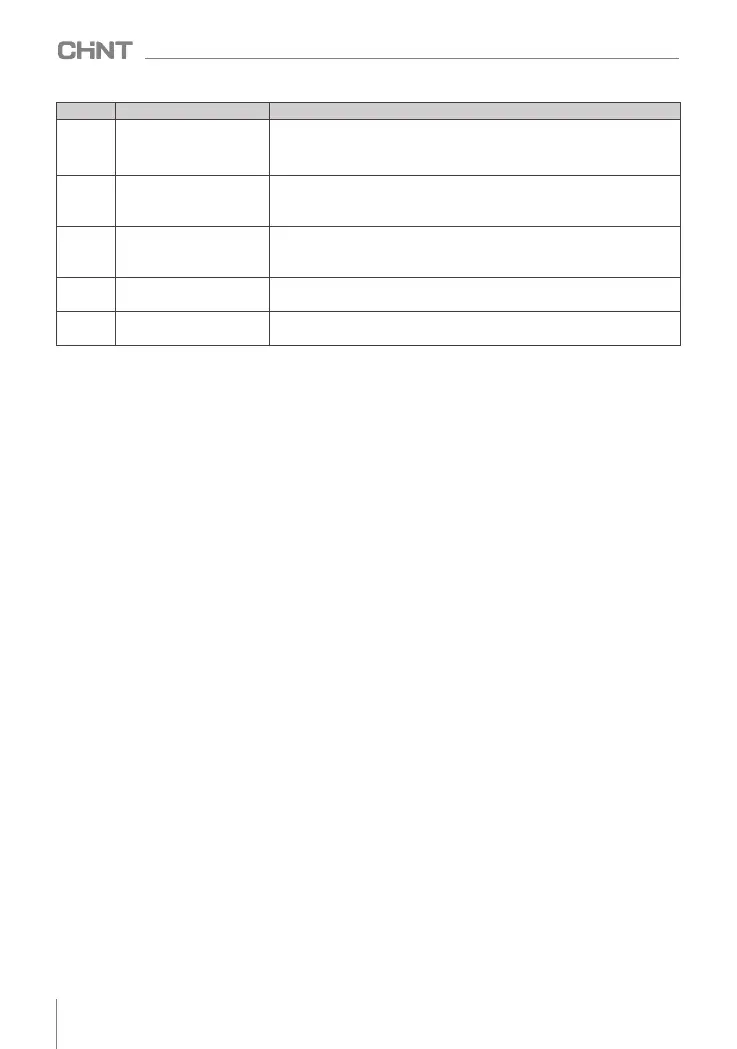
Set value
Function
Illustrate
29
Output current exceeded
After the output current of the inverter exceeds the output current limit value
of F8.22, and the duration exceeds the output current limit detection delay
time F8.23 , DO outputs a valid signal ; output current limit value = F8.22 ×
F2.03 (motor rated current) .
31
Motor overload pre-alarm
Before the motor overload protection action, judge according to the overload
early warning coefficient FE.03, and output a valid signal after exceeding the
pre-alarm threshold.
34
arrive on time
When the timing function selection F8.32 is valid, the inverter will output a
valid signal after the current running time reaches the set timing time, and
the timing time is set by F8.33.
35
AI1 > AI2
When the value of analog input AI1 is greater than the input value of AI2, a
valid signal is output.
37
The current running time is
reached
When the accumulative running time of the inverter exceeds the time set by
F8.34 current running arrival time, it will output a valid signal.
060
NVF2G Series Inverter User's Guide
note: Serial numbers not listed in the table are "reserved"
8.11.3 Analog input terminal function (AI)
NVF2G series inverters are equipped with 2 analog input terminals AI1 and AI2 as standard, both of which
support 0V ~ +10V, 0mA ~ 20mA command input, and the voltage and current can be realized through the
"jumper switch" on the control board. switch. For the method used by the AI channel, please refer to "8.2.3
Setting the main frequency through the analog signal".
8.11.4 Analog output terminal function (AO)
NVF2G series frequency converter comes standard with two analog output terminals AO1 and AO2, both
of which support outputs of 0~+10V and 0 (4) mA~20mA. Voltage and current can be switched through the
"jumper switch" on the control board.
AO gain is used to change the display range, and the zero bias correction coefficient is set to 100% (10V
or 20mA) of the maximum output. The up and down shift of the analog output is set in percentage units.
AO output value=output gain × Value before adjustment and bias correction factor × 10V
Example 1: AO1 outputs the operating frequency, and the output frequency (0-50) Hz corresponds to the
analog output (4-20) mA:
F6.12=20.0%,
— X 10V=10V
50
50
— X 10V=5V
25
50
Value before adjustment=
10V=output gain × 10V+20% × 10V
Output gain=8/10=0.8
∴ F6.13=0.80
Example 2: AO1 outputs the operating frequency, and the output frequency (0-25) Hz corresponds to the
analog output (4-20) mA:
F6.12=20.0%,
Value before adjustment=
10V=output gain × 5V+20% × 10V
Output gain=8/5=1.6
∴ F6.13=1.60



 To Next Page