30
several factors that affect the rate of transpiration, including the size of the plant, light intensity,
temperature, humidity, wind speed, and soil water content.
As light intensity increases, transpiration rate also increases. Plants transpire more rapidly in
the light than in the dark because light stimulates the opening of stomata and increases the
temperature of the leaf. Transpiration rate increases with temperature. This is because water
evaporates faster at higher temperatures. As humidity decreases, the transpiration rate increases and
water dissipates from leaf more quickly. This is because the rate of diffusion of any substance increases
as the difference in concentration of the substances in the two regions increases. Wind affects
transpiration by affecting the humidity of the air surrounding the leaf. When there is no breeze, the air
surrounding a leaf becomes increasingly humid thus reducing the rate of transpiration. When a breeze
is present, the humid air is carried away and replaced by drier air, increasing the rate of diffusion and
transpiration. Soil water content affects transpiration rate as water is continually replaced in the plant
by drawing water from the soil using the roots. A plant cannot continue to transpire rapidly if its water
loss is not made up by replacement from the soil. When absorption of water by the roots fails to keep
up with the rate of transpiration, a loss of tugor occurs, and the stomata close, immediately reducing
the rate of transpiration, as well as the rate of photosynthesis.
Stomatal Conductance
Stomatal conductance is water loss by a leaf and is directly related to the size of the stomatal
aperture or opening. Higher evaporation rates or a high transpiration rate for a plant indicate that the
stomatal conductance will also be high. Other factors influencing stomatal conductance include
humidity, light intensity and temperature.
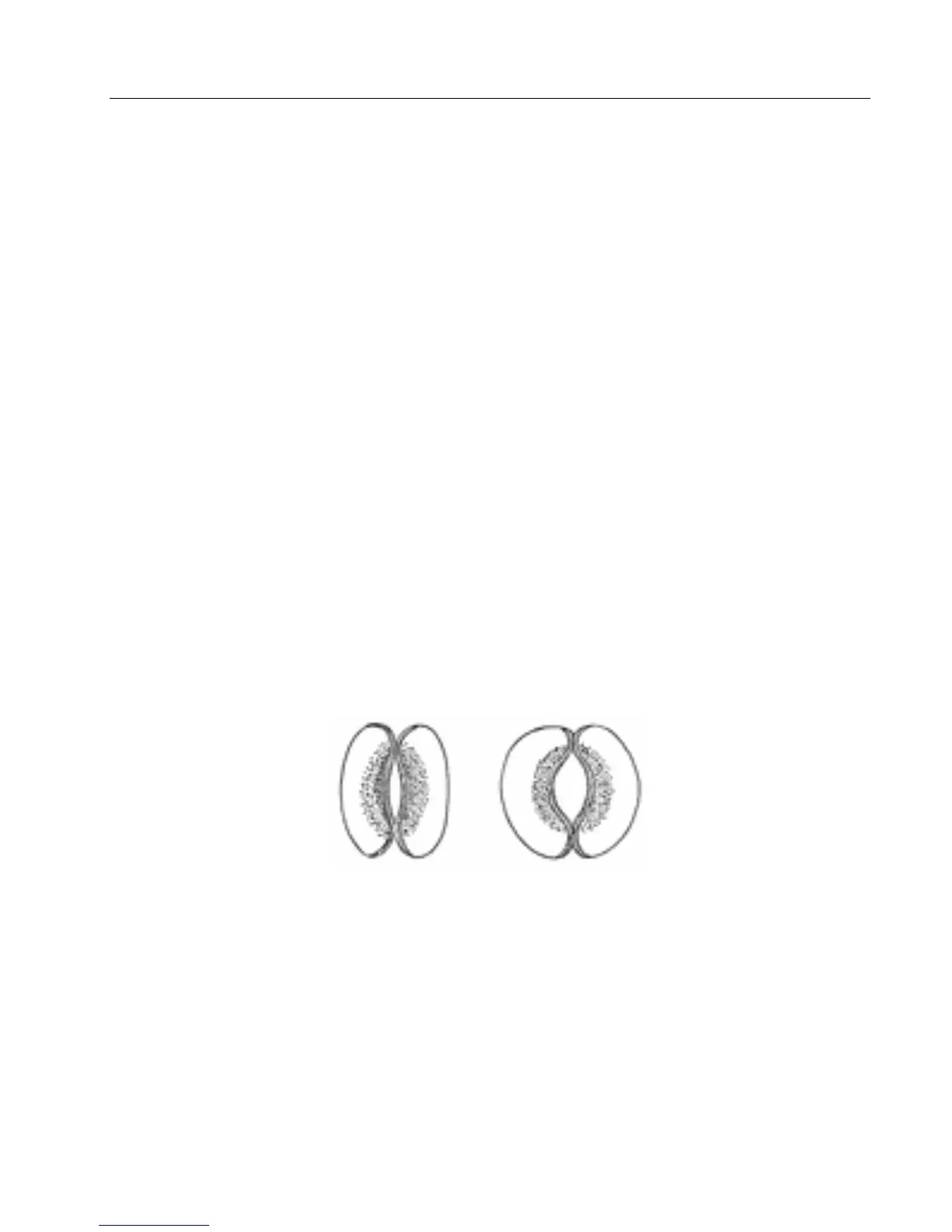
Stomatal apertures (Figure 3) will typically vary in response to changes in light intensity,
saturation deficit of ambient water vapor and soil moisture availability. As stomatal aperture size
changes, rates of photosynthesis and transpiration will vary because the pore (or stomata) size will
provide a corresponding resistance to the diffusion of CO
2
into and H
2
O out of the leaf. The inverse of
this resistance can be calculated as the conductance of these two gases across a leaf surface.
Conductance can be considered in parallel or in series. It is obtained by measuring the transpiration
and leaf surface temperature (°C), and applying the equation.
Figure 3: Stomata surrounded by guard cells, showing a closed stomata and an open stomata.
Open and Closed Systems
The term closed or open is used in the sense of whether or not the atmosphere of the leaf-
enclosing chamber is renewed during the measurement. The CI-340 supports both open and closed
system modes of operation. Early photosynthesis analyzers supported only closed system
measurements, but today most systems are open systems. Open systems provide a faster measurement
and greater control over very small or mole fraction measurements. Open systems are also known as
differential systems, while closed systems are known as depletion systems.



 To Next Page