
 Need help?
Do you have a question about the Cirs ATS539 and is the answer not in the manual?
Proper handling and cleaning procedures to maintain phantom integrity.
General steps and considerations for accurate ultrasound measurements.
Establishing and recording consistent system settings for QA tests.
Recording initial measurements to compare against for drift detection.
Defining acceptable measurement variations from baseline values.
Recommendations on how often system assessments should be performed.
Evaluating the uniform brightness of echoes across the display.
Assessing the system's ability to detect weak echoes at specified depths.
Evaluating the focal zone and beam characteristics for optimal imaging.
Measuring distances along the sound beam axis for accuracy.
Measuring distances perpendicular to the sound beam axis for accuracy.
Assessing the system's ability to distinguish closely spaced reflectors.
Measuring slice thickness or resolution perpendicular to the scan plane.
Evaluating the system's displayed dynamic range and gray scale processing.
Assessing ability to display size, shape, and depth of anechoic structures.
Measuring the distance from transducer face to the first echo.
Diagram illustrating the arrangement and types of targets within the phantom.
Specifications for the phantom's housing, dimensions, and material.
Material and size specifications for the wire targets used in the phantom.
Specifications for anechoic, cylindrical targets used for contrast testing.
Procedures for obtaining repair estimates for non-warranty issues.
Steps for returning products, including RMA process and shipping.
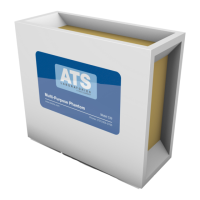
The ATS539 Multi-Purpose Phantom is a device designed for evaluating ultrasound imaging systems across a broad range of clinical imaging frequencies (approximately 2-20 MHz). It serves as a comprehensive tool for quality assurance and performance testing of diagnostic ultrasound equipment.
The phantom is constructed with a combination of monofilament line targets and tissue-mimicking cylindrical targets of varying sizes and contrasts. These targets are strategically positioned to allow for a wide array of measurements and assessments. Cystic-like target structures are arranged vertically in-line, enabling an entire target group to be displayed in a single view. The background material and target structures are acoustically similar, which helps eliminate artifacts such as distortion, shadowing, or enhancement. The phantom also includes six grayscale targets with contrasts ranging from +15 to -15 dB, designed to evaluate the system's displayed dynamic range and grayscale processing performance.
Key tests that can be performed with the ATS539 include:
The phantom is designed for ease of use in routine quality control tests. It provides multiple scanning surfaces (#1, #2, #3, #4) to accommodate different probe types and target groups. Users are instructed to apply coupling gel or water to the scan surface, adjust instrument settings (gain, TGC, output) to "normal" scanning values, and align the probe to maximize targets. For accurate measurements, it's critical to avoid pressing on the scanning surface during vertical distance measurements, as this can temporarily displace wires. The phantom should always be scanned at room temperature (22°C ± 1°C) to ensure accurate speed of sound and perceived measurements. Establishing a baseline for system settings and measurements is emphasized for consistent quality assurance.
The ATS539 phantom is guaranteed for a useful life of 10 years. For best results and longevity, the phantom should be kept clean at all times and stored at room temperature. Accumulation of dried coupling gel on the scan surface should be avoided. Cleaning can be done with warm water and a lint-free cloth. Stubborn stains or dirt may be removed with a mild household cleaner, but petroleum solvents should be avoided as they can adversely react with the rubber-based material. CIRS is ISO 13485:2016 certified and ensures high-quality products through in-house acoustic property testing and ultrasound imaging system inspection of each phantom. A Certificate of Compliance is issued with every phantom. The product comes with a 10-year warranty against defects in material and workmanship. For non-warranty service or returns, customers are advised to contact CIRS Customer Service to obtain an RMA number and follow specific packing and shipping instructions.
 General
| Brand | Cirs |
|---|---|
| Model | ATS539 |
| Category | Medical Equipment |
| Language | English |

 To Next Page