EasyManua.ls Logo

Cisco 7975 - User Manual

Cisco 7975
2 pages
Print Icon
To Next Page IconTo Next Page
Loading...
Basic Phone Features
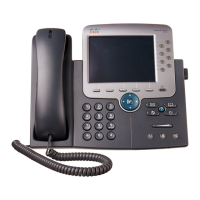
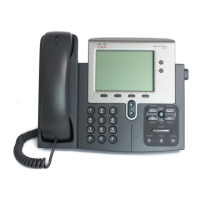
Cisco IP Phone 7975
Quick Reference Guide
1. Basic User Information:
A. Placing a call:
Lift handset, dial number, or
Press NewCall softkey, dial number (engages speaker phone), or
Press NewCall softkey, dial number, lift handset, or
Press Speaker button, dial number
External Calls: 9 + Number
B. Answering a Call:
Lift handset, or
Press Answer softkey (engages speaker phone), or
Press Speaker button
C. Answering Multiple Calls on one line:
When another call is ringing select the Answer Soft Key
To return to other calls, use the Navigation Toggle to highlight the call
and press resume soft key
D. Redial Feature:
Lift handset and press the Redial softkey
E. Call Back Feature:
While listening to ringing or busy tone, press CallBack softkey
When person becomes available, you will receive notification
2. Placing a Call On Hold/Resuming the Call:
Press the Hold softkey
Press the Resume softkey
3. Transferring a Call:
With connected call, press Trnsfer softkey
Dial number to which you are transferring, or
Press
extension/voice mailbox number to transfer to voicemail
Listen for ringing or announce caller
Press Trnsfer softkey again to complete transfer or hang up the
handset.
In order to retrieve caller during the transfer process, press the
EndCall softkey, then press the Resume softkey to connect with
original caller
4. Alternatives to Answering:
1. iDivert:
Press iDivert softkey in order to send caller to voicemail
2.Do Not Disturb:
Press the “Do Not Disturb soft key to activate
Press the “Do Not Disturb” soft key to cancel
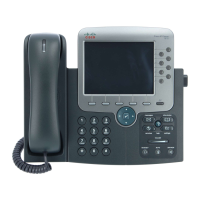
LCD Screen
Additional Line Buttons
Foot Stand
Adjustment
Message
Alert
Voicemail,
Directories,
Services
and
Settings
Navigation
Buttons
Headset, Mute
and Speaker
Buttons

Other manuals for Cisco 7975

Question and Answer IconNeed help?

Do you have a question about the Cisco 7975 and is the answer not in the manual?

Summary

Basic Phone Features

Basic User Information

Covers placing calls, answering calls, and handling multiple calls on one line.

Call On Hold and Resuming

Instructions for placing calls on hold and resuming them.

Transferring a Call

Guide on how to transfer calls to another extension or voicemail.

Alternatives to Answering

Options like iDivert to send calls to voicemail and Do Not Disturb.

Advanced Phone Features

Call Forward Feature

How to forward incoming calls to an alternate phone number or voicemail.

Call Park Feature

Instructions for parking calls and retrieving them from any Cisco Phone.

Conference Calling

Details on initiating and managing conference calls with multiple participants.

Meet-Me Conference

How participants can dial in to join a pre-arranged conference call.

Conference List

Viewing and removing participants from an active conference call.

Message Button Functionality

Using the Message button to log into voicemail.

Button Features and Controls

Directory Button Access

Accessing company directory and call logs (missed, received, placed).

Edit Dial Functionality

Editing numbers selected from directories or call logs.

Services and Settings Buttons

Using Services and Settings buttons for system features and user preferences.

Help and Volume Controls

Using the '?' button for help and adjusting handset/speaker volume.

Headset, Mute, and Speaker Buttons

Activating headset, mute, and speakerphone functions.

Setting Up Speed Dials

Speed;Abbreviated Dials Configuration

Steps to configure and use speed dial numbers (1-199) via web interface.

Overview

The Cisco IP Phone 7975 is a sophisticated communication device designed for professional environments, offering a wide array of features for efficient call handling and user customization. Its primary function is to facilitate voice communication, but it extends far beyond basic calling with advanced capabilities like conferencing, call forwarding, and speed dialing.

Function Description:

The phone serves as a central hub for voice communication, allowing users to place, receive, and manage calls effectively. It integrates with a larger communication system, likely a Cisco Unified Communications Manager, to provide its extensive feature set. The device supports multiple lines, enabling users to handle several calls simultaneously. Its intuitive interface, featuring a large LCD screen and context-sensitive soft keys, guides users through various functions, making complex tasks more accessible. Beyond simple calls, it supports advanced features such as call transfer, hold, redial, and callback, all designed to streamline daily communication workflows. The integration of voicemail, directories, and services further enhances its utility, providing a comprehensive communication solution.

Usage Features:

Basic Call Handling:

  • Placing a Call: Users can initiate calls by lifting the handset and dialing, pressing the "NewCall" softkey and dialing (engaging speakerphone), pressing "NewCall" and dialing then lifting the handset, or pressing the "Speaker" button and dialing. For external calls, a "9" must be dialed before the number.
  • Answering a Call: Calls can be answered by lifting the handset, pressing the "Answer" softkey (engaging speakerphone), or pressing the "Speaker" button.
  • Answering Multiple Calls: When multiple calls ring on one line, the "Answer" softkey is used to pick up the incoming call. To switch between calls, the navigation toggle is used to highlight the desired call, followed by pressing the "Resume" softkey.
  • Redial: The "Redial" softkey, when pressed after lifting the handset, redials the last number called.
  • Callback: If a call encounters a busy tone or rings unanswered, pressing the "CallBack" softkey will notify the user when the person becomes available.

Call Management Features:

  • Hold/Resume: During a connected call, the "Hold" softkey places the call on hold. To retrieve the call, the "Resume" softkey is pressed.
  • Transferring a Call: To transfer a connected call, the "Trnsfer" softkey is pressed, followed by dialing the transfer number. The transfer can be completed by pressing "Trnsfer" again or hanging up. For transferring to voicemail, "*extension/voice mailbox number" is dialed. If the user needs to retrieve the original caller during a transfer, "EndCall" is pressed, then "Resume."
  • Call Forward: Incoming calls can be forwarded to an alternate number or voicemail by pressing the "CfwdAll" softkey and entering the forwarding number or pressing the "Messages" button. To cancel, "CfwdAll" is pressed again.
  • Call Park: This feature allows a call to be parked and retrieved from any Cisco Phone within a 2-minute window. While on a call, "More" then "Park" is pressed. The system provides a "slot number" (xxxx-xxxx) which must be remembered. To retrieve the parked call, the slot number is dialed on any Cisco IP Phone.

Conferencing:

  • Initiating a Conference (Join Multiple Callers): To start a conference, begin with one caller on the line, then press "More" followed by "Confrn." The first caller is put on hold while other participants are dialed. After dialing each new participant, "More" then "Confrn" is pressed to add them to the conference. This process is repeated for all desired participants up to the maximum allowed.
  • Meet-Me Conference (Participants Dial In): To chair a Meet-Me conference, "More" then "MeetMe" is pressed, followed by the Meet-Me number (xxxx-xxxx). Other callers can join by dialing this Meet-Me number.
  • Conference List (View and Remove Participants): During an active conference (not Meet-Me), "More" then "Conflist" can be pressed to view all participants. To remove a participant, "Remove" is pressed. "Update" refreshes the list.

Alternatives to Answering:

  • iDivert: Pressing the "iDivert" softkey sends an incoming caller directly to voicemail.
  • Do Not Disturb: Pressing the "Do Not Disturb" softkey activates or deactivates this feature, preventing incoming calls from ringing the phone.

Button Features:

  • Directory Button: Provides access to the "Company Directory" (searchable by dial pad input) and "Missed, Received, and Placed Call Logs" (navigable with the navigation button and dialable with the "Dial" softkey). It also allows "Edit Dial" to modify numbers from directories or call logs using "<< and >>" softkeys.
  • Services Button: Accesses pre-programmed services by the system administrator.
  • Setting Button: Allows users to set personal preferences.
  • "?" Button: Provides information about any phone feature.
  • Volume Button: Adjusts handset, headset, and speaker volume. The volume level can be saved using the "Save" softkey.
  • Headset Button: Enables the headset feature.
  • Mute Button: Mutes the microphone.
  • Speaker Button: Activates the speakerphone feature.

Maintenance Features:

While the manual primarily focuses on usage, some aspects touch upon maintenance indirectly through user-configurable settings and system administration.

  • Foot Stand Adjustment: The physical foot stand of the phone can be adjusted for optimal viewing and ergonomic comfort, which contributes to the longevity and usability of the device.
  • User Preferences (Setting Button): Users can customize various settings, which can be seen as a form of personal maintenance for their phone experience. This includes adjusting volume levels and other display or audio settings to suit individual needs.
  • System Administrator Pre-programming (Services Button): The "Services" button provides access to features pre-programmed by the system administrator. This implies that the system administrator is responsible for the initial setup and ongoing configuration of certain phone functionalities, ensuring the device operates correctly within the network. This administrative oversight is a key aspect of maintaining the phone's functionality and integration within the larger communication system.
  • Speed Dial Setup (Computer Programmable): Speed dials are set up via a computer interface, not directly on the phone. This involves logging into a "Cisco Telephone User Page" with a User ID and Password. This method of configuration offloads complex setup from the phone itself, making it easier to manage and update frequently used numbers. This external configuration process is a form of system-level maintenance that keeps the phone's quick-dial features current and accurate.
  • Message Button (Voicemail Log-in): The "Message" button logs the user into voicemail. Regular management of voicemail messages (listening, deleting, saving) is a form of personal maintenance that keeps the voicemail system efficient and prevents it from becoming full.

In summary, the Cisco IP Phone 7975 is a robust and versatile communication tool designed for comprehensive call management in a professional setting. Its user-friendly interface, combined with a rich set of features, empowers users to handle calls efficiently, participate in conferences, and customize their phone experience. While direct physical maintenance by the user is minimal, the emphasis on user preferences and system administration highlights the importance of both individual and centralized management for optimal device performance.

Cisco 7975 Specifications

General IconGeneral
Network ProtocolSIP, SCCP
Headset SupportYes
Lines8
AudioFull-duplex speakerphone
Ethernet Ports2 x 10/100/1000 Mbps
Power802.3af PoE
Expansion Module SupportYes, up to 2 modules
CodecsG.711, G.722, G.729, G.729a, G.729ab, iLBC
Buttons5 softkeys
Headset PortDedicated headset port
SpeakerphoneYes

Videos

How to perform Factory Reset on 7975 phone

Related product manuals