Preparing for the road
28www.coachman.co.uk
Owners handbook 2022
Coachman Caravan Company Limited, Amsterdam Road, Sutton Fields Industrial Estate, Hull, HU7 0XF
Breakaway cable
UK law requires that all trailers with
brakes built on or after 1st October 1982
(e.g. caravans, horse boxes, flat bed car
trailers etc.) are fitted with a safety device
to provide protection in the unlikely event
of the separation of the main coupling
while in motion. A device referred to as a
“breakaway cable” fulfills this requirement
and when fitted to a trailer its use is
mandatory. For further information please
refer to:
http://www.tourerinfo.co.uk/
images/breakaway_cable_leaflet_
consumer_042015_final.pdf
Purpose - To apply a trailer’s brakes if
it becomes separated from its towing
vehicle. Having done this, the cable
assembly is designed to part, allowing
the trailer to come to a halt away from
the towing vehicle.
Construction - Usually a thin steel cable,
possibly plastic coated, and fitted with a
means of attachment for connection to
the towing vehicle.
Operation - In the event of the main
coupling of the trailer separating from
the towing vehicle, the cable should be
able to pull tight, without any hindrance,
engaging the trailer’s brakes.
NOTE: The breakaway cable should
never become taut during normal use.
Correct procedure for use:
• Regularly check the cable and clip
for damage. If in doubt, contact your
dealer or service agent.
• Make sure the cable runs as straight
as possible and goes through a cable
guide underneath the trailer coupling.
• Determine whether or not the towbar
has a designated attachment point
(i.e. a part specifically designated by its
manufacturer for a breakaway cable).
Where a designated attachment point
is provided on the towbar:
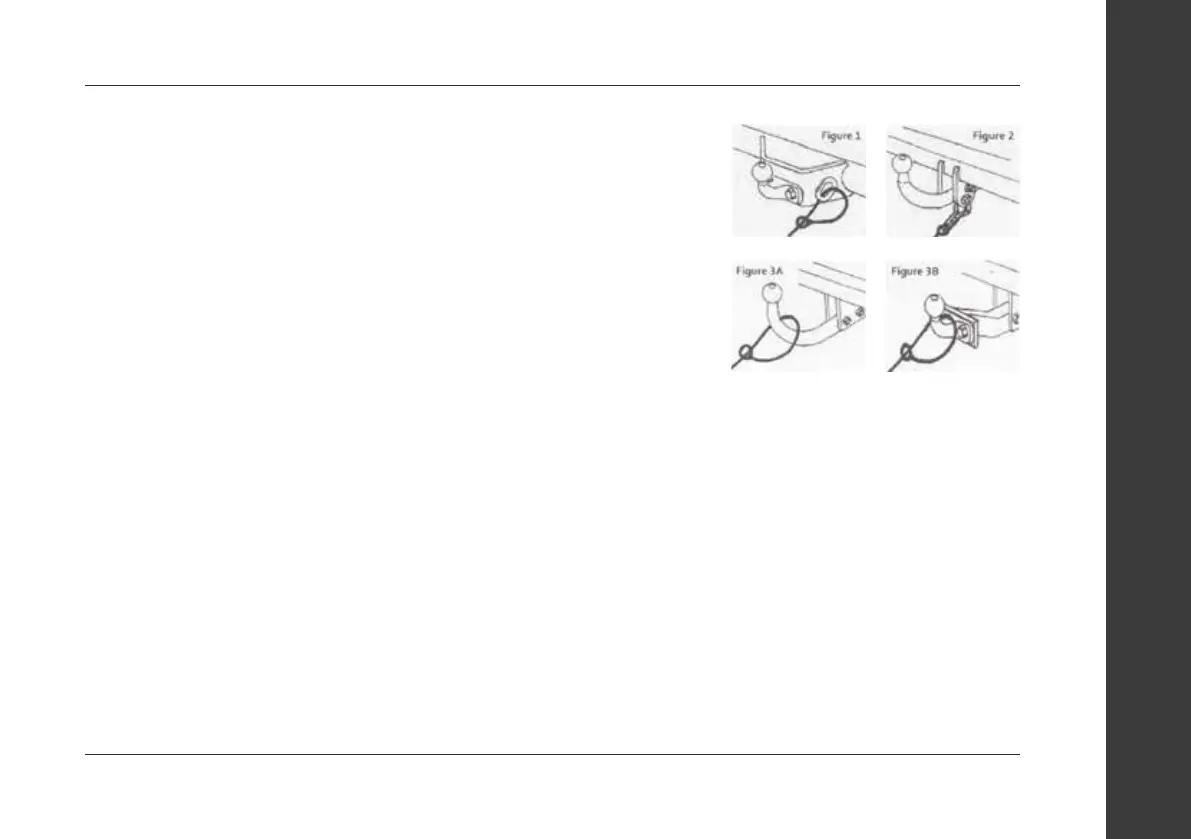
Either: a) Pass the cable through the
attachment point and clip it back on
itself (Fig. 1)
Or: b) Attach the clip directly to the
designated point (Fig.2). This alternative
must be specifically permitted by the
trailer manufacturer since the clip may
not be suiciently strong for use in
this way.
Where NO designated attachment
point is provided on the towbar:
Fixed ball: Loop the cable around the
neck of the towball. If you fit the cable
like this, use a single loop only. See figs.
3A and 3B.



 To Next Page