EasyManua.ls Logo

Commodore VIC-1525 - Page 20

Commodore VIC-1525
39 pages
Print Icon
To Next Page IconTo Next Page
To Previous Page IconTo Previous Page
Loading...
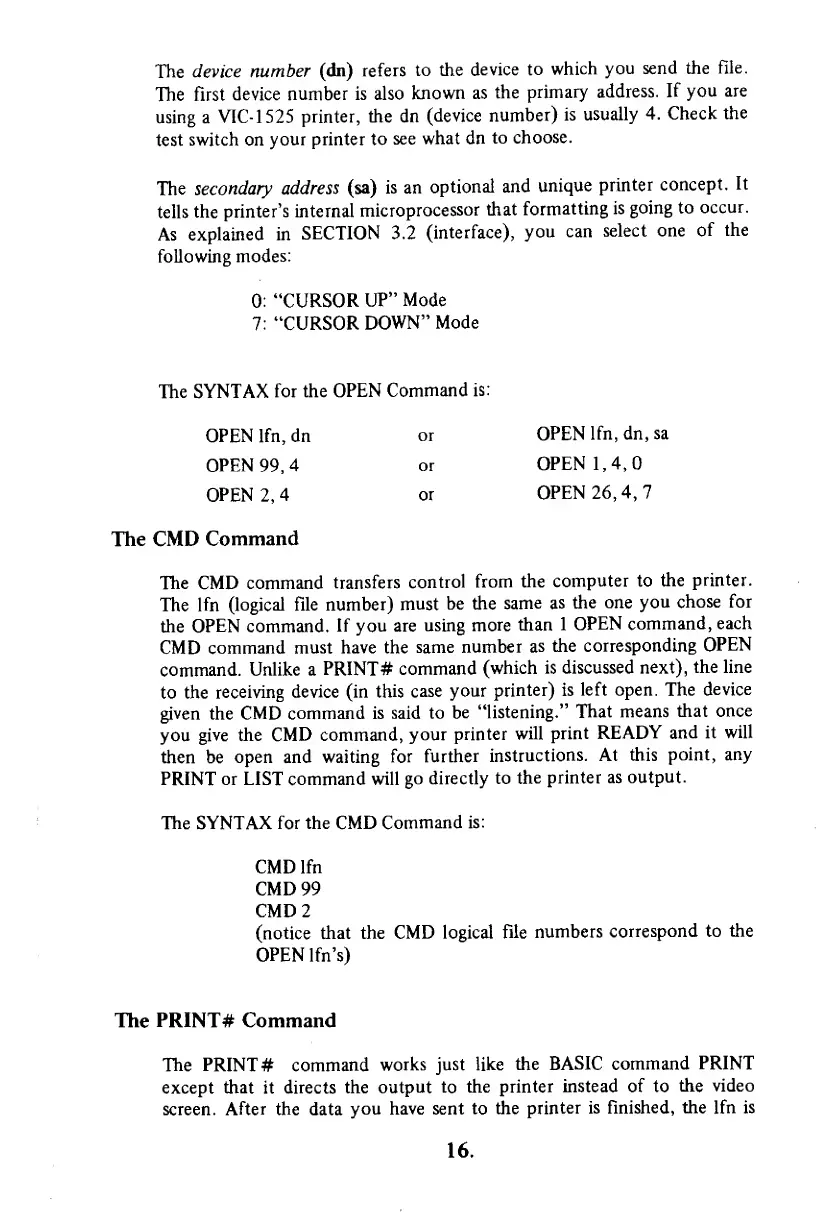
The device
number
(dn)
refers
to the
device
to
which
you send the
file.
The first
device
number is also
known as
the
primary
address.
If you
are
using a
VIC- 1525
printer,
the
dn
(device
number)
is
usually 4.
Check
the
test
switch on
your printer to
see
what dn
to
choose.
The secondary
address
(sa)
is an
optional
and
unique
printer
concept.
It
tells
the
printer's internal
microprocessor
that
formatting
is
going to
occur.
As
explained in
SECTION 3.2
(interface),
you can
select
one
of
the
following
modes:
0: "CURSOR
UP"
Mode
7:
"CURSOR
DOWN"
Mode
The
SYNTAX
for the
OPEN
Command
is:
OPEN lfn, dn
or
OPEN
lfn, dn,
sa
OPEN
99,
4
or
OPEN
1,4,0
OPEN
2,
4
or
OPEN
26,
4,
7
The CMD
Command
The CMD command
transfers
control
from
the
computer to
the
printer.
The
lfn
(logical file
number)
must
be the
same as
the one
you
chose for
the OPEN command.
If
you
are
using
more
than 1
OPEN
command,
each
CMD
command
must have the
same
number
as
the
corresponding
OPEN
command.
Unlike a
PRINT#
command
(which
is discussed next),
the line
to the
receiving
device (in
this
case
your
printer) is
left open. The
device
given
the
CMD
command is
said to
be
"listening."
That
means
that once
you
give the CMD command,
your
printer
will
print
READY and
it
will
then be
open and waiting
for
further
instructions.
At this
point, any
PRINT or LIST command will
go directly
to
the
printer
as
output.
The SYNTAX for the CMD
Command
is:
CMD lfn
CMD 99
CMD 2
(notice
that the
CMD logical
file
numbers
correspond to the
OPENlfn's)
The
PRINT*
Command
The
PRINT* command
works just like
the
BASIC command
PRINT
except
that
it
directs the
output to
the
printer instead of to
the video
screen.
After
the data
you
have
sent
to the
printer
is
finished,
the
lfn is
16.

Other manuals for Commodore VIC-1525

Related product manuals