
 Need help?
Do you have a question about the Control Techniques COMMANDER S100 and is the answer not in the manual?
Drive must be mounted in an enclosure preventing unauthorized access and contamination.
Use appropriate safeguards when lifting the drive. Refer to STEP 1 for weights.
Loose power connections are a fire risk. Ensure terminals are tightened to specified torques.
Unit uses high voltages and currents. Extreme care is necessary. Comply with safety legislation.
Remove AC supply using an isolation device before servicing. Wait 10 minutes for capacitors to discharge.
Hazard exists if plug pins are accessible after unplugging. Implement automatic isolation.
Drive must be grounded by a conductor sufficient for prospective fault current. Adhere to ground connections.
Install suitable overload protection. Integral protection does not provide branch circuit protection.
Drive has solid-state overload protection for the motor. Motor rated current must be entered correctly.
Control circuits have basic insulation. Ensure external circuits have adequate insulation or SELV barrier.
Changes to settings require careful consideration. Take precautions against inadvertent changes.
Drive control functions are not sufficient for safety-critical applications without additional protection.
Installer must ensure system complies with EMC legislation. Product designed to high EMC standards.
Users must not attempt to repair a faulty drive. Return it to the supplier.
Connect supply and motor using specified cables and fuses/MCBs. Single-phase supply to L1 and L2.
Use 10 mm² or equivalent conductors for grounding. Ensure proper connection location and size.
Details default configurations for terminal connections including digital and analog I/O.
Set minimum/maximum frequency, acceleration/deceleration rates, and motor nameplate details.
Enable the drive with terminal 12 and provide a run signal via T13 or T14.
Instructions for restoring factory defaults and troubleshooting drive errors.
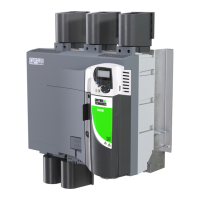
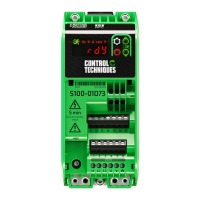
The Commander S100 is a variable speed drive designed for professional integration into industrial equipment and systems. It facilitates precise control of mechanical plant, offering a range of features for mounting, wiring, programming, and motor operation. The drive is compatible with the Marshal mobile app, which provides additional setup, commissioning, diagnostics, and monitoring capabilities.
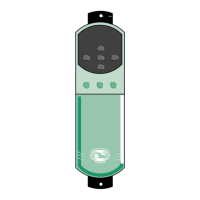
The Commander S100 serves as a variable speed drive (VSD) or variable frequency drive (VFD), controlling the speed and torque of AC motors by varying the frequency and voltage of the power supplied to them. It is designed to be incorporated into complete equipment or systems, providing efficient and precise motor control. The drive is equipped with both a physical keypad for direct parameter editing and NFC (Near Field Communication) for wireless data transfer, enabling quick setup and commissioning via a mobile app. It supports various input/output configurations for integration into control systems, including analog and digital I/O, as well as EIA 485 communications. The drive includes integral solid-state short circuit protection and thermal memory retention for motor overload protection.
The Commander S100 is available in different frame sizes (1, 2, 3) with varying dimensions and weights.
The drive supports various input voltage ratings: 110 V, 230 V, and 400 V, with corresponding fuse/MCB selections and cable sizes (IEC 60364-5-52 mm² and UL 61800-5-1 AWG). For instance, a 110V single-phase S100-01113 model has a max input current of 7.19 A, requiring 10A IEC Class gG fuses or 15A UL Class CC, J or T fuses, and 1.5 mm² (24 AWG) input/output cables. A 400V three-phase S100-02413 model has a max input current of 1.92 A, requiring 4A IEC Class gG fuses or 15A UL Class CC, J or T fuses, and 1.5 mm² (24 AWG) input/output cables. The voltage rating of fuses and MCBs must be greater than or equal to the highest supply voltage of the system.
Terminal connections require specific torque settings: 0.5 Nm for power connections (0.6 Nm for 400V) and 1.5 Nm for ground connections across all voltage ratings. Control circuits are isolated from power circuits by basic insulation, requiring external control circuits to be insulated from human contact.
The operating ambient temperature range is 0 °C to 60 °C (32 °F to 140 °F). Derating is required for reduced clearances or ambient temperatures above 40 °C (104 °F).
The Commander S100 operates with high voltages and currents, storing significant electrical energy. Installation, commissioning, and maintenance must be performed by trained and authorized personnel. An approved isolation device must be used to remove AC supply before servicing, and a minimum of 10 minutes must be allowed for capacitors to discharge. For products connected by plug and socket, a means for automatic isolation of the plug from the drive is necessary to prevent electric shock. The drive must be grounded by a conductor sufficient to carry the prospective fault current. Branch circuit protection must be provided in accordance with relevant electrical codes (NEC, Canadian Electrical Code, etc.). The drive is designed for use in an enclosure in an environment classified as pollution degree 2 (dry, non-conducting contamination). The control functions are not sufficient for safety-critical applications without additional independent channels of protection, and a risk assessment is required for such uses. The product complies with EMC legislation (e.g., Electromagnetic Compatibility Directive 2014/30/EU).
 General
| Brand | Control Techniques |
|---|---|
| Model | COMMANDER S100 |
| Category | DC Drives |
| Language | English |

 To Next Page