15
Single channel dimming
UNLCDHS Programming – Channel Dimming and Switch Mode Explained
Channel 1 (switched output) of the detectors can either be
used to switch a separate channel of standard, non-dimming
luminaires, or to isolate the mains supply to dimming ballasts
(saving on the standby current of the ballasts).
Multiple luminaires may be connected in parallel to Channel
1 (via the N and L/Out terminals) as long as the maximum
total load is not exceeded.
Channel 2 (dimmable output) of the detectors can be used
to control the light output of luminaires that are tted with
dimming ballasts/transformers.
The ballasts/transformers can be connected in parallel to
Channel 2 (via the DIM– and DIM+ terminals).
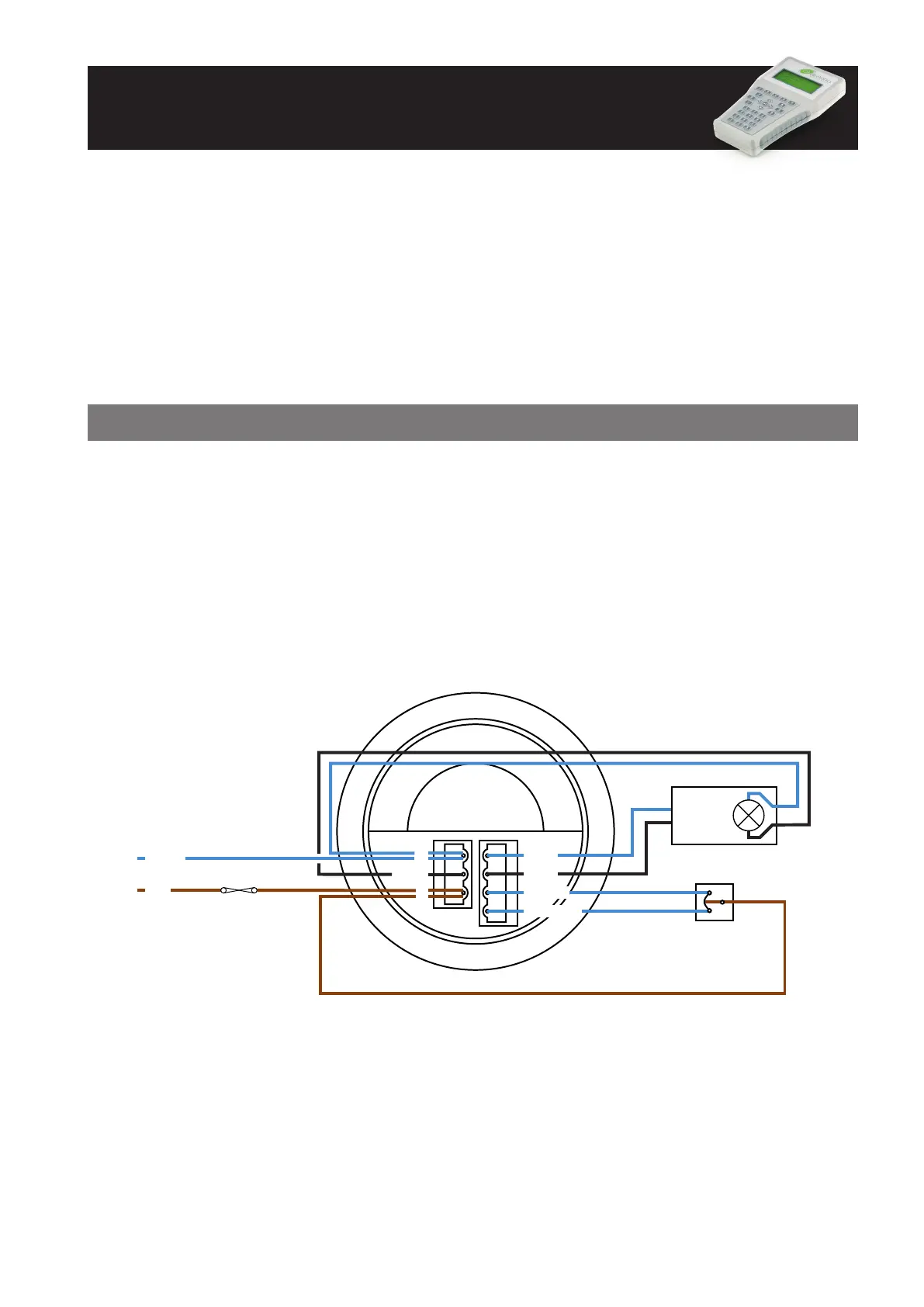
The wiring examples below show common methods of
connecting switch inputs and the output channels for a
single detector unit.
Functions: Switches the luminaire with occupancy and maintains illuminance. Dims and switches using optional centre
biased retractive switch (Legrand Synergy 735414 grid switch or MK K4900 or similar).
Congured to presence detection: Turns on automatically with occupancy. Maintains illuminance. Press and release down
switch to turn o. Press and release up switch to turn back on. Press and hold up switch to dim up, press and hold down
switch to dim down. Turns o aer occupancy.
Congured to absence detection: Press and release up switch to turn on. Maintains illuminance. Press and release down
switch to turn o. Press and hold up switch to dim up, press and hold down switch to dim down. Turns o aer occupancy.
Channel mode: Set to “Switch and dim together”.
Switch mode: Set to “2 position switch together”.
N
L/Out
L
SW1/UP
DIM –
DIM +
SW2 DOWN
Neutral
Live
Centre Biased
Retractive Switch
(240V Switching)
Optional for presence,
mandatory for absence detection
Circuit Protection
(If Required)
Dimming Luminaire
(DALI, DSI or 1-10v)
Dimming
Ballast



 To Next Page