CDR-3250/80 TECHNICAL MANUAL
Table 3-5 Radio Command and Status Messages.
Syntax Reply Description
3-64 Issue 2.2
TB?
1
(Refer to
description)
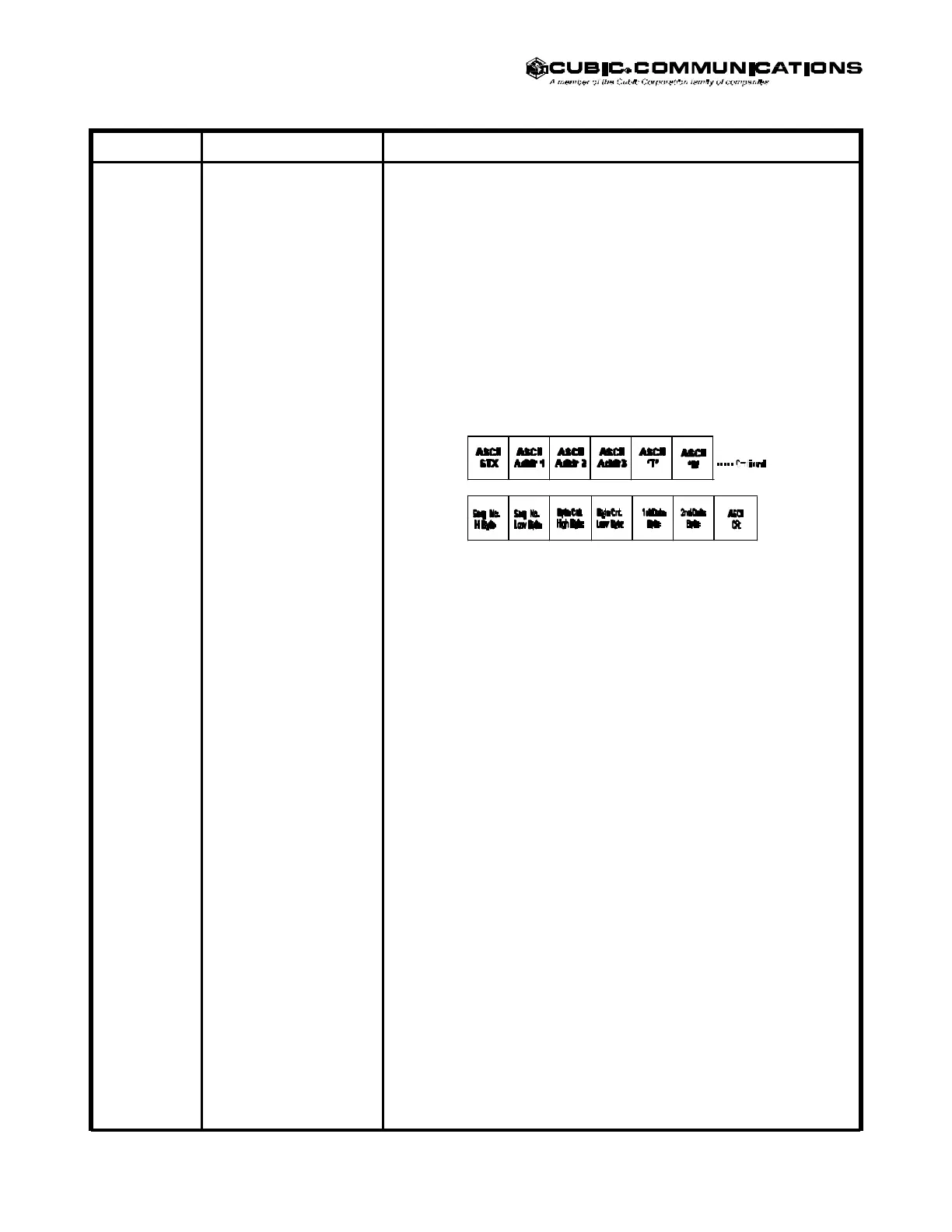
Request the Block signal strength: The reply to this command is a
specially formatted block of data created by the receiver when sweeping
in one of the Pan Sweep data collection modes (T2, T3, and T4). If Special
Step Mode T4 is set, and more than one block of data is available in the
output queue, a separate TB? command must be sent for each one.
This reply message contains 8 bit non-ASCII data so serial interface units
must have their line parameters set for 8 data bits. Following the normal
ASCII STX, three character ASCII address, and the message type header
TB, are a variable number of 8 bit bytes that give the sweep number, the
data byte count, and the data bytes themselves. This data format is
illustrated below:
The two bytes following the TB message header are the block sequence
number. This is a 16 bit value with the high byte sent first and is assigned
by the receiver when the block of sweep data is assembled. This number
can be used to verify that data blocks are not being created faster than
they are being read by the controller.
The first block after beginning a sweep will be number zero. If more than
65,535 sweeps have been taken since the sweep was begun, this number
starts again from zero. The next two bytes give the number of data bytes
that follow. This is a 16 bit value with the high byte sent first.
Following the byte count are the actual data bytes. The first data byte
represents the signal strength of the first frequency visited in the sweep,
the second data byte represents the second frequency visited in the
sweep, and so forth for each frequency in the sweep. Frequencies that are
stored in the sweep skip table are not visited in the sweep and will not
have associated data bytes.
This means that the number of data bytes in the reply message may be
less that the number calculated based on the start frequency, the stop
frequency, and the step size. (Send the CL command to prevent this).
Each data byte is a signed two's complement number that represents the
signal strength of the energy present on the visited frequency in dBm.
The range is approximately -115 to +12 dBm.
Following the last data byte is an ASCII CR (carriage return) character.
This is the last character of the reply message and is included for
consistency with the other messages. It should not be confused with a
data byte.
Courtesy of http://BlackRadios.terryo.org



 To Next Page