Need help?
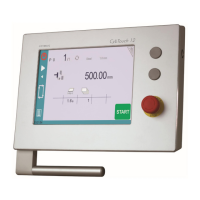
Do you have a question about the CYBELEC CybTouch 12 and is the answer not in the manual?
General safety directives for operating the numerical control.
Explanation of signs and icons used in the manual.
Provides general warnings and information for the user.
Details on settings and navigation within the system.
Overview of the general navigation interface.
How to use the menu button to navigate.
Accessing status information via the status pages zone.
Instructions for cleaning the CybTouch screen.
Details about the status page display.
Configuration of user-specific settings.
How to select and change the system language.
Choosing between mm, inch, and none for length units.
Options for displaying Y1-Y2 values, L-alpha, and bent parts.
Managing material properties and configurations.
Applying permanent correction to the Bottom Dead Center.
Clear indexation, USB Explorer, default retraction, and clock settings.
Calibrating the touchscreen for optimal operation.
Defining screen brightness for normal and Eco modes.
Manually moving machine axes for setup or adjustments.
Returning an unsynchronized beam parallel to the table.
Accessing hardware status and maintenance actions.
Manually adjusting the position of back gauge and beam axes.
Performing maintenance actions like Defrag and Format.
Rearranging memory space and erasing all data.
Creating backups and viewing software information.
Managing computer identification and machine options.
Details on serial number and computer identification.
Displaying installed options and entering new codes.
Transferring data between CybTouch and a USB key.
Converting and importing parts from other Cybelec NCs.
Overview of the basic page layouts.
Description of the Bend Numerical Page interface.
Description of the More Page interface.
Selecting and configuring material properties.
Setting and displaying material thickness.
Setting and displaying material sigma.
Activating or deactivating back gauge retraction.
Adjusting speed change point and bending speed.
Defining the width of the sheet metal part.
Parameters for large radius bends.
Slowing down beam speed after a bend.
Defining the duration the punch remains at BDC.
Automatic calculation and manual adjustment of bending force.
Calculated value for extracting bent parts from tools.
Automatic calculation and manual adjustment of crowning.
Selecting back gauge support and stop positions.
Entering the total amount of parts to be produced.
Manual control over back gauge movement.
Introduction to managing punches.
Step-by-step guide to creating or modifying a punch.
Step-by-step guide to creating or modifying a die.
Conventions for naming punches based on angle and type.
Conventions for naming dies based on width and angle.
Intuitively drawing a part profile on the screen.
Steps for determining and executing a bend sequence.
Creating a part program directly on the Bend Numerical Page.
Defining each step (length or angle) of a profile on a table.
Correcting the angle of the Y1 and Y2 axes.
Making corrections to the crowning value.
Applying corrections to back gauge X and R axis positions.
Steps to save a created program.
Steps to load an existing program.
Steps to delete a program.
Step-by-step guide to making a bend on the EasyBend page.
Messages displayed on a green background with information.
Messages indicating machine or NC errors.
 General
| Touchscreen | Yes |
|---|---|
| Resolution | 1280 x 800 pixels |
| Connectivity | Ethernet, USB |
| Power Supply | 24V DC |
| Operating Temperature | 0°C to 50°C |
| Protection Rating | IP65 front panel |
| Display Size | 12.1 inches |
| Screen Size | 12 inches |
| Processor | ARM Cortex-A8 |
| Communication Ports | Ethernet |

 To Next Page