52
SERVICING
S-1 CHECKING VOLTAGE
1. Remove outer case, control panel cover, etc., from unit being
tested.
With power ON:
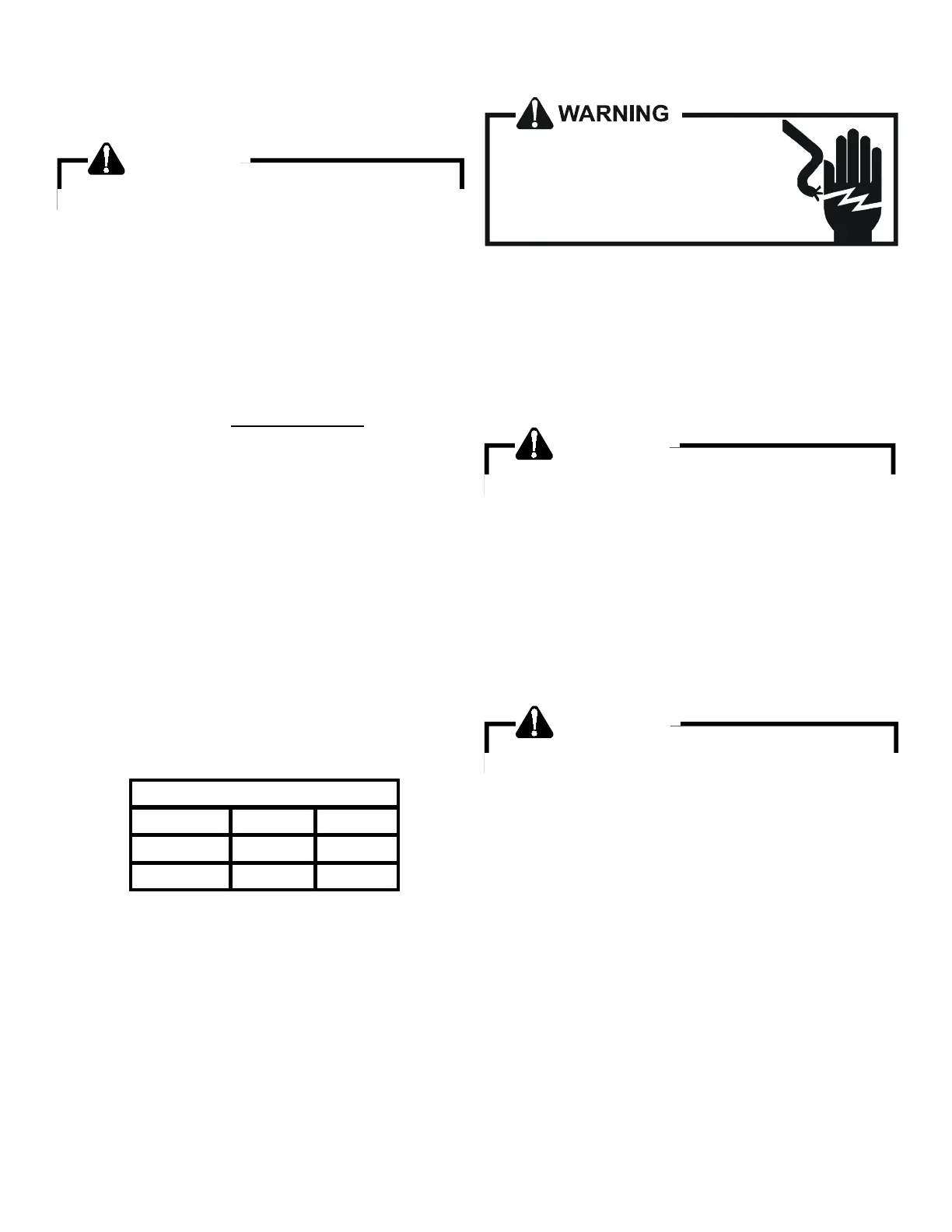
WARNING
Line Voltage now present.
2. Using a voltmeter, measure the voltage across terminals L1
and L2 of the contactor for the condensing unit or at the
eld connecons for the air handler or heaters.
3. No reading - indicates open wiring, open fuse(s) no power or
etc., from unit to fused disconnect service. Repair as need-
ed.
4. With ample voltage at line voltage connectors, energize the
unit.
5. Measure the voltage with the unit starng and operang,
and determine the unit Locked Rotor Voltage. NOTE: If
checking heaters, be sure all heang elements are energized.
Locked Rotor Voltage is the actual voltage available at the
compressor during starng, locked rotor, or a stalled condi-
on. Measured voltage should be above minimum listed in
chart below.
To measure Locked Rotor Voltage aach a voltmeter to the
run "R" and common "C" terminals of the compressor, or
to the T1 and T2 terminals of the contactor. Start the unit
and allow the compressor to run for several seconds, then
shut down the unit. Immediately aempt to restart the unit
while measuring the Locked Rotor Voltage.
6. Locked rotor voltage should read within the voltage tabu-
laon as shown. If the voltage falls below the minimum volt-
age, check the line wire size. Long runs of undersized wire
can cause low voltage. If wire size is adequate, nofy the
local power company in regard to either low or high voltage.
NOTE: When operang electric heaters on voltages other than
240 volts, refer to the System Operaon secon on electric heat-
ers to calculate temperature rise and air ow. Low voltage may
cause insucient heang.
S-2 CHECKING WIRING
HIGH VOLTAGE!
Disconnect ALL power before servicing
or installing. Multiple power sources
may be present. Failure to do so may
cause property damage, personal injury
or death.
1. Check wiring visually for signs of overheang, damaged insu-
laon and loose connecons.
2. Use an ohmmeter to check connuity of any suspected open
wires.
3. If any wires must be replaced, replace with comparable
gauge and insulaon thickness.
S-3A Thermostat and Wiring
WARNING
Line Voltage now present.
With power ON, thermostat calling for cooling
1. Use a voltmeter to check for 24 volts at thermostat wires C
and Y in the condensing unit control panel.
2. No voltage indicates trouble in the thermostat, wiring or
external transformer source.
3. Check the connuity of the thermostat and wiring. Repair or
replace as necessary.
Indoor Blower Motor
With power ON:
WARNING
Line Voltage now present.
1. Set fan selector switch at thermostat to “ON” posion.
2. With voltmeter, check for 24 volts at wires C and G.
3. No voltage indicates the trouble is in the thermostat or wir-
ing.
4. Check the connuity of the thermostat and wiring. Repair or
replace as necessary.
Resistance Heaters
1. Set room thermostat to a higher seng than room tempera-
ture so both stages call for heat.
2. With voltmeter, check for 24 volts at each heater relay.
3. No voltage indicates the trouble is in the thermostat or wir-
ing.
4. Check the connuity of the thermostat and wiring. Repair or
replace as necessary.


 To Next Page