65
SERVICING
1. Operate the system and measure compressor current. Cycle
the unloader ON and OFF at 10 second intervals. The com-
pressor amperage should go up or down at least 25 percent.
2. If step one does not give the expected results, shut unit o.
Apply 18 to 28 volt ac to the unloader molded plug leads and
listen for a click as the solenoid pulls in. Remove power and
listen for another click as the unloader returns to its original
posion.
3. If clicks can’t be heard, shut o power and remove the con-
trol circuit molded plug from the compressor and measure
the unloader coil resistance. The resistance should be 32 to
60 ohms, depending on compressor temperature.
4. Next check the molded plug.
a. Voltage check: Apply control voltage to the plug wires
(18 to 28 volt ac). The measured dc voltage at the female
connectors in the plug should be around 15 to 27 vdc.
b. Resistance check: Measure the resistance from the end
of one molded plug lead to either of the two female connec-
tors in the plug. One of the connectors should read close to
zero ohms while the other should read innity. Repeat with
other wire. The same female connector as before should
read zero while the other connector again reads innity.
Reverse polarity on the ohmmeter leads and repeat. The
female connector that read innity previously should now
read close to zero ohms.
c. Replace plug if either of these test methods doesn’t
show the desired results.
S-18D OPERATION TEST
If the voltage, capacitor, overload and motor winding test fail to
show the cause for failure:
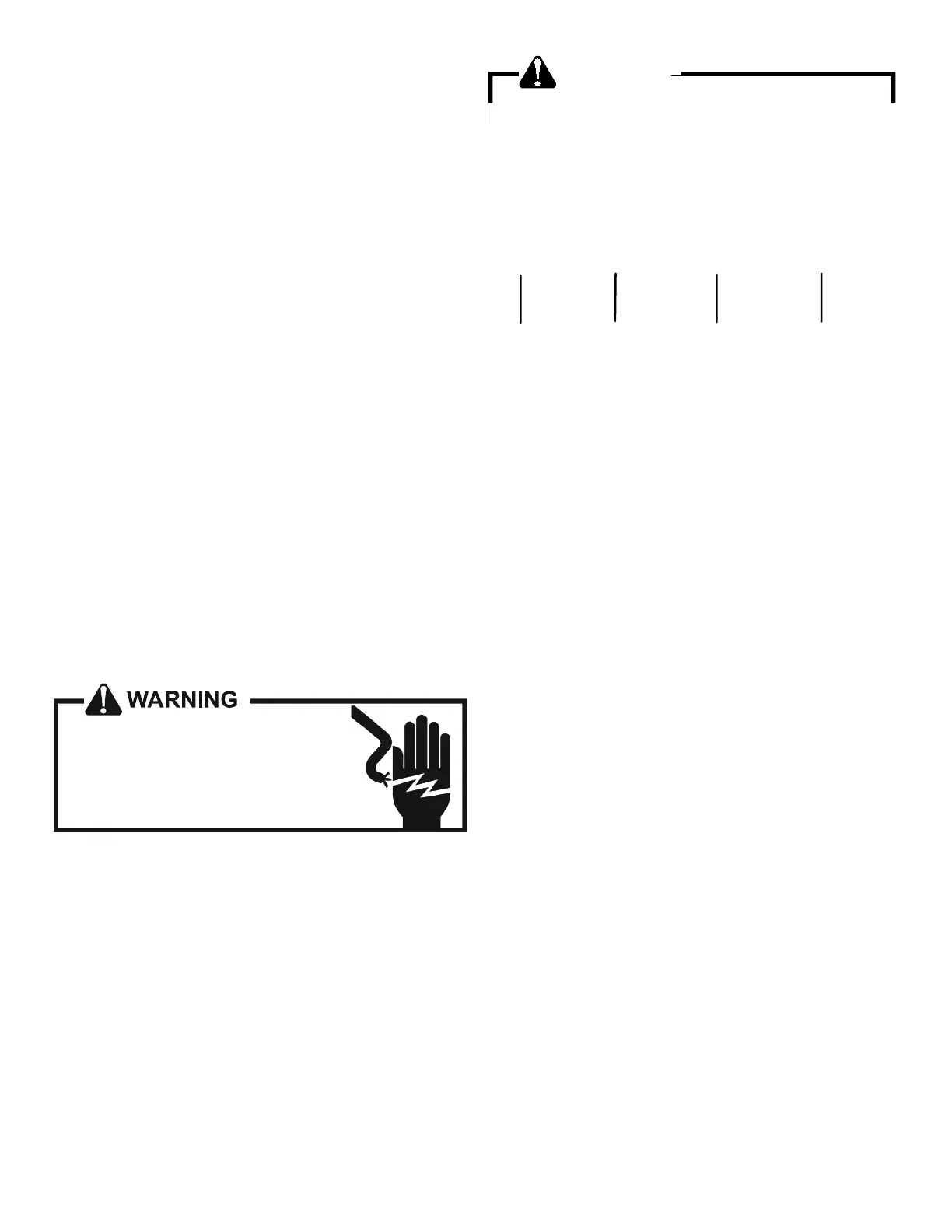
HIGH VOLTAGE!
Disconnect ALL power before servicing
or installing. Multiple power sources
may be present. Failure to do so may
cause property damage, personal injury
or death.
1. Remove unit wiring from disconnect switch and wire a test
cord to the disconnect switch.
NOTE: The wire size of the test cord must equal the line wire
size and the fuse must be of the proper size and type.
2. With the protecve terminal cover in place, use the three
leads to the compressor terminals that were disconnected
at the nearest point to the compressor and connect the
common, start and run clips to the respecve leads.
3. Connect good capacitors of the right MFD and voltage rang
into the circuit as shown.
4. With power ON, close the switch.
WARNING
Line Voltage now present.
a. If the compressor starts and connues to run, the cause for
failure is somewhere else in the system.
b. If the compressor fails to start - replace.
COPELAND COMPRESSOR
03 A 12345 L
YEAR
MONTH
SERIAL
NUMBER
PLANT
S-18E CHECKING 3-PHASE SCROLL
COMPRESSOR ROTATION
Verify the proper rotaon of Copeland scroll compressors as
follows:
NOTE: The compressor may run backwards (noisy operaon) for
1 or 2 seconds at shutdown. This is normal and does not harm
the compressor.
1. Install gauges and verify that the sucon pressure drops
while the discharge pressure increases.
2. Listen for normal compressor sound levels. Reverse rotaon
results in elevated or unusual sound levels.
3. Reverse rotaon will result in substanally reduced amp
draw from tabulated values.
To correct improper rotaon, switch any two power supply leads
at the outdoor unit contactor.
The 3-phase scroll compressors are direcon of rotaon sen-
sive. They will rotate in either direcon depending on the
phasing of the power. There is no negave impact on durability
caused by operang 3-phase compressors in reversed rotaon.
The compressor’s internal protector will trip, de-energizing the
compressor. Connued operaon of 3-phase scroll compressors
with the rotaon reversed will contribute to compressor failure.
All 3-phase scroll compressors should be checked for correct
phase rotaon.
S-18 TESTING CRANKCASE HEATER
(OPTIONAL ITEM)
The crankcase heater must be energized a minimum of four (4)
hours before the condensing unit is operated.
Crankcase heaters are used to prevent migraon or accumula-
on of refrigerant in the compressor crankcase during the o
cycles and prevents liquid slugging or oil pumping on start up.
A crankcase heater will not prevent compressor damage due to a
oodback or over charge condion.


 To Next Page