REPLACING FAULTy SENSORS
MT6210 A2L MITIGATION CONTROLDAIKIN APPLIED
14
Replacing Faulty Sensors
WARNING
Field replacement sensors must be Daikin Applied approved service parts. The
use of non-certied parts can result in property damage, personal injury, or
death.
The refrigerant sensors are designed to be maintenance-free for
the life of the equipment, but it is always a possibility for failures
to occur in the eld. In the unlikely event that a sensor does fail,
replacing the failed sensor can be easily accomplished with an
new, unused sensor acquired from a certied Daikin Applied
service parts supplier.
Sensor Failure Indicators
The need to replace a refrigerant sensor in the eld can be
indicated in one of three ways:
1. Loss of Communication (LOC)
The sensor’s capability to communicate to the MT6210
control has been compromised by an internal fault in
the sensor. It is important to rule out other causes of the
communication failure that might exist outside the sensor
itself, such as loose connections or broken wires.
2. Sensor Self-Test Failure (FLT)
The sensor failed its internal self-test and reported this
failure to the MT6210. The self-test periodically checks that
the sensor’s internal functions and tolerances are within
normal operating parameters and reports the status of
these tests continuously.
3. Conguration Error (CFG)
A conguration error indicates a mismatch between the
expected sensor conguration and what the control is
seeing on the sensor network. This is an unlikely condition
where the number or addressing of the sensors is incorrect,
and there are distinct steps to diagnose the exact cause of
this error.
Sensor Network Verication
When a sensor failure is indicated, the current state of sensor
network should be veried following these steps:
1. Remove the 24 VAC power from the MT6210 control. This
can be easily accomplished by shutting down the main
power to the unit. The MT6210 typically provides power
to all the refrigerant sensors in the system, so removing
power from the MT6210 also powers down the sensor
network.
2. If an auxiliary 5 VDC power supply is used to power the
refrigerant sensors separate from the MT6210 internal
power supply, ensure this is also powered down.
3. Leave the controller/network un-powered for 30 seconds.
4. Re-apply power to the controller/network.
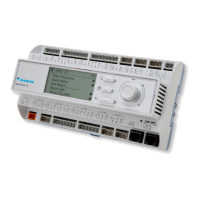
5. Observe the MT6210 LED display for the network summary
information. This information is displayed after the 30
second warm-up period (St-UP). Record which sensors are
present (S0x=1) and which sensors are not (S0x=0).
6. Continue to observe the MT6210 display for re-occurrence
of the previous fault.
Identifying Faulty Sensor
Conrmation of the sensor issue for each failure indication is as
follows:
1. The sensor indicating the LOC Fault shows as a missing
sensor in the power-up network summary. For example, if
the system fault was S02 LOC and the network summary
shows S02=0, then the failure is conrmed.
2. The sensor indicating the FLT Fault shows as an active
sensor in the power-up network summary, S0x=1, and
the S0x FLT fault re-appears after start-up, the failure is
conrmed.
3. In the case of the CFG FLT fault, the indication will be a
mis-addressed sensor in the network or more sensors
discovered that the number of sensors expected. This will
be indicated during the power-up network summary and
may require factory assistance to resolve.
Installing Single Replacement Sensors
Once the failed sensor is veried, the sensor location must be
ascertained and access to the sensor achieved. Once accessed,
replace the sensor as follows:
1. Remove power the MT6210 control and auxiliary 5 VDC
power supply (if used).
2. Disconnect the Modbus connection at the sensor pigtail
(approximately 6” from the sensor body).
3. Remove the two screws securing the sensor to the sensor
mounting bracket. Note the orientation of the sensor to the
bracket.
4. Position a new, unused sensor on the bracket and secure
with the mounting screws.
5. Connect the unit wiring harness to the new sensor.
6. Apply power to the controller/network.
7. Observe the MT6210 display and record the network status
summary.
The MT6210 will identify the replacement sensor and re-address
that sensor to its new location in the system. The system will
indicate all sensors discovered and functioning, and the unit will
resume normal operation.
NOTE: USE ONLY NEW, UNUSED SENSORS FOR FIELD
REPLACEMENTS. If a previously installed sensor
is used as the replacement sensor, the MT6210 will
not identify that sensor as a replacement and the
addressing routine may fail.




 To Next Page