User_Manual-PILATUS-V1_2.doc 10/57
The great advantage of this approach is that standard technologies are used
for both the silicon sensor and the CMOS readout chips, which guarantees
highest quality. Both processes are optimized separately, as the best silicon
substrates for X-ray detection and for high-speed/high-quality electronics are
very different. Moreover, the small size of the pixel and of the interconnection
results in a very low capacitance, which has the beneficial effect of reducing
the noise and power consumption of the pixel readout electronics.
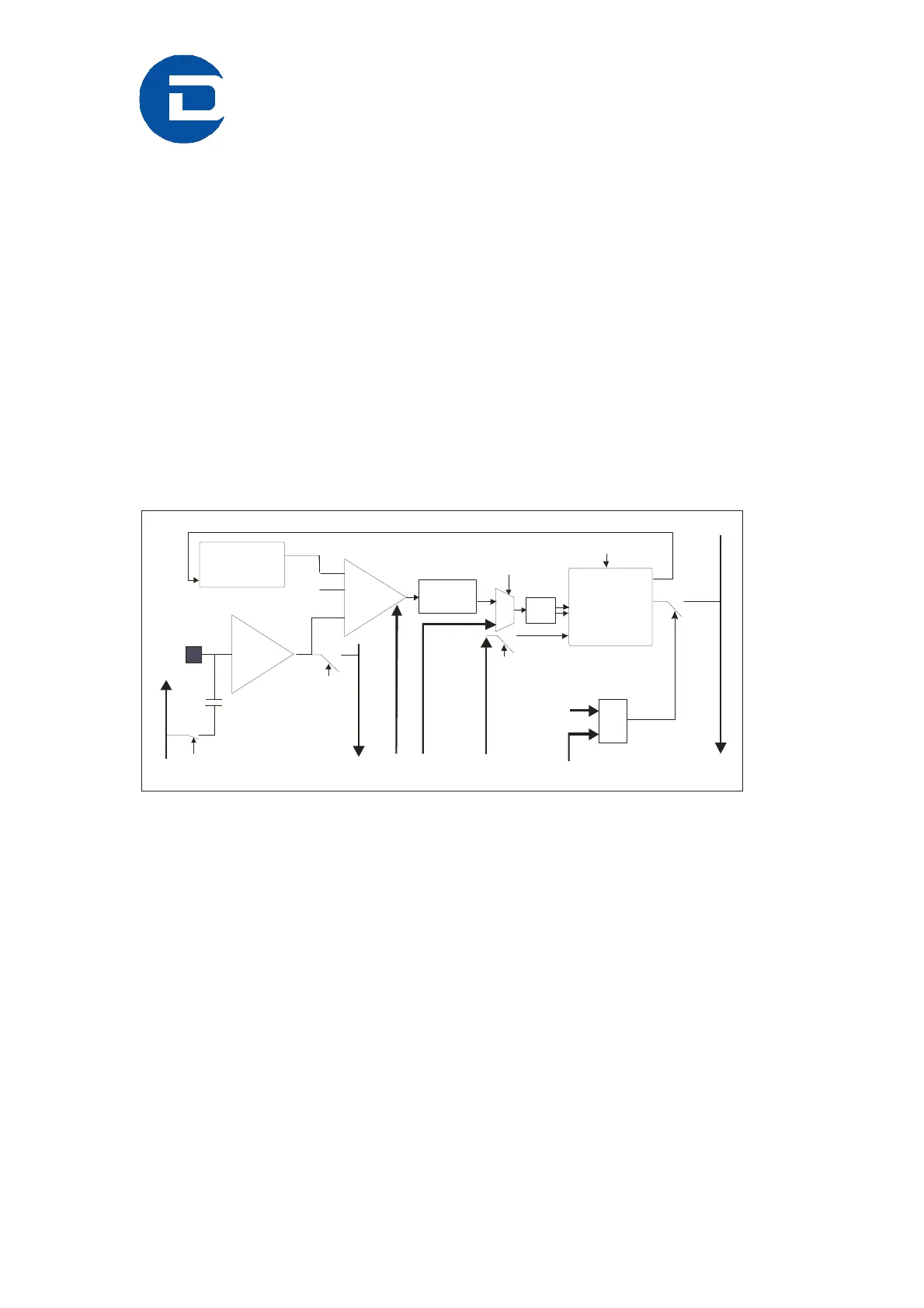
X-ray data collection can be improved with detectors operating in single
photon counting mode. A hybrid pixel which features single photon counting
comprises a preamplifier, which amplifies the charge generated in the sensor
by the incoming X-ray, and a discriminator, which produces a digital signal if
the incoming charge exceeds a pre-defined threshold. The discriminator feeds
a 20 bit counter, which then leads to completely digital storage and noiseless
readout of the number of detected X-rays in each pixel (Figure 4)
Global
Tresh
6 Bit Latch
+ DAC
CS
Amp
Comp
Bump
Pad
DOUTAOUT
Rowsel
Pixsel
Pixsel
Pixsel
Pixsel
Colsel
-
+
CAL
1.6fF
20 bit
Counter
Pixsel
Pixsel
&
PILATUS II Pixel Cell
DCLK
ENA
Pulse
Shaper
DIN
φ
1
-
Gen
φ
2
CNT/RO
Figure 4 Block diagramm of the CMOS chip
The fundamental unit of the DECTRIS detectors consists of a single fully
depleted monolithic silicon sensor with an 8 x 2 array of CMOS readout chips
bump-bonded to it. Each sensor is a continuous array of 487 x 197 = 94965
pixels without dead areas and covers an active area of 83.8 x 33.5 mm
2
. The
readout chips are wire-bonded to the mounting bracket with its readout control
electronics and forms the complete module (Figure 3).


 To Next Page