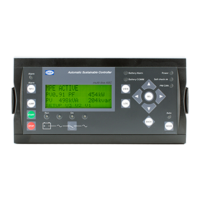
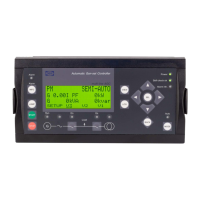
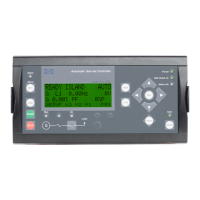
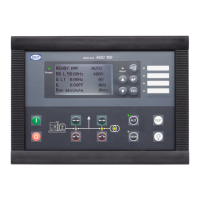
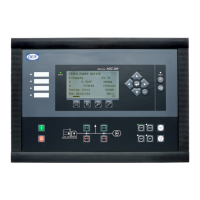
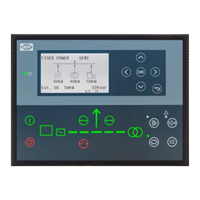
The DEIF Automatic Sustainable Controller (ASC) is a specialized unit designed for the efficient management and control of photovoltaic (PV) power plants, particularly in grid-connected or stand-alone applications. This commissioning guide outlines the necessary steps for setting up and verifying the ASC, ensuring its proper integration and operation within a power system.
Function Description
The ASC acts as a central control unit for PV installations, facilitating the integration of solar power with existing grid or generator systems. Its primary function is to manage the power flow from PV inverters, ensuring stable and reliable operation of the entire plant. Key functionalities include:
- Power Supply Management: The ASC requires a 24 V DC power supply. It continuously monitors the auxiliary supply voltage, with configurable low and high voltage thresholds (menus 4960, 4970, 4980, 4990) to ensure stable operation and trigger alarms if the supply falls outside acceptable limits.
- PV Breaker Control and Feedback: For systems incorporating a PV breaker, the ASC provides control signals for opening and closing the breaker (terminals 14 and 17, respectively). It also receives feedback on the breaker's open and closed positions (terminals 26 and 27), enabling it to detect and report failures in breaker operation (menus 2160, 2170, 2180). This ensures the safe isolation of the PV plant when necessary.
- Mains Breaker Position Monitoring: In systems where a mains breaker is present, the ASC monitors its open and closed positions through dedicated feedback inputs (terminals 24 and 25). While it doesn't directly control the mains breaker, this monitoring is crucial for the ASC to understand the grid connection status and manage the PV plant accordingly, especially in non-power management configurations (menu 2210).
- Power Management CAN Bus Communication: For more complex power management systems, the ASC utilizes a CAN bus (terminals A1 and A3) to communicate with other DEIF controllers or compatible devices. This allows for coordinated control and data exchange within a multi-source power plant, with configurable CANport selection (menu 7841) and actions in case of CAN failure (menu 7870). Proper termination of the CAN bus with 120 Ohm resistors is essential for reliable communication.
- Stand-Alone System Integration: In stand-alone applications, the ASC can monitor the status of multiple genset breakers (terminals 43-48) to determine the number of active generators. This information is used in conjunction with the nominal power ratings of each genset (menus 7481-7486) to optimize PV power contribution and ensure system stability. The system supports up to 16 gensets.
- Transducer Signal Processing: The ASC processes 4-20 mA analog signals from various transducers, including those for mains power (terminals 103, 104), genset summated power (terminals 106, 107), and genset summated reactive power (terminals 109, 110). These multi-inputs are configurable via the DEIF Utility Software, allowing for precise scaling and interpretation of power measurements (menus 4120, 4250, 4380).
- Modbus Master Communication: The ASC functions as a Modbus master to communicate with Sunspec-supported inverters or those with proprietary protocols (terminals 29 and 31). This enables the ASC to send control commands and receive operational data from the inverters. Key Modbus parameters, such as PV communication type (menu 7561), actions at communication error (menu 7570), external communication ID and baud rate (menu 7510), and transmit telegram type (menu 7564), are configurable.
- Voltage and Current Measurements: The ASC includes dedicated inputs for PV current (terminals 73-78) and voltage measurements (terminals 79-84 for PV, 85-89 for bus). These measurements are crucial for monitoring the PV plant's output and the overall bus conditions, with configurable nominal ratings and CT/PT ratios (menus 6003, 6004, 6041-6044, 6051-6053, 6061, 6063).
- Emergency Stop Functionality: An emergency stop feature (menu 3490) is implemented to quickly shut down the PV plant. When activated, it sends a 0 kW reference to the PV plant and opens the PV breaker, ensuring immediate cessation of power generation. The fail class for this alarm can be configured (menu 3495).
Usage Features
The ASC is designed for flexible deployment in various PV applications, offering features that simplify commissioning and operation:
- Scalable Power Representation: The ASC allows for two main scaling options for power presentation (menu 9030): 10-2500 V AC for lower power installations and 100-25000 V AC for higher power. This flexibility ensures appropriate display and control resolution based on the plant's capacity.
- Configurable Multi-Inputs: The 4-20 mA transducer inputs are highly configurable via the DEIF Utility Software. This allows users to precisely define the relationship between the analog input signal and the actual power values, including setting 4 mA and 20 mA values for import and export power.
- Modbus Communication Flexibility: The ASC supports both broadcast and unicast Modbus communication (menu 7562). Unicast is often preferred during initial setup for verifying communication with individual inverters, while broadcast can be used for controlling multiple inverters simultaneously. The transmit rate (menu 7563) and telegram type (menu 7564) are also adjustable.
- Application Configuration via PC Utility: The DEIF Utility Software provides a graphical interface for configuring the application, allowing users to define the plant's specifics, such as the presence of a grid, mains breaker, and PV breaker. This visual approach simplifies the setup process for both stand-alone and power management configurations.
- ADFweb Device Integration: For specific inverter types, such as SMA STP25000 TL, the ASC can integrate with ADFweb HD67510 devices. The commissioning guide provides detailed steps for configuring the ADFweb device, including setting up IP addresses, Modbus slave details, and routing tables, to ensure seamless communication with the inverters.
- Comprehensive Alarm Management: The ASC incorporates various alarms for critical events, including PV communication errors (menu 7570), PV warnings (menu 7580), PV shutdowns (menu 7590), and external communication errors (menu 7520). These alarms can be enabled and configured with appropriate actions to alert operators and initiate protective measures.
- Translation Capabilities: The DEIF Utility Software includes a translation page, allowing users to customize the display of multi-input values and menu numbers, enhancing user-friendliness in different linguistic contexts.
Maintenance Features
While the ASC is designed for robust operation, certain features and procedures contribute to its maintainability and long-term reliability:
- Diagnostic Tools: The DEIF Utility Software serves as a powerful diagnostic tool, allowing users to monitor real-time values from transducers and communication channels. This helps in identifying and troubleshooting issues during commissioning and ongoing operation.
- Transducer Signal Testing Procedure: The guide outlines a detailed testing procedure for transducer signals, involving opening and closing the mains breaker and observing the corresponding power readings in the display/utility software. This systematic approach helps verify the accuracy and functionality of the transducer inputs.
- Modbus Communication Verification: The commissioning process emphasizes verifying Modbus communication by testing with individual inverter IDs before switching to broadcast mode. This step helps isolate and resolve communication issues early in the setup phase.
- Firmware Update Capability: The ASC supports firmware updates via Ethernet (UDP) using the ADFweb utility. This allows for future enhancements, bug fixes, and compatibility improvements, ensuring the device remains up-to-date with evolving system requirements.
- Factory Settings as a Baseline: The unit is delivered with factory settings, which serve as a starting point for configuration. While these settings may not be optimal for every application, they provide a known good state from which to begin customization.
- Clear Documentation and Support: The commissioning guide itself is a crucial maintenance feature, providing detailed instructions, wiring diagrams, and menu references. This comprehensive documentation, along with DEIF's support, aids in troubleshooting and ensures proper operation throughout the device's lifespan.
- Security Measures: The requirement for a master password for certain menu selections (e.g., menu 9030) ensures that critical settings are protected from unauthorized changes, contributing to system integrity and preventing accidental misconfigurations.

 Need help?
 General

 To Next Page