60
Troubleshooting
Troubleshooting
WARNING: Before you begin any of the procedures in this section, follow the Safety instructions.
Self-test
Your monitor provides a self-test feature that allows you to check whether your monitor is functioning properly. If your monitor and
computer are properly connected but the monitor screen remains dark, run the monitor self-test by performing the following steps:
1. Turn off both your computer and the monitor.
2. Unplug the video cable from the computer.
3. To ensure proper self-test operation, remove all digital and the analog cables from your computer.
4. Turn on the monitor.
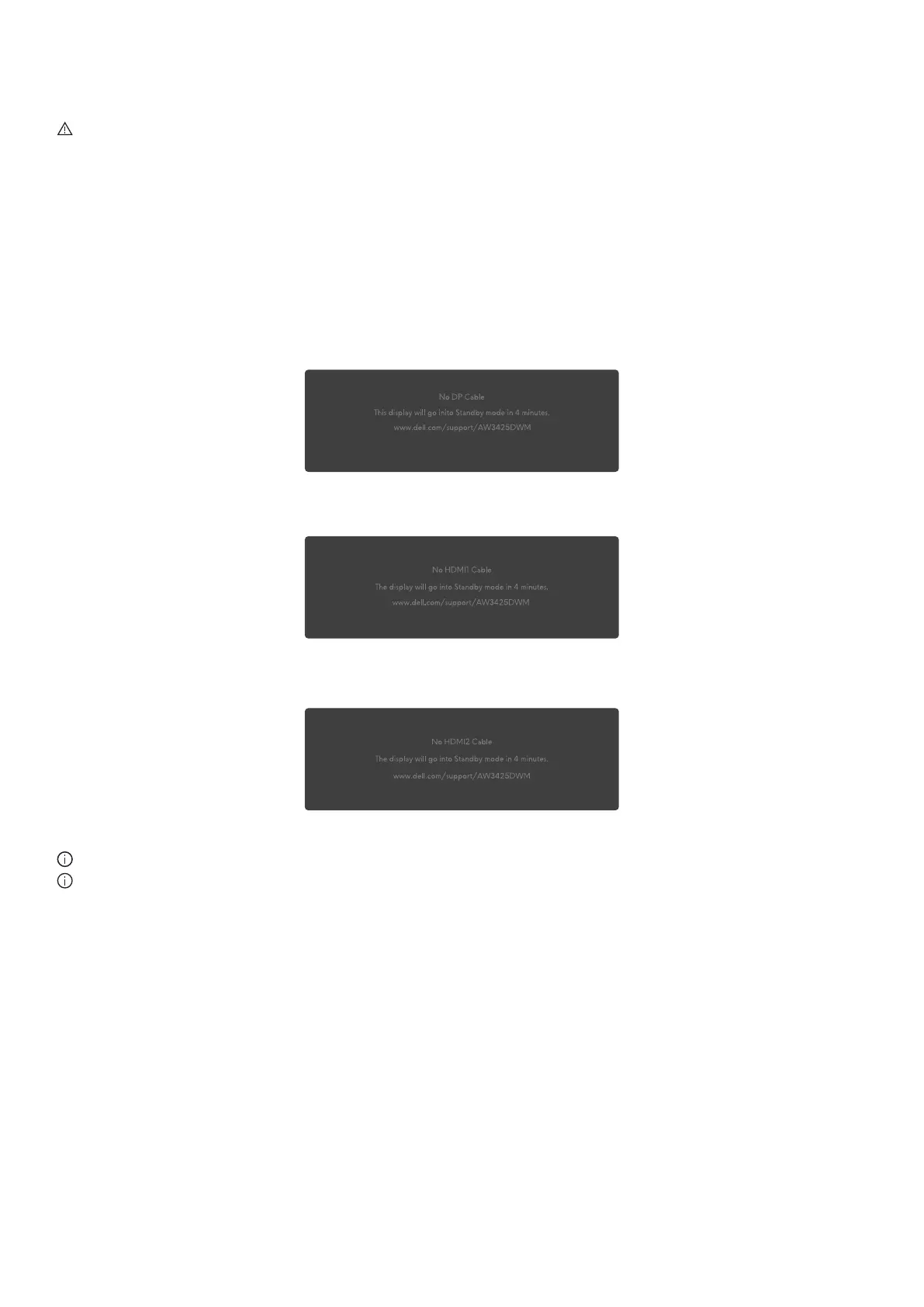
A dialog box should appear on-screen, indicating that the monitor is working correctly and is not receiving a video signal. While in
self-test mode, the power LED remains white (the default color).
Figure 44. Warning message for no DP cable
or
Figure 45. Warning message for no HDMI1 cable
or
Figure 46. Warning message for no HDMI2 cable
NOTE: The message may vary slightly depending on the connected input signal.
NOTE: This dialog box also appears during normal operation, if the video cable is disconnected or damaged.
5. Turn off your monitor and reconnect the video cable; then turn on your computer and the monitor.
After performing the above steps, if the monitor displays no video output, then the problem may be with the graphics card or the
computer.



 To Next Page