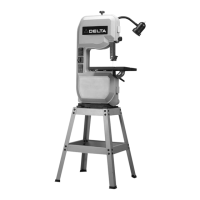
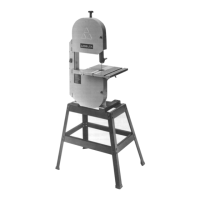
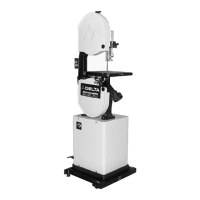
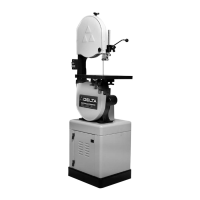
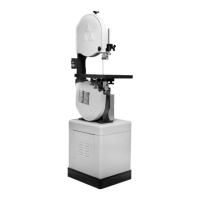
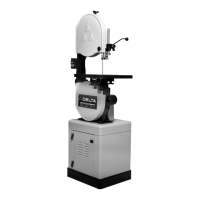
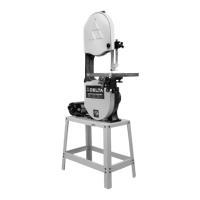
This document provides an instruction manual for the Delta 9" Bench Band Saw, Model 28-150. This bench band saw is designed for woodworking applications, allowing users to make various cuts in wood and wood products. It is a stationary power tool intended for use on a workbench or other supporting surface.
Function Description
The Delta 9" Bench Band Saw is primarily used for cutting curves, irregular shapes, and straight lines in wood and similar materials. It operates by means of a continuous band blade that rotates around two wheels, with the cutting action occurring on the downward-moving portion of the blade. The machine is equipped with a motor that drives the blade, and a table where the workpiece is supported during cutting. The blade guides and support bearings ensure the blade remains stable and properly aligned during operation, contributing to accurate cuts and blade longevity.
Usage Features
The band saw incorporates several features designed to enhance its usability and versatility:
- Table Tilt: The table can be tilted up to 45 degrees to the right, allowing for bevel cutting operations. This adjustment is controlled by a lock handle and a knob, with a scale and pointer indicating the degree of tilt. Positive stops are provided for both 90-degree and 45-degree angles to the blade, which can be adjusted for precise calibration.
- Blade Tension Adjustment: The machine accommodates different blade widths (1/8", 1/4", and 3/8") and requires proper blade tension for optimal performance and blade life. A tension knob is used to adjust the blade tension, with specific turn recommendations for each blade width. A convenient chart on the saw's rear displays blade choice and minimum cutting radius.
- Blade Tracking Adjustment: To ensure the blade rides true on the approximate center of the wheels, a blade tracking knob is provided. Slight adjustments to this knob move the blade to the rear or front, allowing for precise alignment.
- Upper Blade Guide Assembly: This assembly, which includes blade guides and a support bearing, is adjustable in height. It should be positioned no more than 1/4" above the workpiece to ensure stability and accuracy during cutting. A knob allows for loosening, rotation, and positioning of the guide assembly.
- Lower Blade Guides and Support Bearing: Similar to the upper assembly, the lower blade guides and support bearing are crucial for preventing blade twisting and supporting the blade during cutting. These components are adjustable to ensure they are close to the blade sides without pinching and that the support bearing is set approximately 1/32" behind the blade's rear edge, with the blade overlapping the bearing's outside diameter by about 1/8".
- Miter Gage: A miter gage is supplied with the band saw, allowing for cross-cutting operations. Its body can be adjusted up to 45 degrees right and left, facilitating angled cuts.
- Accessory Rip Fence (Optional): For straight cutting and resawing applications, an optional rip fence (Accessory 28-181) can be attached to the table. It can be moved along the table surface and locked into position, ensuring it is parallel to the miter gage slot for accurate cuts. The clamping action of the rip fence can be tightened or loosened as needed.
- Work Light: The band saw includes a flexible lamp that operates independently. It helps illuminate the work area, improving visibility during cutting. The lamp requires a 40-watt or less A-15 appliance light bulb.
- Dust Chute: A built-in dust chute with a 1-1/2" I.D. opening is provided for connecting to a dust collection system, helping to maintain a clean work environment and manage wood dust.
- Switch with Lock-Out Feature: The power switch is located on the front of the band saw. It includes a lock-out feature to prevent unauthorized use. By removing the switch toggle, the machine cannot be started.
- Hinged Door: The machine features a hinged door that provides access to the internal components for adjustments such as blade changes, tracking, and guide adjustments. Safety latches secure the door during operation.
Maintenance Features
Proper maintenance is essential for the safe and efficient operation of the band saw. The manual outlines several maintenance-related features and procedures:
- Blade Changing: The manual provides detailed instructions for changing the blade, including releasing tension, removing the blade guard, and re-tensioning. It emphasizes checking the new blade's teeth direction and carefully turning it inside out if necessary.
- Wrench Storage: Dedicated storage for the 3mm and 4mm adjustment wrenches is provided inside the wheel cover, ensuring they are conveniently accessible.
- Wheel Brushes: Two wheel brushes are installed on the machine to keep the tires free of wood chip build-up. These brushes are adjustable, allowing users to maintain their effectiveness.
- Belt Tension Adjustment: The drive belt, which connects the motor pulley to the saw pulley, requires proper tension for optimal performance. The manual describes how to check and adjust belt tension by loosening screws and rotating the motor.
- Cleaning: Users are advised to keep tools sharp and clean for best and safest performance. The manual also recommends cleaning the table and work area before leaving the machine.
- Lubrication: The manual instructs users to follow instructions for lubricating the machine, although specific lubrication points are not detailed in the provided excerpt.
- Checking Damaged Parts: Before each use, users should inspect the tool for any damaged guards or parts, ensuring they operate properly and perform their intended function. Any damaged parts should be repaired or replaced before resuming operation.
- Grounding Instructions: The tool is equipped with a 3-prong grounding plug and requires a properly grounded outlet to protect the operator from electric shock. The manual provides detailed grounding instructions, including the use of 3-wire extension cords and temporary adapters if a grounded outlet is unavailable (not applicable in Canada).
- Troubleshooting Guide: A comprehensive troubleshooting guide is included to help users diagnose and resolve common problems such as the saw not starting, frequent breaker trips, excessive vibration, blade issues (breaking, not tracking, unsatisfactory cuts), and table tilt scale inaccuracies. This guide provides probable causes and corresponding remedies.
- Blade Care: The manual emphasizes the importance of using sharp blades, keeping them free from gum and pitch, and cleaning them frequently. It also advises against forcing or twisting the blade, feeding stock too fast, and applying excessive tension.
- Identification Plate: An identification plate located at the rear of the machine near the motor contains the Model No. and Serial No., which are important for parts, service, warranty, or other assistance.

 Need help?
 General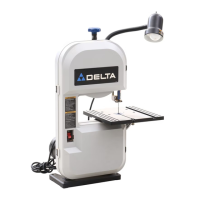

 To Next Page