Need help?
Do you have a question about the Delta 31-120 and is the answer not in the manual?
Details electrical circuit requirements, wire gauge, and fuse protection for safe operation.
Explains the critical importance of grounding the tool to prevent electric shock.
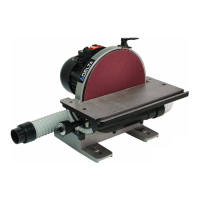
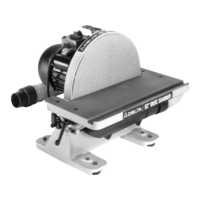
The Delta 12" Disc Sander with Integral Dust Collection (Model 31-120) is a robust woodworking machine designed for sanding and shaping various materials, primarily wood. This tool is engineered to provide efficient and precise sanding operations, making it suitable for both professional workshops and home shop environments. Its integral dust collection system is a key feature, aiming to maintain a cleaner work area and improve air quality by capturing sawdust generated during operation.
The primary function of the 12" Disc Sander is to smooth, shape, and finish workpieces using an abrasive disc. The machine is powered by a 1/2 H.P., 120V, single-phase motor, which drives the 12-inch abrasive disc at a no-load speed of 1725 RPM. This rotational speed is optimized for effective material removal and finishing. The sander features a work table, measuring 17-1/4" x 6-1/4", which provides a stable surface for supporting workpieces during sanding. This table is designed to tilt, offering versatility for various sanding angles.
A significant aspect of this sander's design is its integral dust collection system. Equipped with an efficient, integral fan, the machine actively draws sawdust away from the sanding area. While the system provides excellent dust collection on its own, the manual suggests connecting a dust collector of some kind to the machine for optimal performance. If a dedicated dust collector is not available, a supplied dust hose can be inserted into the dust port and directed into a garbage can, offering a basic but effective solution for containing debris. This feature is crucial for maintaining a clean and safe working environment, as well as for protecting the operator from inhaling fine dust particles.
The sander is also equipped with a manual disc brake. This brake allows the operator to quickly stop the rotation of the abrasive disc after the power switch has been turned off. This safety feature helps prevent accidental contact with a moving disc and reduces the waiting time for the disc to come to a complete stop naturally.
Operating the Delta 12" Disc Sander involves several user-friendly features and adjustments that enhance its versatility and precision. The machine's controls are straightforward, with the main switch located on top of the motor for easy access. To turn the sander "ON," the switch is moved towards the rear, and to turn it "OFF," it's moved to the front position. A safety locking mechanism is integrated into the switch, allowing it to be locked in the "OFF" position by pulling out the switch toggle. This prevents unauthorized use and accidental startups, enhancing overall workshop safety.
The work table is a central component for usage, offering significant adjustability. It can be tilted up to 45 degrees both up and down, enabling a wide range of angled sanding operations. This tilt mechanism is controlled by table lock handles, which, being spring-loaded, can be repositioned on their studs for convenience. A scale and pointer are provided to accurately indicate the degree of tilt, ensuring precise angle settings. For specific angles, such as 90 degrees and 45 degrees, positive stops are incorporated, which can be adjusted to ensure the table is perfectly square or at the desired angle relative to the abrasive disc.
Adjusting the miter gauge slot parallel with the abrasive disc is a critical setup step for accurate sanding. This adjustment ensures that workpieces guided by a miter gauge will be sanded consistently across their surface. The manual provides clear instructions for this, involving the use of a combination square and loosening/tightening screws that secure the table to the trunnions. Similarly, adjusting the table square with the abrasive disc and setting the 90-degree positive stop is essential for straight and accurate sanding. These adjustments involve using a square, loosening locknuts, and adjusting screws until the table is perfectly perpendicular to the disc.
For end sanding and angled sanding, the table includes a 3/8" x 3/4" slot designed to accommodate an accessory miter gauge. The use of a miter gauge is highly recommended for achieving accurate straight and angled end-sanding results, providing a guided and stable method for presenting the workpiece to the abrasive disc.
A crucial safety guideline emphasized in the manual is the importance of maintaining a maximum clearance of 1/16" between the table edge and the abrasive disc. This small gap is vital to prevent workpieces or fingers from becoming trapped between the table and the rotating disc, significantly reducing the risk of injury.
Regular maintenance is key to ensuring the longevity and safe operation of the Delta 12" Disc Sander. The manual outlines several maintenance procedures, with changing abrasive discs being one of the most common. The abrasive disc is designed for easy replacement: old discs can be peeled off, and new ones, after removing their backing, are slid between the table and the disc plate, then firmly pressed into position while manually rotating the disc plate. Before installing a new disc, it's important to ensure the disc plate is clean, dry, and free from oil or grease to ensure proper adhesion. A critical safety reminder is to always ensure the abrasive disc is securely in position before connecting the machine to a power source.
Beyond disc replacement, general maintenance includes keeping the work area clean and the tool in top condition. This involves regularly removing scrap pieces and other objects from the table and abrasive disc before operation. The manual also advises keeping tools sharp and clean for best and safest performance, although for a disc sander, this primarily refers to the abrasive disc itself.
The machine's construction and components are designed for durability, but the manual stresses the importance of checking for damaged parts. Before further use, any guard or other part that is damaged should be carefully inspected to ensure proper operation. This includes checking for alignment of moving parts, binding, breakage, and mounting issues. Any damaged part should be properly repaired or replaced to prevent further hazards.
The integral dust collection system, while efficient, also requires attention. Although not explicitly detailed as a maintenance task, ensuring the dust hose is clear and the fan mechanism is free from obstructions would be part of routine care to maintain optimal dust extraction performance.
Overall, the Delta 12" Disc Sander is presented as a reliable and versatile tool for woodworking, with a strong emphasis on user safety through its design features, operational guidelines, and maintenance recommendations.
 General
| Type | Oscillating Spindle Sander |
|---|---|
| Dust Collection | Yes |
| Dust Port | Yes |
| Spindle Stroke | 1 inch |
| Spindle Sizes | 1/2", 1-1/2", 2" |
| No Load Speed | 1720 RPM |

 To Next Page