Need help?
Do you have a question about the Delta 31-255x and is the answer not in the manual?
Obtain supervisor advice, clear the sanding area, and remove all tools and gauges.
Use a dust collector, sand wood only, and do not use short or thin pieces.
Dress properly, avoid contact before starting, sand with grain, disconnect power, and never leave unattended.
Inspect drum abrasive, connect dust collection, set table height, and start infeed conveyor.
Feed stock, raise table to rotate drum, remove stock, and adjust drum speed for finish.
Use 120 grit abrasive, 3300sfpm speed, and limited feed depth for fine finishing hardwoods.
Turn on infeed belt, place stock, listen to drum motor, adjust speed, and increase as work progresses.
Observe infeed belt tracking, suspend if off, and run narrow stock at an angle for even wear.
Periodically clean the drum belt and clean the machine at the end of the work session.
Choose from 36g, 80grit, 120 grit, 180 grit, or 220 grit based on sanding needs.
Disconnect power, open cover, release clips, remove old strip, cut and install new strip with tapered ends.
After running one workpiece, re-tension the drum abrasive belt.
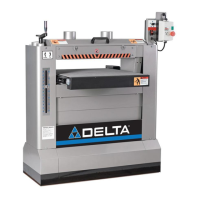
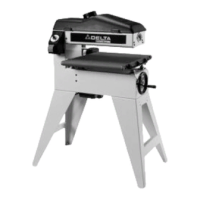
The Delta 31-255x is an 18" x 36" drum sander designed for precise sanding of wood and wood-like products. It features a two-speed drive system and can accommodate an optional outboard shaft for an accessory pneumatic drum, enabling contour sanding. This system allows for accurate sanding of material up to 18" wide in a single pass, or 36" wide in two passes.
Before operating, users unfamiliar with the equipment should seek advice from the supervisor. A dust collector must be attached to the machine during operation. The sander is exclusively for wood or wood-like products; sanding metal can cause fire, injury, or product damage. The feed belt tracking should be periodically checked to prevent run-off. Before starting, ensure the sanding area and infeed/outfeed tables are clear of all objects, tools, gauges, and wrenches. Do not sand material shorter than 7" long or thinner than 1/32" thick. All sanding workpieces extending past the infeed/outfeed conveyor must be supported at table height. Operators should dress appropriately, avoiding loose clothing, jewelry, or gloves, and containing long hair to prevent entanglement with moving parts. The workpiece must not contact the sanding belt before starting the machine. Always sand with the grain of the wood. Disconnect the machine from the power source before installing, removing, or adjusting drum belts, conveyor belts, or accessories. Wood dust can be irritating and cause respiratory problems, so a dust mask or filter system should be worn if sensitive to wood dust. Never leave the machine running unattended.
Before any work, inspect the drum abrasive for tears and damage, cleaning it with an abrasive cleaning stick if necessary. Users causing damage to the sandpaper may be charged $10 for a replacement strip (2"w x 13'-2½"). Connect the dust collection system to the 4" opening in the drum cover.
To set the table height:
Turn on the drum motor using the On-Off switch (up for on, down for off) located below the switch shield on the left side of the machine. The normal operating speed for the drum is 2210 surface feet per minute, suitable for general purpose sanding, stock removal, surfacing, and rough finishing.
For fine finishing on hardwoods, change the drum abrasive to 120 grit, increase the drum speed to 3300 sfpm, and limit feed depths to no more than 0.004" (1/16th of a turn of the wheel at a time). This process should be repeated for 150 and 220 grit abrasive.
Turn on the infeed belt conveyor by rotating the "Table Feed Knob" clockwise ¼ turn. Place stock onto the infeed table and guide it under the pressure rollers. Carefully listen to the drum motor sound; reduce the infeed conveyor speed by rotating the dial counter-clockwise 1/8th turn at the first indication of the drum slowing. As work progresses, the infeed conveyor speed can be increased slightly if there's no strain, but each thickness adjustment requires repeating the previous step.
Observe the infeed belt position on the slider bed after each pass to ensure straight tracking. If it moves left or right, suspend operations and consult the Supervisor on Duty, as failure to correct tracking will damage the conveyor belt (Cost: $40.00). For stock 9" or less in width, run it at an angle through the machine to ensure even wear across the drum belt. Periodically clean the drum belt with an abrasive cleaning stick. At the end of each session, clean the drum abrasive, conveyor belt, and blow dust from the two motors and drives.
Standard abrasive is 80g or 120g Alumina-Zirconia belting (blue), which reduces burning, especially on Maple, Cherry, or Mahogany, due to its self-cleaning, cooler running, and pitch tolerance.
To replace a damaged drum belt or change to a finer grit (review section 3.d.1 before changing grit):
This process requires removing the infeed/outfeed table and realigning the drum. Follow instructions in the manual or request assistance from the supervisor.

 To Next Page
 General