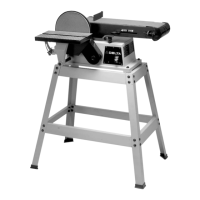
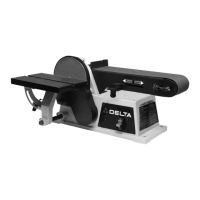
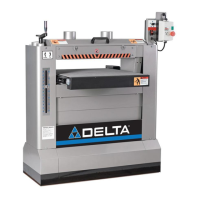
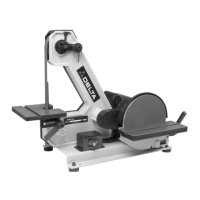
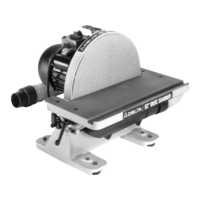
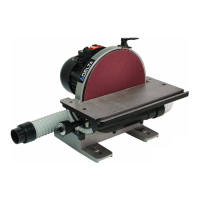
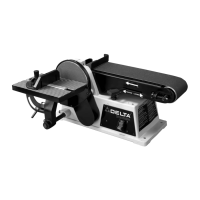
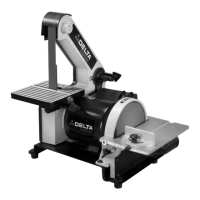
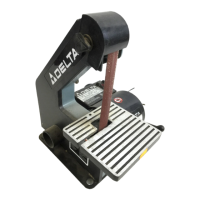
The document describes the Delta Model 31-300 Sanding Center, a 6" Belt/12" Disc Sander, which is an industrial/commercial duty 1-1/2 HP belt/disc sander.
Function Description:
The Delta Model 31-300 Sanding Center is designed for various sanding operations, including surfacing, edge sanding, and sanding inside and outside curves. It features both a sanding belt and a sanding disc to accommodate different workpiece shapes and sizes. The machine is powered by an induction-type, ball-bearing motor, providing long-lasting, smooth performance. The sanding belt operates at 3000 SFPM (Surface Feet Per Minute), and the disc revolves at 2100 RPM.
Important Technical Specifications:
- Model: 31-300
- Type: 6" Belt/12" Disc Sander
- Motor: 1-1/2 HP, induction-type, ball-bearing
- Electrical: Wired for 120 volts, 60 HZ alternating current (can be reconnected for 240 volts, single phase).
- Belt Speed: 3000 SFPM
- Disc Speed: 2100 RPM
- Grounding: Must be grounded while in use to protect the operator from electric shock.
- Overload Protection: Equipped with a reset overload relay button.
- Extension Cords: Requires 3-wire extension cords with 3-prong grounding type plugs and matching receptacles. Specific gauge recommendations are provided based on ampere rating and cord length for both 120V and 240V circuits.
Usage Features:
- Sanding Arm Positions: The sanding arm can be used in vertical, horizontal, or any intermediate angle. This flexibility allows for diverse sanding tasks.
- Belt Table Adjustment: The belt table can be adjusted to 90 degrees to the belt for precise sanding. It can also be tilted 45 degrees down for angled work. A trunnion key and stud mechanism, along with a lock handle and adjusting screw, facilitate these adjustments.
- Disc Table Adjustment: The disc table can also be adjusted to 90 degrees to the disc and tilted 45 degrees down. Similar to the belt table, a lock handle and adjusting screw are used for precise positioning.
- Miter Gauge Slots: Both the belt and disc tables feature miter gauge slots, which can be adjusted to be parallel to the sanding surface for accurate work.
- Power Take-Off Shaft: A power take-off shaft is located on the lower end of the sanding belt arm to accommodate accessories. It is crucial to cover this shaft when not in use to prevent entanglement hazards.
- On-Off Switch: Located on the sander base, the switch moves up for "ON" and down for "OFF."
- Locking Switch: The switch can be locked in the "OFF" position using a padlock with a 3/16" diameter shackle to prevent unauthorized use.
- Sanding Techniques:
- Surfacing/Edge Sanding (Belt): Place the sanding arm horizontally, use the table to keep the workpiece in place, and move the workpiece evenly across the belt. Maintain a maximum distance of 1/16" between the table and the belt to avoid trapping the workpiece or fingers.
- Inside Curves (Belt): Can be sanded on the top sanding drum by loosening knobs and removing the guard. The guard must be replaced after the operation.
- Outside Curves (Disc): Sand on the left side (downward rotation side) of the disc. Sanding on the right side (upward rotation side) can cause kickback. Maintain a maximum distance of 1/16" between the table and the disc.
- End Sanding (Disc): Use an accessory miter gauge and move the work from the center to the left side of the disc. Always sand on the left (downward rotation) side.
- End Sanding Wide Workpieces (Belt): Use the sanding arm in the vertical position. An accessory miter gauge can be used for more accurate work.
Maintenance Features:
- Cleaning: Periodically blow out air passages with dry compressed air. Plastic parts should be cleaned with a soft damp cloth; solvents should not be used.
- Cast Iron Protection: To protect cast iron tables from rust, apply household floor paste wax weekly. For more thorough protection, a procedure involving WD-40®, degreaser, and TopCote® Aerosol is recommended, along with a Scotch-Brite™ Blending Hand Pad and a pushblock.
- Belt Replacement: Involves loosening lock knobs, removing the top cover, loosening screws to hinge open the back panel, releasing belt tension, sliding off the old belt, and installing a new one in the direction of the arrow printed on the inside. Tension and tracking adjustments are then required.
- Disc Replacement: Refer to the "ATTACHING SANDING DISC" section in the manual.
- Belt Tension and Tracking Adjustment: The machine is shipped without belt tension. Before operation, the belt tension lever and tracking knob must be adjusted. Tension is determined by belt flatness and slippage during heavy work. Tracking is adjusted by hand-rotating the belt and turning the tracking knob, with slight adjustments possible while the motor is running. Set screws for tension and tracking may need tightening over time.
Safety Guidelines:
The manual emphasizes reading and understanding all warnings and operating instructions. Key safety precautions include:
- Wearing eye and hearing protection (ANSI Z87.1 and S3.19 compliant).
- Wearing proper apparel (no loose clothing, jewelry).
- Avoiding dangerous environments (damp/wet locations).
- Maintaining tools in peak condition.
- Checking for damaged parts.
- Keeping the work area clean and child/visitor-free.
- Reducing unintentional starting by ensuring the switch is "OFF" before plugging in and locking it when not in use.
- Using guards.
- Removing adjusting keys and wrenches before starting.
- Using the right machine for the job and recommended accessories.
- Using proper extension cords.
- Securing the workpiece.
- Feeding the workpiece against the direction of rotation to avoid kickback.
- Not forcing the workpiece.
- Not overreaching or standing on the machine.
- Never leaving the machine running unattended.
- Disconnecting power before adjustments or repairs.
- Staying alert and using common sense, avoiding operation while tired or under the influence.
- Using dust collection and appropriate respiratory protection (NIOSH/OSHA approved) due to potential exposure to hazardous dust (wood dust, crystalline silica, lead, arsenic, chromium).
For parts, service, warranty, or other assistance, users can visit www.deltamachinery.com or call 1-800-223-7278 (1-800-463-3582 in Canada). Postal mail inquiries can be sent to the Technical Service Manager at Delta Machinery, Jackson, TN, or Guelph, Ontario (Canada).

 Need help?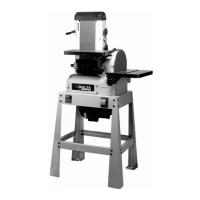

 To Next Page
 General