
 Need help?
Do you have a question about the Delta VFD-M Series and is the answer not in the manual?
Key safety warnings and cautions for installation, wiring, and operation.
Technical data for the 115V class of AC motor drives.
Technical data for the 230V class of AC motor drives.
Technical data for the 460V class of AC motor drives.
Details on control system, resolution, and operational characteristics.
Drive protection, display, environmental factors, and basic wiring diagram.
Explanation of the digital keypad's display panel and control buttons.
Step-by-step instructions for setting parameters and operating the drive.
Table of model names, current ratings, wire gauge, and torque specs.
Information on wire type and requirements for proper terminal connections.
Explanation of AC line input, motor output, and brake resistor terminals.
Diagrams and explanations for control wiring in NPN mode.
Details on the function and settings of multi-function input terminals.
Information on analog voltage, current, and output signals.
Parameters for setting frequency command and operation source.
Settings for stop method, output frequency, and acceleration/deceleration times.
Parameters for jog frequency, stall prevention, and overload settings.
Settings for DC braking, momentary power loss, and speed search.
Configuration options for multi-function input terminals.
Parameters for analog output signal type and gain adjustment.
Settings for multi-function output terminals and motor parameters.
Configuration for the electronic thermal overload relay.
Settings for over-torque detection, fault handling, and user-defined display.
Parameters for communication frequency and skip frequency settings.
Parameters for fault records and locking/configuring settings.
Settings for PLC operation modes and time duration for step speeds.
Parameters for speed step duration and communication protocol settings.
Settings for auto energy saving and adjustable acceleration/deceleration.
Parameters for Auto Voltage Regulation and auto motor tuning.
Settings for control modes, PID set points, and feedback selection.
Parameters for PID control gains, offsets, and input/output delays.
Settings related to sleep mode, frequency saving, and external control.
Settings for secondary frequency command and software braking levels.
Parameters for simple index functions and communication modes.
Details on OC, OU, OH fault codes and their corrective actions.
Information on LU, OL fault codes and troubleshooting steps.
Covers EEPROM, External Fault, Communication errors and remedies.
Details on OCa, OCd, OCN, CFA, GFF fault codes and troubleshooting.
Information on remaining hardware and communication fault codes.
Covers PID feedback faults and physical dimensions of the drive.
Table showing physical dimensions (W, H, D) for various drive models.
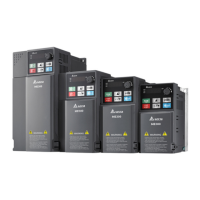
The DELTA VFD-M Series is a high-performance AC motor drive designed for controlling the variable speed of 3-phase induction motors. It is manufactured with high-quality components and materials, incorporating the latest microprocessor technology to ensure reliable and efficient operation.
The VFD-M Series utilizes SPWM (Sinusoidal Pulse Width Modulation) control, offering both V/F (Voltage/Frequency) and sensorless vector control modes. This allows for precise motor speed and torque control across a wide range of applications. The drive supports an output frequency range of 0.1 to 400 Hz, with a resolution of 0.1 Hz for both frequency setting and output frequency.
Key control features include auto-torque and auto-slip compensation, enabling a starting torque of 150% at 5.0 Hz. The drive is equipped with overload endurance, capable of sustaining 150% of rated current for one minute. It also features three skip frequency zones, with settings ranging from 0.1 to 400 Hz, to avoid resonant frequencies in the mechanical system. Acceleration and deceleration times are adjustable from 0.1 to 600 seconds, with four independent settings available.
Stall prevention is integrated, with a configurable level from 20% to 200% of the rated current. DC injection braking is available for quick stopping, with an operation frequency range of 0-60 Hz and an output range of 0-100% rated current. Start times for DC braking can be set from 0-5 seconds, and stop times from 0-25 seconds. The braking torque is approximately 20%, with potential for up to 125% with an optional brake resistor or externally mounted brake unit (1-15HP braking transistor built-in). An adjustable V/F pattern further enhances motor control flexibility.
The VFD-M Series offers various input and output options. Frequency setting can be done via a potentiometer (5KΩ/0.5W), 0 to +10VDC, 4 to 20mA, or an RS-485 interface. Multi-function inputs (0 to 5) support 7 steps, Jog, and up/down commands. Operation settings can be configured via the keypad or external signals. Multi-step selection (0 to 7), Jog, accel/decel inhibit, first to fourth accel/decel switches, counter, PLC operation, external Base Block (NC, NO), auxiliary motor control, driver reset, UP/DOWN key settings, and sink/source selection are all supported by the multi-function input signals.
For monitoring and indication, the drive provides multi-function output signals for AC drive operation, frequency attained, non-zero status, base block, fault indication, local/remote indication, PLC operation, auxiliary motor output, ready status, overheat alarm, and emergency stop. Analog output signals are available for frequency and current, and an alarm output contact (1 Form C or open collector) is included.
Additional operational functions include AVR (Automatic Voltage Regulation), S-Curve acceleration/deceleration, over-voltage and over-current stall prevention, fault records, adjustable carrier frequency, momentary power loss restart, auto tuning, frequency limits, parameter Lock/Reset, vector control, counter, PID Control, MODBUS communication, reverse inhibition, abnormal reset, abnormal re-start, digital frequency output, sleep/revival function, and 1st/2nd frequency source selections.
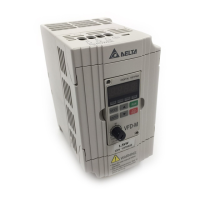
The digital keypad, LC-M02E, serves as the primary interface for programming and control. It features a display panel with a 6-key, 4-digit, 7-segment LED, and 4 status LEDs to show motor and drive parameters, as well as operation status (RUN, STOP, FWD, REV). The keypad allows users to set parameter numbers and change numerical data, such as frequency reference, using UP and DOWN keys. A potentiometer is available for master frequency setting. The ENTER key is used to confirm selected parameters or data changes, while the STOP/RESET key halts operation and resets parameters after a fault. The MODE key switches between normal and program modes, displaying AC drive status or allowing parameter selection.
The VFD-M Series is designed for ease of installation and maintenance. However, it is crucial to adhere to safety guidelines. AC input power must be disconnected before any wiring. After power-off, a hazardous voltage may still remain in the DC-link capacitors; a ten-minute wait is recommended for discharge to safe levels. Internal components or wiring should never be reassembled. Incorrect cable connections to input/output terminals can destroy the drive. The output terminals (U/T1, V/T2, W/T3) must never be connected directly to the AC mains power supply.
Proper grounding of the VFD-M using the ground terminal is essential and must comply with local laws. The VFD-M series is specifically designed for 3-phase induction motors and should not be used for 1-phase motors or other purposes, nor for life support or life safety situations.
Environmental conditions for installation are important: avoid high temperatures, direct sunlight, high humidity, excessive vibration, corrosive gases or liquids, or airborne dust/metallic particles. The drive should be used within its specified operating conditions to prevent fire, explosion, or electric shock. Children and unqualified personnel should be kept away from the equipment.
For long motor cables, a frequency inverter duty motor or an AC output reactor may be necessary to prevent damage to the motor's layer insulation. The rated voltage for the AC motor drive must be within specified limits (e.g., ≤240V for 230V models).
The VFD-M Series includes comprehensive protection functions such as self-testing, over voltage, over current, under voltage, overload, overheating, external fault, electronic thermal, and ground fault protection. These features contribute to the longevity and reliability of the device.
For maintenance, it is important not to perform Hi-pot tests on internal components, as the semiconductors are sensitive to high pressure. The printed circuit boards contain highly sensitive MOS components, which are susceptible to static electricity. Therefore, these components or circuit boards should not be touched with metal objects or bare hands. Only qualified personnel should install, wire, and maintain the AC motor drive.
The device's cooling method is fan-cooled, requiring regular checks to ensure ventilation holes are not obstructed and heatsinks are clean. The fan itself should be checked and cleaned periodically. Adequate spacing for ventilation must be provided during installation.
The drive's fault codes provide valuable diagnostic information for troubleshooting. For example, "Over current" (oC) may indicate incorrect motor horsepower, short circuits, or excessive loading, suggesting an increase in acceleration time or checking motor conditions. "Over voltage" (oU) could be due to input voltage outside the rated range, voltage transients, or motor regeneration, potentially requiring an increase in deceleration time or an optional brake resistor. "Overheating" (oH) points to high ambient temperature, obstructed ventilation, dirty heatsinks, or a faulty fan. "Low voltage" (Lu) suggests checking input voltage, sudden motor load, or incorrect wiring for 3-phase models. "Overload" (oL) indicates motor overload, requiring a reduction in torque compensation or a higher power drive model.
Other fault codes like "Internal EEPROM can not be programmed" (cF1) or "Internal EEPROM can not be read" (cF2) may require power cycling or resetting the drive to factory settings. "External Fault" (EF) indicates an external terminal is closed to GND, requiring a RESET command after the fault is cleared. "Auto accel/decel failure" (cFA) could be due to an unsuitable motor, excessive regenerative energy, or sudden load changes. "Ground fault" (GFF) suggests a short circuit at the output terminal, potentially damaging the power module. "Communication error" (cE1) points to loose connections or incorrect communication protocol. "External Base Block" (bb) indicates the external input terminal is active, requiring deactivation. "OC hardware error" (HPF) typically requires returning the device to the factory.
Regular monitoring of the total operation time (days and minutes) can help in scheduling preventive maintenance. The software version is also displayed for reference.
 General
| Braking Unit | Built-in |
|---|---|
| Control Mode | V/F control, Sensorless Vector Control |
| Protection Functions | Overcurrent, Overvoltage, Undervoltage, Overheating, Short Circuit |
| Operating Temperature | -10°C to +50°C |
| Overload Capacity | 150% for 60 seconds |


 To Next Page