D1000 Installation and Service Manual 31
Home LAB-110073 Rev. 3
MAINTENANCE
NOTE: Abrasive cleaning pads are not recommended as they may scratch or mar the surface.
INSPECTING THE DISCHARGE NOZZLES
All discharge nozzles have blow-off nozzle caps installed. Remove nozzle caps by carefully pulling them off.
Inspect the nozzle orifice and caps for grease build-up and/or if so rinse with hot water until build-up is no longer
present.
If clogging is suspected, remove the discharge nozzle with a 7/16” wrench
o Flush with hot water until the water flows freely through the discharge nozzle
o If this cannot be achieved, replace the nozzle since it can substantially compromise the fire
suppression.
Re-install the discharge nozzle and protective nozzle caps
NOTE: The nozzle caps should stay on the discharge nozzles at all times. In the event of a
discharge, the caps will blow-o
.
INSPECTING THE FUSIBLE LINKS
The fusible link system should be inspected monthly to ensure the unit is in proper working order in the case of a fire.
Place the hood in maintenance mode (see page 21).
Remove the extinguisher from the hood (see page 22).
Check fusible links for signs of wear and for date stamp
o When the fusible links need to be replaced, replacements may be ordered from your local distributor
Inspect the pulleys and actuation cable.
Pulleys should rotate freely and the actuation cable should be flexible.
Ensure there is no grease build-up present; if there is, carefully clean with a mixture of mild detergent and warm
water.
Reinstall the tank by reversing the steps to remove the tank.
Remove the hood from maintenance mode and return to normal operation mode.
CLEANING THE HOOD
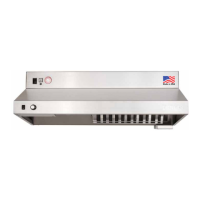
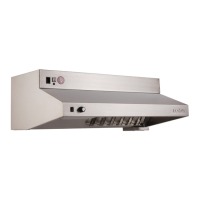
To remove cooking debris and grease build up, clean the unit thoroughly using a mixture of mild detergent and
warm water. Taking care not to splash water onto the electrical system, as this could damage the hood.
The grease entrapment filter, grease tray and front discharge grille (on recirculating hoods only), should be cleaned
by running through the dishwasher or washing them in the sink with mild detergent and warm water
The carbon filter cannot be washed and should be replaced periodically as needed. About every 2-3 months
depending on the amount of use.
WARNING: If grease build-up on the actuation cable is not kept to a minimum, the actuation
cable could become sti
and will not discharge the suppressant in the event of a fire.



 To Next Page