Operation Section
1
–
3
1.3 Types Of And Transitions In ECD (ELECTRONICALLY CONTROLLED
DIESEL) Systems
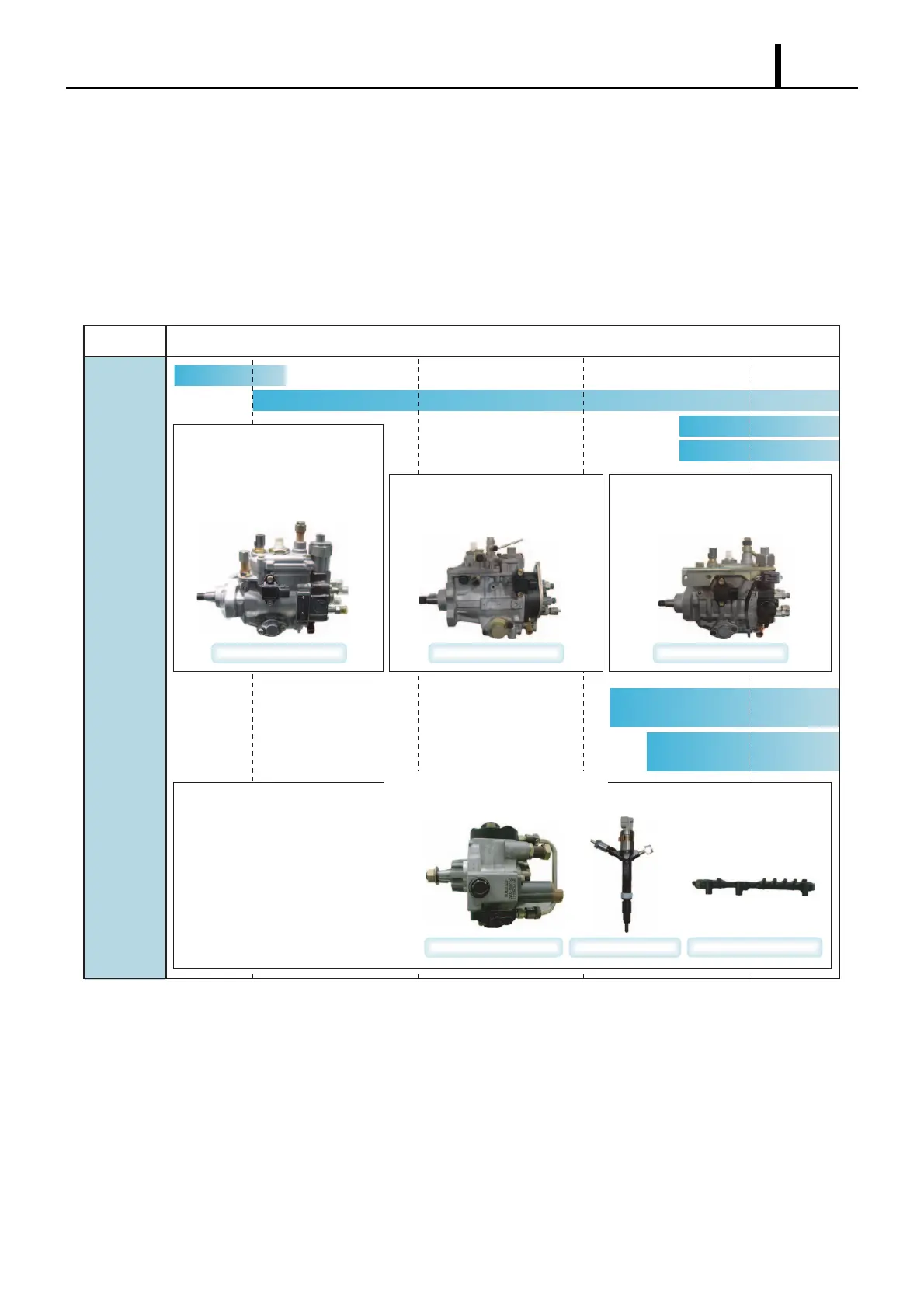
z ECD systems include the ECD-V series (V3, V4, and V5) which implements electronic control through distributed pumps
(VE type pumps), and common rail systems made up of a supply pump, rail, and injectors. Types are the ECD-V3 and
V5 for passenger cars and RVs, the ECD-V4 that can also support small trucks, common rail systems for trucks, and
common rail systems for passenger cars and RVs. In addition, there are 2nd-generation common rail systems that sup-
port both large vehicle and passenger car applications. The chart below shows the characteristics of these systems.
ECD-V1
ECD-V3
ECD-V4
ECD-V5
'85 '90 '95 '00
Large Vehicle Common Rail
(HP0)
(HP2)
Passenger Car Common Rail
Common Rail System
·
Maximum Injection Pressure 180 MPa
· Uses pilot injection to reduce the
engine combustion noise
· Fuel raised to high pressure by the
supply pump is temporarily
accumulated in the rail, then injected
after the injector is energized.
System
Types and
Transitions
· Maximum Injection Pressure 130 MPa
· Inner Cam Pumping Mechanism
·
Maximum Injection Pressure
100 MPa
·
Uses pilot injection to reduce the
engine combustion noise.
Supply Pump Injector Rail
· The world's first SPV (electromagnetic
spill valve system) is used for fuel
injection quantity control, so the
quantity injected by each cylinder can
be controlled.
·
Maximum Injection Pressure 60 MPa
Q000750E
ECD-V3 ECD-V4 ECD-V5


 To Next Page