Operation Section
1
–
89
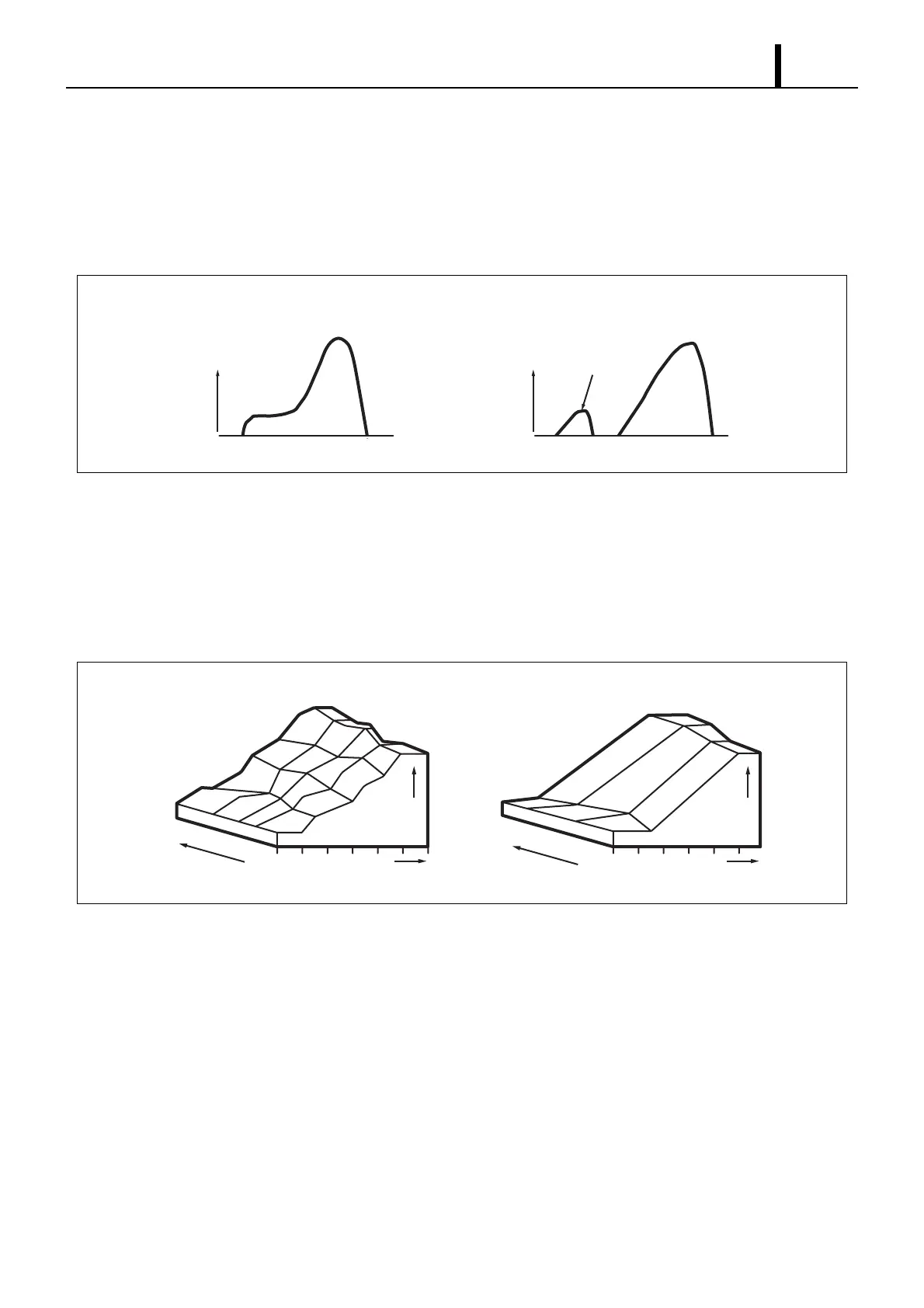
• As the injection pressure increases, the injection rate increases accordingly. The increase in injection rate leads to an
increase in the volume of the air-fuel mixture that is created between the start of injection until ignition (the ignition lag
period). Because this mixture is subsequently combusted at once, it creates noise (diesel knock) and NOx. For this
reason, it is necessary to appropriately control the injection rate by maintaining a low injection rate at the beginning
of injection and supplying a sufficient quantity after the ignition. To meet this need, two-spring nozzles have been
adopted and a pilot injection system has recently been developed.
(3) Higher Injection Timing Control Precision
• Reducing exhaust gas emissions and fuel consumption and optimizing the injection timing are important. It is ex-
tremely difficult to achieve the desired exhaust emission reduction levels through methods that adjust the injection
timing according to speed (or centrifugal force), such as the conventional mechanical timer. For this reason, electron-
ically controlled systems have been adopted to freely and precisely control the injection timing in accordance with the
engine characteristics.
(4) Higher Injection Quantity Control Precision
• Power output adjustment in a diesel engine is accomplished by regulating the fuel injection quantity. Poor injection
quantity control precision leads to increased exhaust gas emissions, noise, and poor fuel economy. For this reason,
electronically controlled systems have been developed to ensure high precision injection quantity control.
2-Spring Nozzle
Injection Rate
Common Rail System
Injection Rate Control
Injection Quantity
Injection Quantity
Pilot Injection
Q000922E
Electronic Control Type Mechanical Timer
Engine Speed Engine Speed
Injection Quantity
Injection Quantity
Advance
Angle
Advance
Angle
Q000923E


 To Next Page