7
Failure to follow this caution may result in furnace damage. Air for
combustion must not be contaminated by halogen compounds, which
include fluoride, chloride, bromide, and iodine. These elements can
corrode heat exchangers and shorten furnace life. Air contaminants are
found in aerosol spray, detergents, bleaches, cleaning solvents, salts,
air fresheners, and other household products.
CARBON MONOXIDE POISONING HAZARD
Failure to follow this warning could result in personal injury or death.
The operation of exhaust fans, kitchen ventilation fans, clothes dryers,
attic exhaust fans or fireplaces could create a NEGATIVE PRESSURE
CONDITION at the furnace. Make-up air MUST be provided for the
ventilation devices, in addition to that required by the furnace.
CARBON MONOXIDE POISONING HAZARD
Failure to follow the steps outlined below for each appliance connected
to the venting system being placed into operation could result in carbon
monoxide poisoning or death. The following steps shall be followed for
each appliance connected to the venting system being placed into
operation, while all other appliances connected to the venting system
are not in operation:
1. Seal any unused openings in venting system;
2. Inspect the venting system for proper size and horizontal
pitch, as required in the National Fuel Gas Code, NFPA
54/ANSI Z223.1-2009 and these instructions. In Canada, refer
to CAN/CSA-B149.1-2010. Determine that there is no
blockage or restriction, leakage, corrosion and other
deficiencies, which could cause an unsafe condition
3. As far as practical, close all building doors and windows and
all doors between the space in which the appliance(s)
connected to the venting system are located and other spaces
of the building.
4. Close fireplace dampers.
5. Turn on clothes dryers and any appliance not connected to
the venting system. Turn on any exhaust fans, such as range
hoods and bathroom exhausts, so they are operating at
maximum speed. Do not operate a summer exhaust fan.
6. Follow the lighting instructions. Place the appliance being
inspected into operation. Adjust the thermostat so appliance
is operating continuously.
7. Test for spillage from draft hood equipped appliances at the
draft hood relief opening after 5 minutes of main burner
operation. Use the flame of a match or candle.
8. If improper venting is observed during any of the above tests,
the venting system must be corrected in accordance with the
National Fuel Gas Code, NFPA 54/ANSI Z223.1-2009. In
Canada, refer to CAN/ CSA-B149.1-2010.
9. After it has been determined that each appliance connected
to the venting system properly vents when tested as outlined
above, return doors, windows, exhaust fans, fireplace
dampers and any other gas-fired burning appliance to their
previous conditions of use.
CARBON MONOXIDE POISONING HAZARD
For all venting configurations for this appliance and other gas
appliances placed into operation for the structure, provisions for
adequate combustion, ventilation, and dilution air must be provided in
accordance with:
U.S.A. Installations: Section 9.3 NFPA 54/ANSI Z223.1 1−2009, Air for
Combustion and Ventilation and applicable provisions of the local
building codes.
Canadian Installations: Part 8 of CAN/CSA−B149.1−10. Venting
Systems and Air Supply for Appliances and all authorities having
jurisdiction.
CARBON MONOXIDE POISONING HAZARD
Failure to follow this warning could result in personal injury or death. To
route the vent pipe and combustion air pipe through the furnace, the
manufacturer supplied kit must be used. See Canadian Installations:
Part 8 of CAN/CSA−B149.1−10. Venting Systems and Air Supply for
Appliances and all authorities having jurisdiction.
Failure to properly seal the blower compartment from the furnace
vestibule could result in the circulation of carbon monoxide throughout
the structure. Seals supplied in this kit must be installed per the
instructions provided. Follow all procedures outlined in these
instructions.
2- INTRODUCTION
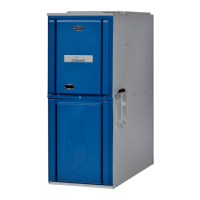
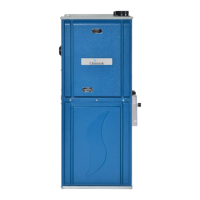
This 4-way multi-positioning Category IV condensing furnace is CSA
design certified as a direct vent (2 pipes) or non-direct vent (1 pipe). The
furnace is factory shipped for use with natural gas. The furnace can be
converted in the field for use with propane gas when a factory supplied
conversion kit is used. Refer to the furnace rating plate for conversion kit
information.
This Category IV furnace is approved for installation in
Manufactured/Mobile housing. The furnace must be installed in
accordance with the instruction provided in this manual. Follow all
national and local codes and standards in addition to these
instructions. The installation must comply with regulations of the serving
gas supplier, local building, heating, plumbing, and other codes.
This furnace is designed for minimum continuous return air temperature of
60 °F (16 °C) or intermittent operation down to 55 °F (13 °C) such as when
used with a night setback thermostat. Return air temperature must not
exceed 80 °F (27 °C). Failure to follow these return air temperature limits
may affect reliability of heat exchangers, motors, and controls (Figure 1
Freeze protection and return air temp.).
The furnace should be sized to provide 100 % of the design heating load
requirement plus any margin that occurs because of furnace model size
capacity increments. Heating load estimates can be made using approved
methods available from Air Conditioning Contractors of America (Manual
J); American Society of Heating, Refrigerating, and Air Conditioning
Engineers; or other approved engineering methods. Excessive over sizing
of the furnace could cause the furnace and/or vent to fail prematurely.





 To Next Page