9
LT-2023
TROUBLESHOOTING
SYSTEM OPERATION
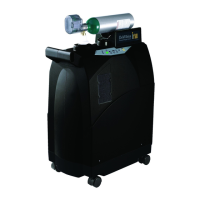
The DeVilbiss Oxygen Concentrator uses a pressure swing adsorption system.
The air is drawn into the unit through air lters and into a double-head
compressor.
A pneumatic diagram of the system is shown on Page 36.
The compressed air passes through a rotary valve, which is cycled at a pre-
determined rate, and is directed into one of two sieve beds. The sieve beds
contain molecular sieve material which is a synthetically-produced inorganic
silicate. It is very porous and has the unique ability to selectively adsorb nitrogen
from the air as it passes through the sieve bed.
As one bed is being pressurized, the other bed is quickly depressurized. This
allows the nitrogen that was adsorbed during its pressurization cycle to be
exhausted from the sieve material.
The nitrogen is released through exhaust ports located on the rotary valve
assembly. The ports are connected to a single piece of hose running from the
valve to the exhaust mufer.
Also during each bed pressurization, a small amount of oxygen ows through an
orice from the pressurized bed into the depressurizing bed. This helps purge the
nitrogen from the depressurizing bed.
The beds will continue to be alternately pressurized and depressurized as the
unit operates.
Oxygen leaving the sieve beds is directed through a check valve to the
accumulator tank. A pressure regulator on the tank controls the oxygen pressure
as it leaves the accumulator and enters the ow meter. The ow meter allows the
oxygen ow to be controlled and adjusted to the level prescribed by the patient’s
physician. From the ow meter the oxygen passes through the nal bacteria lter
and nally the oxygen outlet port to the patient.
The DeVilbiss Oxygen Concentrator operates on a timed cycle (3.6 sec. @
5LPM) that is controlled by the PC board. The PC board will send voltage to the
valve causing it to shift and alternately pressurize the sieve beds.
The PC board also activates the electronic alert system. Low ow, system
abnormality, and power failure are indicated by audible and visible alerts. A high
pressure condition will be indicated with a “popping” type sound produced by
release of pressure from a pressure relief valve on the compressor head.
The 525 operating system incorporates “turn-down” technology. The PC board
constantly monitors the ow rate and will decrease the cycle time whenever the
ow rate is less than 1.2 LPM. Therefore it “turns-down” the cycle based on lower
oxygen demand. As a result, the unit runs cooler and less power is consumed.
NORMAL OPERATING SEQUENCE
When the concentrator is turned “On,” the following cycling sequence can be
observed by attaching a pressure gauge to the manifold or accumulator tank test
point.
1. The rotary valve is quickly cycled several times to relieve residual bed
pressure preventing a static condition in the compressor. This rapid cycling
only happens on start-up and is clearly heard as pressure is being quickly
exhausted several times. The pressure exhausts through an exhaust
mufer that is connected to the valve.
2. The PC board applies a short DC voltage signal to the valve. The valve will
stop for several seconds causing the right bed to pressurize rst while the
left bed depressurizes.
3. Voltage is again applied to the valve for a short time. The valve will stop for
approximately a second. During this time the sieve bed pressures are
equalized.
4. A short DC voltage signal is again applied to the valve. The valve will stop
for several seconds causing the left bed to pressurize while the right bed
depressurizes.
5. A short DC voltage signal is again applied to the valve. The valve will stop
for approximately a second. During this time, the sieve bed pressures are
equalized.
6. The cycle then repeats with step 2.
NOTE–In the “turn-down” mode, the xed cycle time is decreased to less than 2
seconds.



 To Next Page