Before Using Your Battery Charger
It is important to understand your charger's requirements. This section will tell you about your charger's electrical
requirements and how to prepare a battery for charging.
Plugging it in
Your charger should be grounded to reduce the
risk of electrical shock.
Your charger is equipped with an electrical cordthat
has an equipment grounding conductor and a ground-
ing plug designed to be used on a 120 volt circuit. The
plug must be plugged into an outlet that has been
propedy installed and grounded in accordance with all
local codes and ordinances.
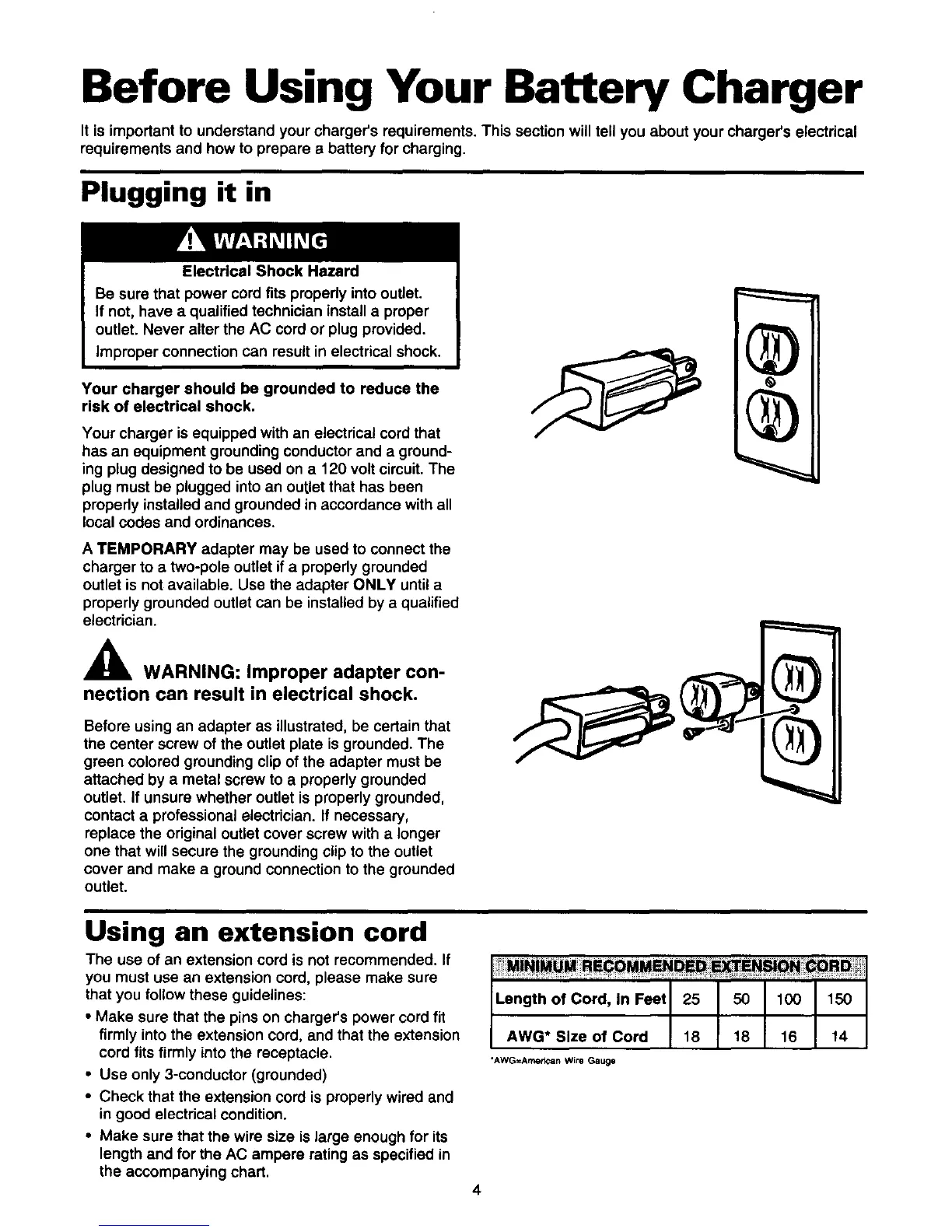
A TEMPORARY adapter may be used to connect the
charger to a two-pole outlet if a properly grounded
outlet is not available. Use the adapter ONLY until a
properly grounded outlet can be installed by a qualified
electrician.
A WARNING: Improper adapter con-
nection can result in electrical shock.
Before using an adapter as illustrated, be certain that
the center screw of the outlet plate is grounded. The
green colored grounding clip of the adapter must be
attached by a metal screw to a properly grounded
outlet. If unsure whether outlet is properly grounded,
contact a professional electrician. If necessary,
replace the original outlet cover screw with a longer
one that will secure the grounding clip to the outlet
cover and make a ground connection to the grounded
outlet.
Using an extension cord
The use of an extension cord is not recommended. If
you must use an extension cord, please make sure
that you follow these guidelines:
• Make sure that the pins on charger's power cord fit
firmly intothe extension cord, and that the extension
cord fitsfirmly into the receptacle.
• Use only 3-conductor (grounded)
• Check that the extension cord is properly wired and
in good electrical condition.
• Make sure that the wire size is large enough for its
length and for the AC ampere rating as specified in
the accompanying chart.
Length of Cord, In Feet 25 50 100 150
AWG* Size of Cord 18 18 16 14
'AWG=Amedcan Wire Gauge





 To Next Page