✗
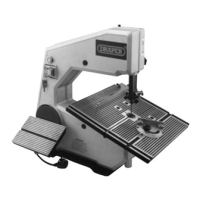
TIPS ON USING YOUR BANDSAW
For all cutting operations the upper blade guard should be adjusted to just clear the work being
cut (3mm). Not only does this provide the best operator safety, but it also brings the blade
guides closer to the work giving more accurate results and easier control.
Use both hands to feed the workpiece to the blade. The work must be held flat on the table at
all times to prevent binding of the blade. Use a steady even pressure just sufficient to keep the
blade cutting.
Always use a rip fence or mitre guide where possible to eliminate any sideways slip of the work.
This is most important when the table is tilted to an angle.
Always plan work ahead. The tradesman’s rule is “measure twice, cut once”. It is best to finish a
cut in one continuous operation, but frequently backtracking will be necessary. Turn off the
motor and allow the blade to come to a complete stop before backing the blade out of the cut.
Remember that the blade removes material during the cut. This gap created by the blade is
called the kerf and must be allowed for when cutting to exact sizes. Plan your cut so that the kerf
is to the scrap side of the line you wish to cut. If necessary, allow a little more for finish sanding.
RIP SAWING
This term refers to the cutting of timber with the grain rather than at a right angle to the grain.
You can rip wood freehand to a previously drawn line, but best results are obtained by using the
rip fence. If the table is set at a level angle set the rip fence to the left hand side of the blade.
This allows you to use your right hand to hold the work firmly against the fence. The width of
cut indicator on right hand side of the blade if the width of the workpiece allows it.
With the fence on the downhill side of the table it will help support the work against slipping.
The width cut indicator shows the distance between the blade and the rip fence.
CROSS CUTTING
This term refers to cutting of timber at right angles to the grain. This type of cut can also be
made freehand but the mitre guide is used to ensure accurate results. The mitre guide can be
adjusted to a 45˚ angle to produce mitre cuts, or with the table tilted as well, compound mitre
cuts.
Make sure the work is held firmly against the table and against the face of the mitre guide. Be
careful to keep your fingers away from the blade, particularly at the end of the cut.
FREEHAND SAWING
The ease with which many different and varied shapes can be cut is one of the most important
features of the bandsaw. Select a blade suitable for cutting the smallest radius in the work you
have planned.
When freehand cutting always feed the work slowly so that the blade can follow the line you
wish to saw. Make sure not to drag the work off line forcing the blade sideways, or twisting it.
In many cases, it is helpful to rough cut about 6mm away from the line in difficult curves and
corners. In the case of very sharp curves which may be too tight for the blade, make relief cuts
onto the face of the curve so that these scraps will fall as the final radius is sawn.
- 19 -



 To Next Page