Appendix: Acoustics
Dynaudio Professional AIR reference manual – 2014-09-28 109
Absorbers
All materials in a room act acoustically – even if they
are not so-called “acoustical materials”. Basically, there
are three kinds of absorbers:
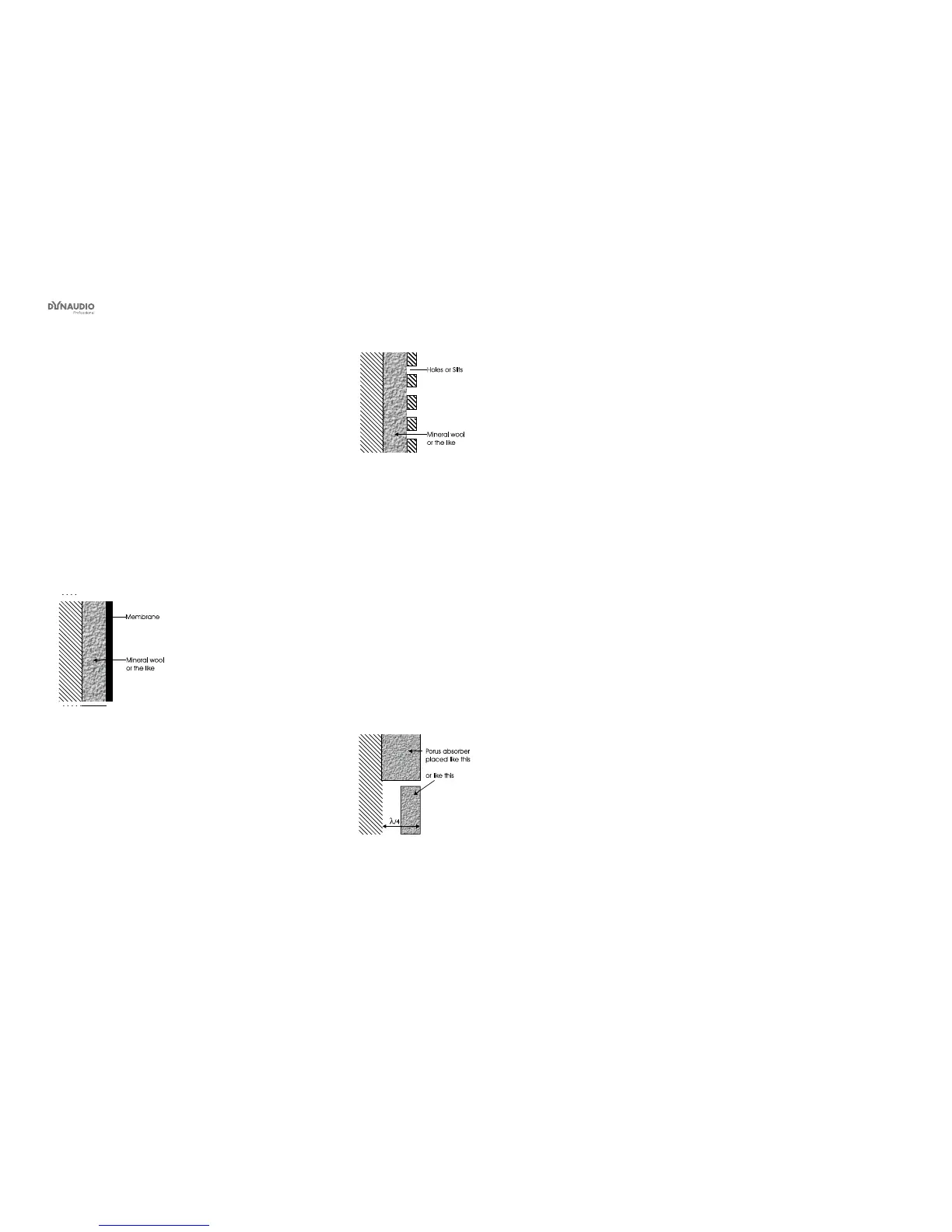
Membrane absorbers
This class of absorber includes wooden oors, win-
dows, doors, etc. These absorbers provide absorption
in the low end of the frequency range. Under normal
conditions, large areas of a basic room belong to this
class. While their efciency is normally not very high,
specially designed membrane absorbers can be very
effective.
Fig. 61: Membrane absorbers
Resonance absorbers
Resonance absorbers include slit panels, perforated
plates, Helmholtz resonators etc. These absorbers are
normally used for midrange frequencies. The absorp-
tion is medium to high.
Fig. 62: Resonance absorbers
Porous absorbers
These absorbers include mineral wool, carpets, cur-
tains, and so on. They can be very effective, but the
thickness of the material has to be taken into account.
Thin layers will only absorb the highest frequencies.
Think of a rehearsal room in a concrete basement
where the only damping is a carpet on the oor – this
will do very little for low frequencies!
To absorb a given frequency (and all frequencies
above), the thickness of the absorber must be the quar-
ter of the wavelength of that frequency. Put differently:
The front of the material must be placed at a distance
of one quarter of the wavelength.
Fig. 63: Porous absorbers



 To Next Page