Need help?
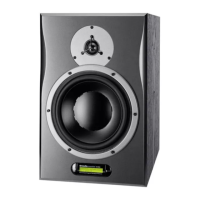
Do you have a question about the Dynaudio AIR 20 and is the answer not in the manual?
Essential guidelines for safe operation and maintenance of the apparatus.
Ensures proper electrical connections and safe installation practices are followed.
Details compliance with FCC and Canadian standards for electromagnetic compatibility.
Provides care instructions for optimal performance and explains the break-in period.
Explains test tones and provides contact information for Dynaudio Professional Support.
Guides users on how to effectively use the manual for setup and operation.
Introduces the AIR monitor system and its key advantages.
Explains the network architecture involving master and slave units.
Describes remote control options and common features of monitors.
Explains standby, power save modes, and proper system shutdown.
Covers high-efficiency power supplies and their benefits.
Details controls and connections on the rear of the AIR Master unit.
Outlines the controls and connections on the rear of Slave and Subwoofer units.
Explains the function of the optional digital I/O card for 5.1 setups.
Guides on using the display and arrow keys for menu navigation and operation.
Provides an overview of the monitor's menu system and available parameters.
Explains the home screen display and volume adjustment using arrow keys.
Details how to configure bass management modes and crossover frequencies.
Guides on selecting system setup and assigning monitor tasks.
Covers external clock, analog sensitivity, and monitor calibration settings.
Explains how to reset the entire AIR system setup to default values.
Illustrates connection diagrams for various stereo configurations with and without subwoofers.
Shows connection diagrams for 5.1, 5.3, 6.1, and 7.1 channel surround sound systems.
Details digital setups using optional cards and chained monitor configurations.
Guides on loading and saving system configurations as presets.
Details which global and local parameters are stored with presets.
Provides general guidelines and notes for optimal monitor placement.
Emphasizes symmetrical layout and offers specific positioning advice.
Describes various room position settings for acoustic compensation.
Steps for checking placement, assigning positions, and performing phase checks.
Guides on evaluating placement by ear, using sweeps, and basic EQ.
Covers calibration of main monitors and subwoofers for accurate sound.
Introduces the AIR Remote and its key features for system control.
Explains control of reference levels and preset recall using the remote.
Details mute, unmute, solo functions, and master volume control.
Overviews the software, its features, and system requirements for installation.
Guides on downloading, installing, and connecting the AIR Control software.
Explains managing parameters, editing, and software version checks.
Covers system-wide settings, presets, and file operations.
Details bass management settings and grouping EQs for synchronized adjustments.
Describes locking features for security and configuring global preferences.
Guides on selecting monitors and configuring individual setup parameters.
Details configuring EQ, managing firmware, and accessing monitor logs.
Provides technical details for TC LINK and AES/EBU cables.
Describes balanced audio, serial to CAT 5, and USB to COM adapters.
Lists factory and user presets with their detailed level and parameter settings.
Details procedures for resetting monitor settings and the entire network.
Explains common error messages displayed by AIR monitors and their meanings.
Outlines warranty periods, conditions, and exclusions for Dynaudio products.
Provides detailed technical specifications for AIR 6 and AIR 15 models.
Lists detailed technical specifications for AIR 20 and AIR 25 models.
Details technical specifications for AIR BASE 1 and AIR BASE 2 subwoofers.
Presents technical specifications for AIR Base 12 and AIR Base 24 subwoofers.
Guides on room sizes, listening distances, and system delay times.
Summarizes key specifications across the entire AIR product range and accessories.
Declares conformity with safety and emission standards for AIR products.
Introduces room acoustics, key parameters, and reverberation time.
Explains Sabine's formula, absorber types, and diffusion.
Details standing waves, room modes, and comb filtering effects.
Explains subwoofer function, bass management, and LFE channel.
Discusses monitor delaying techniques and acoustic calibration principles.
Guides on using sound level meters or microphones for acoustic measurements.
Provides links to support, warranty, product info, social media, and newsletters.
 General
| Brand | Dynaudio |
|---|---|
| Model | AIR 20 |
| Category | Speaker System |
| Language | English |

 To Next Page