Recommended Maintenance
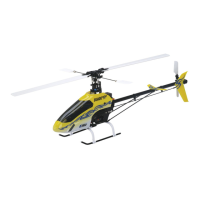
Routine maintenance is necessary to keep your Blade 400 3D in optimal and safe flying condition.
Some of the most important things to check routinely include:
• Ball Links
Before each flying session, check to see that the plastic ball link ends are secure, but not tight
(binding), on the linkage/control balls. The plastic ball links can wear over time, and if they become
too loose on the control balls, they can separate from the ball in flight and cause a crash. Be sure to
replace any worn ball links before they fail.
Also, any ball links that are tight (binding) on the linkage/control balls can be loosened by carefully
squeezing the sides of the link with a pair of pliers. However, exercise extreme care when “sizing”
the ball links as it is possible to loosen them too much for safe use.
• Bearings
The one-way bearing in the main drive gear should be cleaned using isopropyl alcohol or electric
motor spray, then lubed with lightweight oil, approximately every 80 to 100 flights. All other
bearings typically exhibit very long life and normally only need to be replaced if they ever become
notchy (sticky in places when turning) or draggy.
• Oiling
It’s important to apply a small amount of lightweight oil (like TRI4026) to any areas where a bushing
may ride on a shaft, especially after replacing any of the parts with new ones after a crash. Some
areas to oil include where the washout base bushing and swashplate control ball ride on the main
shaft, and where the tail rotor control pitch slider bushing rides on the tail rotor shaft.
• O-Ring Head Dampeners
The O-ring dampeners in the head block will periodically wear and lose their elasticity. Worn
O-rings can cause main rotor blade tracking problems as well as stability and control response
issues. If you begin having trouble with the blades going in and out of track during flight, or if the
helicopter feels loose and “mushy” during flight, it is likely time to replace the O-ring dampeners.
The O-ring dampeners can wear out in approximately 30 to 60 flights depending on how the model
is flown.
Also, when replacing the O-ring dampeners, it’s important to lubricate them with a silicon-based
grease to prevent friction.
• Tail Rotor Drive Belt
It’s typical for the tail drive belt to stretch slightly over the first few flights. When new, frequently
check and adjust the belt tension as required. After approximately 20 to 40 flights, the belt elasticity
will stabilize, requiring little to no additional tension adjustment.
GENERAL
1. A model aircraft shall be defined as a non-human-carrying device capable of sustained flight in the atmosphere. It shall not exceed
limitations established in this code and is intended to be used exclusively for recreational or competition activity.
2. The maximum takeoff weight of a model aircraft, including fuel, is 55 pounds, except for those flown under the AMA Experimental Aircraft
Rules.
3. I will abide by this Safety Code and all rules established for the flying site I use. I will not willfully fly my model aircraft in a reckless and/or
dangerous manner.
4. I will not fly my model aircraft in sanctioned events, air shows, or model demonstrations until it has been proven airworthy.
5. I will not fly my model aircraft higher than approximately 400 feet above ground level, when within three (3) miles of an airport without
notifying the airport operator. I will yield the right-of-way and avoid flying in the proximity of full-scale aircraft, utilizing a spotter when
appropriate.
6. I will not fly my model aircraft unless it is identified with my name and address, or AMA number, inside or affixed to the outside of the
model aircraft. This does not apply to model aircraft flown indoors.
7. I will not operate model aircraft with metal-blade propellers or with gaseous boosts (other than air), nor will I operate model aircraft with
fuels containing tetranitromethane or hydrazine.
8. I will not operate model aircraft carrying pyrotechnic devices which explode burn, or propel a projectile of any kind. Exceptions include
Free Flight fuses or devices that burn producing smoke and are securely attached to the model aircraft during flight. Rocket motors up to a
G-series size may be used, provided they remain firmly attached to the model aircraft during flight. Model rockets may be flown in accordance
with the National Model Rocketry Safety Code; however, they may not be launched from model aircraft. Officially designated AMAAir Show
Teams (AST) are authorized to use devices and practices as defined within the Air Show Advisory Committee Document.
9. I will not operate my model aircraft while under the influence of alcohol or within eight (8) hours of having consumed alcohol.
10. I will not operate my model aircraft while using any drug which could adversely affect my ability to safely control my model aircraft.
11. Children under six (6) years old are only allowed on a flightline or in a flight area as a pilot or while under flight instruction.
12. When and where required by rule, helmets must be properly worn and fastened. They must be OSHA, DOT, ANSI, SNELL or NOCSAE
approved or comply with comparable standards.
RADIO CONTROL
1. All model flying shall be conducted in a manner to avoid flying or flight over unprotected people.
2. I will have completed a successful radio equipment ground-range check before the first flight of a new or repaired model aircraft.
3. I will not fly my model aircraft in the presence of spectators until I become a proficient flier, unless I am assisted by an experienced pilot.
4. At all flying sites a line must be established, in front of which all flying takes place. Only personnel associated with flying the model aircraft
are allowed at or in front of the line. In the case of air shows, a straight line for demonstrations must be established. An area away from the
line must be maintained for spectators. Intentional flying behind the line is prohibited.
5. I will operate my model aircraft using only radio-control frequencies currently allowed by the Federal Communications Commission (FCC).
Only individuals properly licensed by the FCC are authorized to operate equipment on Amateur Band frequencies.
6. I will not knowingly operate my model aircraft within three (3) miles of any preexisting flying site without a frequency-management
agreement. A frequency-management agreement may be an allocation of frequencies for each site, a day-use agreement between sites, or
testing which determines that no interference exists. A frequency-management agreement may exist between two or more AMA chartered
clubs, AMA clubs and individual AMA members, or individual AMA members. Frequency-management agreements, including an interference
test report if the agreement indicates no interference exists, will be signed by all parties and copies provided to AMA Headquarters.
7. With the exception of events flown under official AMA rules, no powered model may be flown outdoors closer than 25 feet to any individual,
except for the pilot and located at the flightline.
8. Under no circumstances may a pilot or other person touch a model aircraft in flight while it is still under power, except to divert it from
striking an individual.
9. Radio-controlled night flying is limited to low-performance model aircraft (less than 100 mph). The model aircraft must be equipped with a
lighting system which clearly defines the aircraft’s attitude and direction at all times.
10. The operator of a radio-controlled model aircraft shall control it during the entire flight, maintaining visual contact without enhancement
other than by corrective lenses that are prescribed for the pilot. No model aircraft shall be equipped with devices which allow it to be flown to
a selected location which is beyond the visual range of the pilot.
FREE FLIGHT
1. I will not launch my model aircraft unless I am at least 100 feet downwind of spectators and automobile parking.
2. I will not fly my model aircraft unless the launch area is clear of all individuals except my mechanic, officials, and other fliers.
3. I will use an effective device to extinguish any fuse on the model aircraft after the fuse has completed its function.
CONTROL LINE
1. I will subject my complete control system (including the safety thong where applicable) to an inspection and pull test prior to flying. The pull
test will be in accordance with the current for the applicable model aircraft category. Model aircraft not fitting a specific category shall use
those pull test requirements as indicated for Control Line Precision Aerobatics.
2. I will ensure that my flying area is clear of all utility wires or poles and I will not fly a model aircraft closer than 50 feet to any above-ground
electric utility lines.
3. I will ensure that my flying area is clear of all nonessential participants and spectators before permitting my engine to be started.
PARK FLYER SAFE OPERATING RECOMMENDATIONS
- Inspect your model before every flight to make certain it is airworthy.
- Be aware of any other radio frequency user who may present an interference problem.
- Always be courteous and respectful of other users of your selected flight area.
- Choose an area clear of obstacles and large enough to safely accommodate your flying activity.
- Make certain this area is clear of friends and spectators prior to launching your aircraft.
- Be aware of other activities in the vicinity of your flight path that could cause potential conflict.
- Carefully plan your flight path prior to launch.
- Abide by any and all established AMA National Model Aircraft Safety Code.



 To Next Page